


What to Expect From an Online Acne Program
This article is educational and does not diagnose a condition or replace care from a qualified medical professional.
If you are weighing up what to expect from online acne program care, the honest answer is a structured, personalised process rather than a single product recommendation or a promised cure. With our Virtual ProAcne program at Macherre Medical Center, that process starts with an extended consultation, moves into a gradual routine, and continues through regular reviews that adapt to how your skin actually responds. The usual duration we describe is 4–6 months, though the precise length depends on your starting point and your individual plan.
Think of this guide as the map before you commit: how remote acne support works, what it realistically can and cannot do, and the moments when an in-person medical assessment matters more than any skincare routine.
Table of contents
The real decision behind choosing online acne care
The useful question is not whether online acne care is good or bad in the abstract. It is whether your particular concern can be assessed and monitored safely at a distance, or whether you need an examination by a dermatologist or another qualified medical professional.
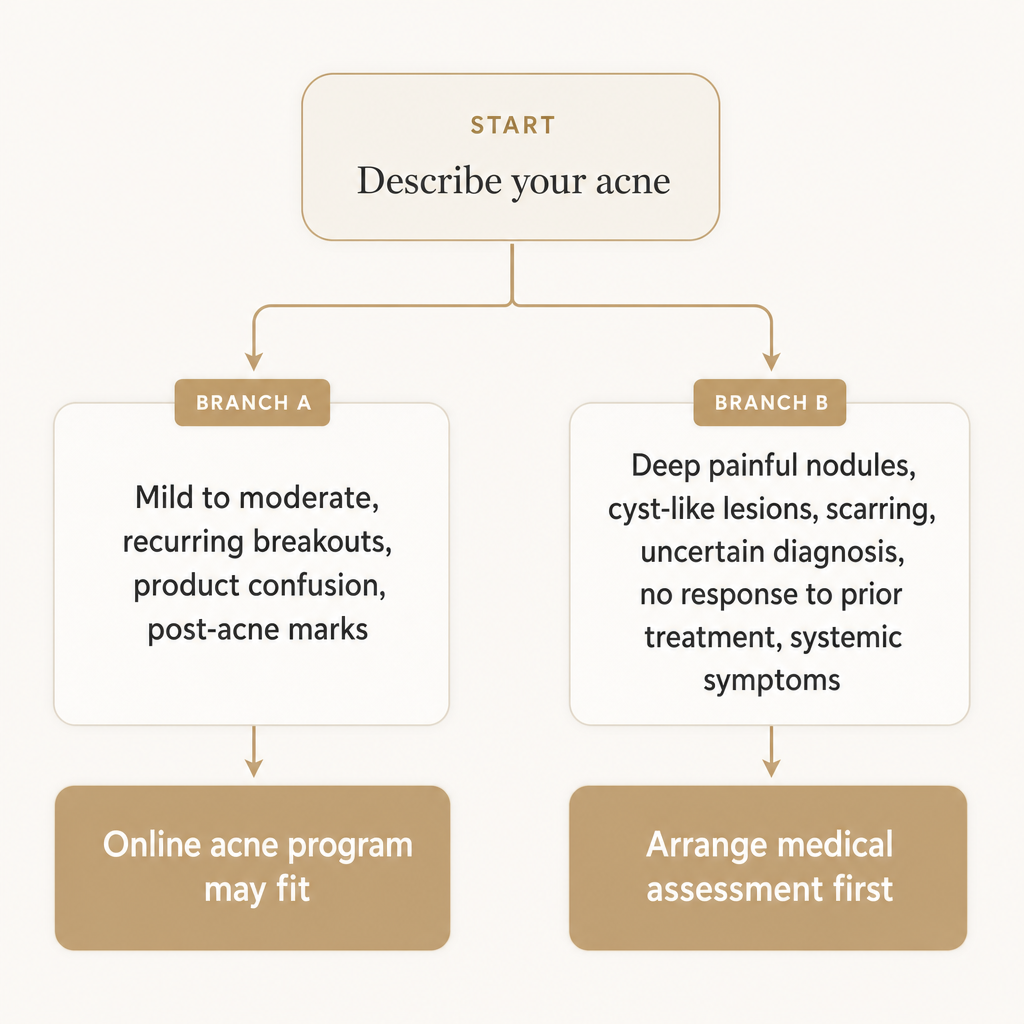
Remote support tends to fit well when you have recurring mild or moderate breakouts, when you are unsure which products to keep or drop, when your skin is acne-prone and easily irritated, or when adult and hormonally influenced breakouts sit alongside post-acne marks. It also suits people who want regular feedback instead of a single one-off opinion.
Acne can look similar to other skin conditions, and that is where a remote path has limits. NICE recommends referral when there is diagnostic uncertainty, nodulocystic acne, acne-related scarring or persistent pigmentary change, or an inadequate response to appropriate treatment. Reading that against your own skin is the first filter: if any of those apply, a routine alone is not the right starting tool.
What happens before the program begins
The first stage of Virtual ProAcne is an extended consultation. Before any plan is prepared, we review your skin history, current routine, treatment experience, photographs, lifestyle details, and any laboratory results you choose to share. The aim is to build context around your acne rather than hand you a generic product list.
To make that review meaningful, you may be asked to provide a completed questionnaire, clear photographs of the affected areas, your current skincare and treatment routine, a history of products or treatments you have already tried, notes on irritation, dryness, triggers, and flare-ups, and any relevant laboratory results you wish to include.
Why this detail matters becomes clear with an example: two people with facial spots may need very different advice if one has mainly blackheads and whiteheads while the other has painful inflammatory lesions, a damaged skin barrier, or stubborn dark marks. A good first look at those differences is exactly what happens after an online skin consultation when a plan is built around the person rather than the symptom.
An online consultation also should not sweep away everything you already use. We may keep some products, pause certain steps, or introduce active ingredients one at a time. That is especially relevant if you have been stacking several exfoliants, scrubs, retinoids, acne treatments, or fragranced products, because too many actives at once can increase irritation and make it harder to see what is helping and what is causing trouble.
What your acne plan may include
The exact routine is individual, and the starter set is selected after the extended consultation rather than being identical for everyone. In practice, a plan may include a gentle cleanser, a moisturiser suited to your tolerance, daily sun protection, one or more acne-focused topical products, a gradual schedule for introducing actives, instructions for responding to dryness or irritation, and a path for simplifying the routine once your skin becomes more stable.
Understanding how common acne ingredients behave helps you follow a plan with intent rather than guesswork. The American Academy of Dermatology supports several topical options, with the right choice depending on acne type, severity, skin sensitivity, pregnancy status, previous treatment, and other health considerations.
- Benzoyl peroxide helps reduce acne-associated bacteria.
- Topical retinoids help unclog pores and reduce inflammation.
- Salicylic acid helps exfoliate and clear blocked pores.
- Azelaic acid can address clogged pores, bacteria, inflammation, and some post-acne dark marks.
- Clascoterone is a topical option that acts on hormonal pathways involved in acne.
- Topical antibiotics, where used, should be selected and monitored carefully; the AAD recommends pairing them with benzoyl peroxide to help limit antibiotic resistance.
These are general mechanisms, not an invitation to self-prescribe. A remote skincare consultation focuses on topical and routine-based care, while prescription medicines, hormonal treatment, oral antibiotics, isotretinoin, or any suspected underlying medical condition call for a licensed clinician and a local prescribing pathway.
Why routines are introduced gradually
Introducing changes slowly serves two practical purposes, and both protect your results.
The first is tolerability. Retinoids, benzoyl peroxide, acids, and other actives can cause dryness, stinging, peeling, or redness, and that risk climbs sharply when several are started together. A phased schedule gives the skin barrier time to adapt.
The second is clear feedback. If you begin four new products at once and your skin reacts, there is no reliable way to know which one is responsible. Spacing changes out turns a guessing game into a readable signal, which is also why a personalised skincare plan tends to outperform a crowded shelf of unrelated products.
Gradual does not mean grin-and-bear-it. Mild adjustment sensations are expected, but significant burning, swelling, blistering, a worsening rash, or other concerning symptoms mean stopping the suspected product and seeking appropriate medical advice.
What progress reviews and between-visit support involve
Virtual ProAcne is built around reviews every two weeks. Depending on the arrangement, a review may take the form of a 25-minute video call or a structured chat review using fresh photographs, your feedback, and the skin's response, after which we adjust the plan.
A review commonly looks at whether new breakouts are becoming more or less frequent, how redness, dryness, peeling, or discomfort are changing, whether the routine is realistic to follow, whether each product is being used at the intended frequency, whether new marks or scarring are appearing, and whether the original concern still looks consistent with acne. It also asks a quieter but important question: can the routine be simplified, or does something need closer evaluation?
The point of these reviews is not to promise a fixed result on a fixed date. Acne fluctuates, and the same routine may not stay appropriate for the whole program. We describe most plans as lasting 4–6 months, but duration follows the starting point, the skin's response, and how consistently the plan is followed.
Between scheduled reviews, our program includes message support. That is where you can ask whether to continue or pause a new product, flag dryness or discomfort, check how to fit a new active into your routine, document a change you have noticed, or clarify an instruction. Messaging support is not emergency care, though. Severe swelling, breathing difficulty, rapidly worsening inflammation, fever, eye involvement, serious pain, or a widespread blistering reaction should be assessed urgently through local medical services.
What online acne care cannot guarantee
Any program that respects your trust has to be clear about its ceiling. Online acne care cannot honestly guarantee completely clear skin, a universal timeline, permanent prevention of future breakouts, a specific percentage of improvement, confirmation of every diagnosis from photographs alone, that topical skincare will be enough for severe acne, or that scars and pigmentation will vanish during the program.
The AAD is explicit that acne treatment is not one-size-fits-all and spans topical, oral, hormonal, and procedural options, and its guideline recommends isotretinoin for some people with severe acne or acne that has not responded to standard therapy. Those realities are the reason a responsible online program defines its scope out loud and refers you onward when your concern sits beyond it.
That referral threshold is worth knowing before you start. Arrange assessment with a dermatologist or a qualified local clinician if you have deep, painful nodules or cyst-like lesions, rapidly worsening or widespread acne, severe inflammation with systemic symptoms, significant or progressive scarring, persistent dark or light pigmentary changes, uncertainty about whether the condition is acne at all, acne that has not improved after appropriate treatment courses, a marked effect on mood or daily functioning, or possible medication-related or hormonal symptoms that need investigation. NICE specifically advises urgent same-day referral for suspected acne fulminans, and specialist referral for diagnostic uncertainty, nodulocystic acne, scarring, persistent pigmentary change, and certain treatment failures. People who may need isotretinoin belong in a dermatologist-led pathway, and no skincare consultation should be presented as a substitute for it.
Current Virtual ProAcne options
Our live Virtual ProAcne page sets out the current options, and because currency, payment arrangements, and individual plans vary, the live page is the place to confirm details before booking. The table below is a planning snapshot, not a quote.
| Option | What to expect |
|---|---|
| Extended Acne & Rosacea Consultation | Detailed assessment, a starting plan, and guidance on how to continue |
| Monthly support | Support paid month to month, with duration set individually |
| Four- to six-month support | Full Virtual ProAcne support across the stated duration |
| Starter skincare set | Purchased separately, with exact products chosen after the consultation |
| Complete six-month package | Six months of support plus the products needed to begin |
The complete package brings together six months of personal support, two online check-ins each month, routine adjustments every two weeks, message support between check-ins, the starter products, a Macherre app subscription, and a guide to possible triggers. If you are an international patient, review the English or Russian version of the live Virtual ProAcne page before payment, since currency, availability, communication arrangements, and local healthcare requirements can differ by locale.
How to prepare for your consultation
A little preparation makes the first review far more productive. Before your appointment, gather recent photographs taken in clear, even lighting, a list of your current products and how often you use them, the names and dates of previous acne treatments, notes on any burning, itching, dryness, or sensitivity, details of where and when breakouts tend to appear, relevant medical or medication information, and your questions about cost, product availability, follow-up, and escalation. Our walkthrough of how online skincare consultation works covers the photo and intake basics in more depth.
One caution matters more than any checklist: do not stop prescribed medication or change a medical treatment plan on the strength of an online skincare article. Any change to prescribed care belongs in a conversation with the clinician who prescribed it or an appropriate local healthcare professional.
If your main concern is not active acne, a more specific starting point may serve you better, whether that is post-acne and discoloration treatment for lingering marks or rosacea management for persistent redness. Matching the program to the concern is the difference between momentum and months of guesswork.
Frequently asked questions
Is an online acne program suitable for hormonal acne?
It can suit routine guidance and topical skincare, but adult breakouts around the jawline, chin, or lower face may involve hormonal factors. Prescription hormonal treatment or investigation needs an appropriate medical clinician, so do not assume every adult breakout is hormonal acne.
Can online acne care treat acne scars?
An online program may help reduce new breakouts and discuss post-acne marks, but established scars usually need a separate assessment. Scar treatments can involve procedures that cannot be selected safely from photographs alone.
Does the Virtual ProAcne program last exactly six months?
No. We describe a typical duration of 4–6 months, and the exact length depends on your starting point, your response, and your individual plan. A six-month package is one payment option, not a sign that everyone needs the same pathway.
Are products included in the program?
It depends on the option. The complete six-month package includes the products needed to begin, while with monthly payment the starter skincare set is listed separately and chosen after the extended consultation.
Is online acne care a replacement for a dermatologist?
No. Online skincare support can be appropriate for selected concerns, but it is not a universal replacement for diagnosis, prescription care, physical examination, urgent assessment, or specialist management. Severe, scarring, treatment-resistant, or diagnostically uncertain acne should be referred to an appropriate medical professional.