


Benefits Of A Personalized Skincare Plan
This article is educational and does not diagnose a condition or replace care from a qualified medical professional.
When over-the-counter products keep failing, the issue is often not that you need something stronger. You may be pairing the wrong actives, introducing them too fast, or treating one concern while quietly aggravating another. The benefits of a personalized skincare plan come down to matching your routine to your skin's current condition, your product history, and how you actually respond over weeks and months, rather than following a universal template that was never built for your face.
A personalized plan is not a cure and does not replace medical diagnosis. What it can do is make skincare structured and responsive, which matters most for adults managing acne-prone, sensitive, rosacea-prone, dry, or pigmented skin that has not improved on its own.
Table of contents
What a personalized skincare plan actually is
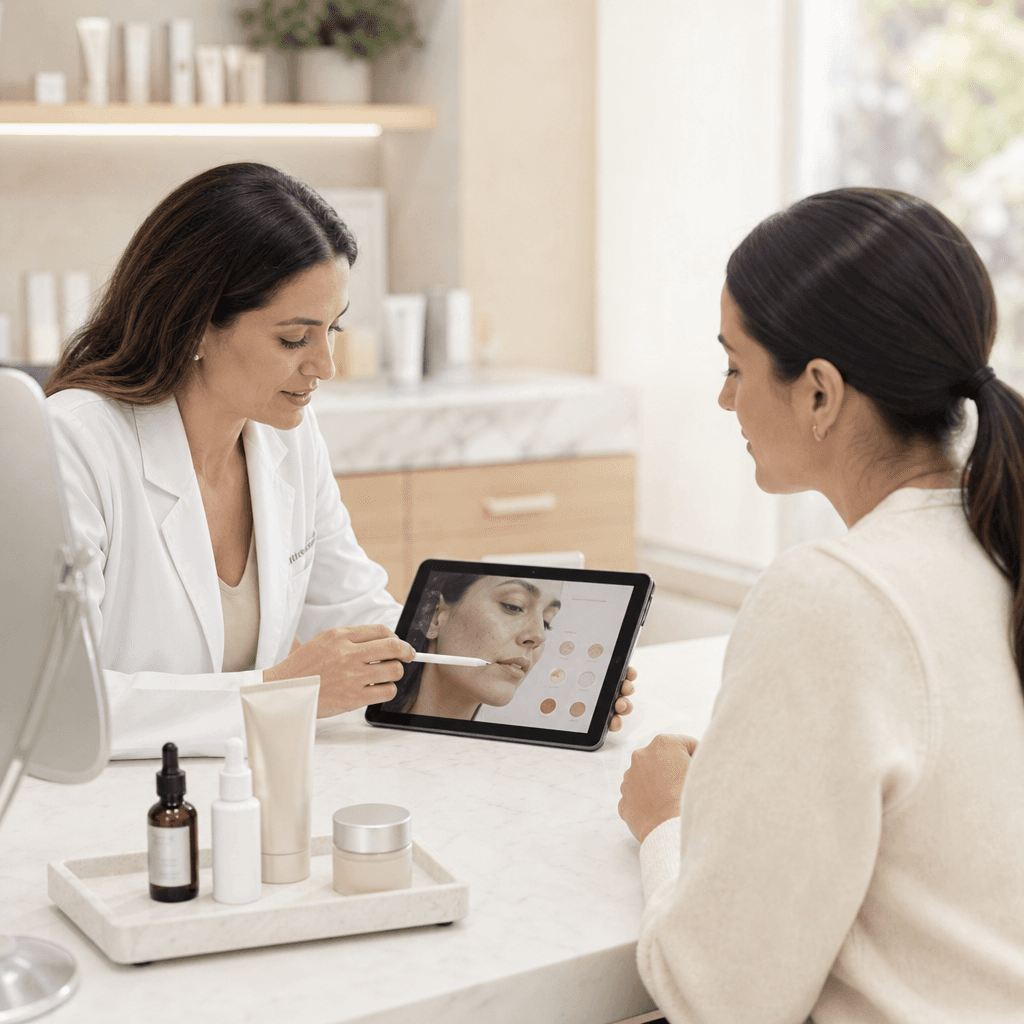
A personalized skincare plan is an individualized routine and monitoring approach built around specific factors rather than a generic product list. It starts from your main concern, the location and duration of your symptoms, the products and treatments you have already tried, your history of irritation, your current routine and lifestyle, your priorities and budget, and how your skin behaves once products are introduced.
In practice, a plan sets out morning and evening routines, product options, a schedule for introducing active ingredients, barrier-supporting steps, and defined review points. Personalization does not mean more expensive or prescription-only products. It means choosing and sequencing care for one person instead of assuming the same routine suits everyone.
This individualized logic is echoed in clinical guidance. The American Academy of Dermatology's updated acne guidance stresses that treatment is not one-size-fits-all and that the most appropriate option differs according to individual patient factors. A plan built the same way tries to respect that reality rather than override it.
How tailored care changes your results
The real value of personalization shows up in six practical ways, each tied to a problem that generic routines tend to create.
It reduces guesswork. When people change several products at once, improvement or worsening becomes impossible to trace back to a cause. A tailored plan gives each product a defined job, specifies what to use morning versus evening, which active to introduce first and how often, and which reactions to watch. That structure makes it easier to see what your skin tolerates and what is driving dryness, stinging, congestion, or flare-ups.
It accounts for your skin's current state. The best routine for oily, inflamed acne is not the right routine when skin is peeling or sensitized, and a discoloration routine may need to pause when fresh breakouts appear. A tailored plan balances goals instead of chasing one symptom. For acne-prone skin, NICE recommends a non-alkaline synthetic detergent cleanser, advises avoiding oil-based and comedogenic products and sunscreens, and supports gradual or short-contact use of irritating topical treatments where appropriate.
It prevents overly aggressive routines. Stacking exfoliants, retinoids, acne actives, scrubs, and fragranced products together increases irritation, and irritated skin that burns, tightens, or peels only gets harder to read. A plan helps decide which actives suit your concern, whether to alternate days, whether to add a gentler cleanser or moisturizer, and when a reaction needs professional assessment.
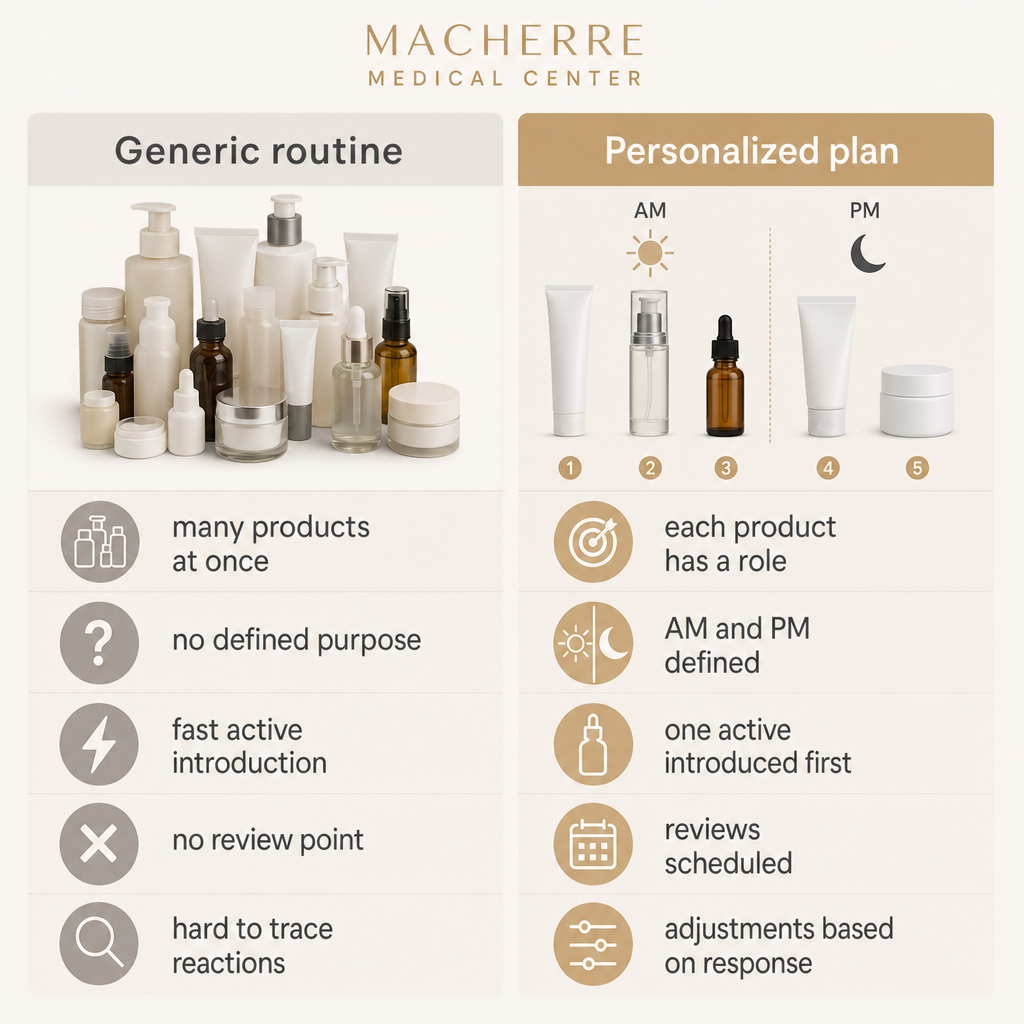
It supports gradual introduction. Active ingredients need time for skin to adapt, and introducing several at once makes tolerability impossible to judge. A personalized schedule may start one active before adding another, lower the frequency at first, shorten contact time when appropriate, and track dryness, redness, itching, or burning. The exact approach depends on the product, the concern, and your medical history, and a consultation should never be used to self-prescribe medication or delay necessary care.
It builds follow-up into the plan. A routine that looks right on day one often needs to change as skin responds to seasons, adherence, product availability, and new breakouts. Regular reviews answer concrete questions: is the routine tolerable, are breakouts clustering in the same areas, is a product causing unexpected dryness, should an active be slowed down, can the routine be simplified, or is another kind of assessment needed. Our Virtual ProAcne program describes progress reviews every two weeks using new photos, feedback, and your skin's response, through a short video call or a structured chat review, with adjustments when needed.
It handles more than one concern at a time. Acne rarely travels alone; it overlaps with post-inflammatory hyperpigmentation, redness, sensitivity, dryness, and uneven texture, and treating one too hard can worsen another. A tailored approach weighs those relationships: acne care accounts for irritation and discoloration risk, pigmentation care accounts for ongoing inflammation and sun exposure, rosacea-prone skin demands a cautious approach to products and triggers, and dry or sensitive skin may need barrier support before stronger actives are considered. We run separate consultation pathways for concerns including acne treatment, post-acne and discoloration, rosacea management, and sensitive skin care, so overlapping concerns are not forced into a single generic regimen.
Personalized plan versus choosing products on your own
A personalized plan is not automatically better because it contains more products. Its value depends on the quality of the assessment, the suitability of the recommendations, the safety of the instructions, and whether follow-up exists.
Choosing products independently can be reasonable when your concern is mild and stable, you tolerate your current routine, you understand what each product is for and its limits, you can introduce changes gradually, and you know when to seek professional advice.
A consultation tends to earn its place when the picture is harder to read:
- Acne has continued despite a consistent routine
- You have recurring irritation or peeling
- Several products have produced conflicting results
- You have active acne together with persistent dark marks
- You are unsure whether redness is acne, sensitivity, or rosacea
- You want help simplifying an overloaded routine
- You need monitoring while introducing active skincare
Some situations point past cosmetic skincare entirely. For diagnostic uncertainty, severe acne, acne conglobata or fulminans, scarring, persistent pigmentary changes, or significant psychological distress, clinical dermatology assessment may be appropriate. NICE specifically recommends referral in several of these situations, including diagnostic uncertainty and severe forms of acne.
What our personalized plan includes
Our current Virtual ProAcne page describes a 4–6 month online program. The exact duration is individualized according to your starting point, how your skin responds, and how consistently the plan is followed, and the complete package provides six months of personal support.
The program is described as including an extended consultation; a review of skin history, current treatment, routine, lifestyle, and any blood-test results you provide; a personalized morning and evening routine; product options; a gradual schedule for introducing active products; progress reviews every two weeks; routine adjustments when needed; support between check-ins for questions about dryness, irritation, or unexpected reactions; and guidance on maintenance so you become more independent with skincare over time.
The program can run alongside an existing treatment plan, but it is not framed as a universal substitute for medical treatment. Diagnosis, medication decisions, and urgent concerns belong with an appropriately qualified healthcare professional. Pricing, included products, payment structure, and treatment length depend on the option you select and your individual plan, so the most reliable step is to confirm current details on the Virtual ProAcne program page before booking. If you are weighing a specific concern, budget, or timeline, tell us your main goal and history and we can point you to the pathway that fits.
What a personalized plan cannot promise
A responsible plan should never promise a guaranteed cure, a fixed result by a particular date, or one universal routine for everyone. It should not claim that non-medication skincare will be enough for severe acne, that every product will suit you or stay irritation-free, that pigmentation, rosacea, or acne will never return, or that an online consultation can identify every skin condition from photographs.
Skin concerns can share symptoms while having different causes, and they often overlap. A remote consultation is unsuitable when an in-person examination, testing, prescription treatment, urgent assessment, or a procedure is needed.
Contact a local doctor or dermatologist promptly for rapidly worsening or painful severe acne, extensive nodules, suspected infection, a sudden widespread rash, eye symptoms linked with facial redness, or any concern about a changing or suspicious lesion.
Deciding whether it is worth it for you
A personalized plan is worth considering if you have spent money on products without understanding how they fit together, repeatedly developed irritation, or need help managing several related concerns at once. The decision is less about finding a flawless routine and more about choosing a structured, reviewable approach that can change as your skin changes.
The practical value is greatest when the service gives you a detailed assessment rather than a generic list, clear reasons for each recommendation, a gradual introduction plan, follow-up and adjustment, transparent pricing, sensible safety boundaries, and a willingness to refer or escalate when a concern needs medical care. If those elements are present, a tailored plan stops being a product bundle and becomes a way to manage your skin over time.
Frequently asked questions
What are the main benefits of a personalized skincare plan?
Less guesswork, better coordination between products, gradual introduction of active ingredients, support for several concerns at once, and the ability to adjust the routine based on how your skin responds rather than on a generic template.
Is personalized skincare only for acne?
No. It can also address sensitivity, rosacea, post-acne discoloration, hyperpigmentation, dryness, dehydration, and uneven texture. The right plan depends on the concern and whether it can be safely assessed remotely.
How long does a personalized skincare plan take to work?
There is no universal timeline. Response depends on the concern, product choice, consistency, tolerance, and whether the underlying issue has been correctly identified. Our Virtual ProAcne program is described as lasting four to six months, but that is the program duration, not a guarantee that acne resolves within it.
Can I use a personalized plan alongside medication?
Our Virtual ProAcne program can be completed alongside an existing treatment plan. Tell the consultant about every medication and product you use, and do not start, stop, or combine prescription treatments without advice from the clinician responsible for your care.
What if my skin becomes irritated?
Stop adding new active products and contact the professional supporting your plan for guidance. Seek medical care for severe swelling, blistering, breathing difficulty, eye involvement, or a rapidly worsening reaction. Our Virtual ProAcne page states that clients can message between check-ins about dryness, irritation, and unexpected reactions.
This article provides general education and does not constitute an individualized diagnosis or treatment recommendation.