



What Happens After an Online Skin Consultation
This article is educational and does not diagnose a condition or replace care from a qualified medical professional.
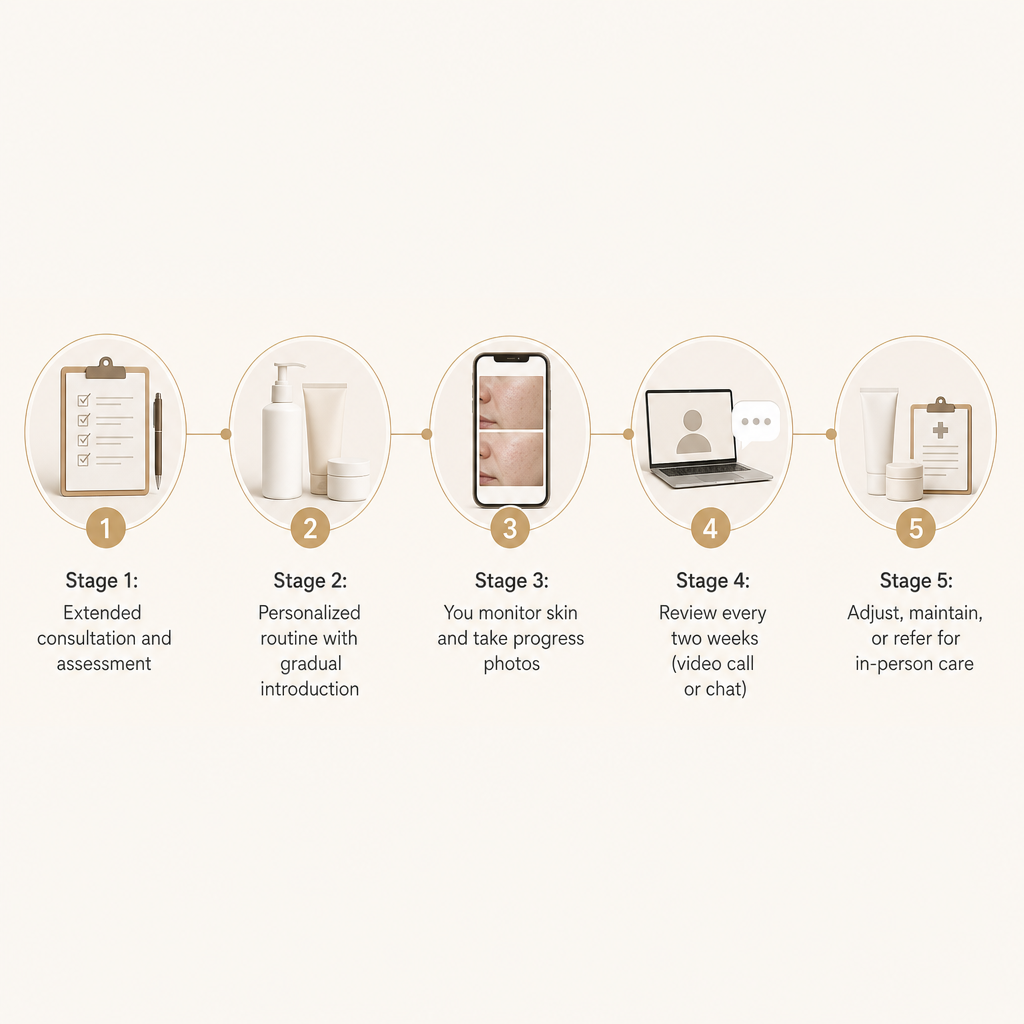
After an online skin consultation, the real work begins with what you receive next: not a generic product list, but a personalized plan that explains what to use, how to introduce it, what to watch for, and when to review it. Knowing what happens after an online skin consultation helps you judge whether a service is actually supporting your skin over time or just selling you a one-off recommendation. In our Virtual ProAcne program, that plan continues with progress reviews every two weeks and support between check-ins, currently structured as a 4–6 month pathway whose exact length depends on your starting point and response.
Think of the consultation as the opening of a monitored process, not a one-time verdict. A good plan should move with your skin as it reacts, as the season shifts, or as a product you once tolerated starts to sting.
Table of contents
What actually gets decided after your consultation
The consultation is where we decide which concerns to address first and whether a remote approach suits your situation at all. That triage matters more than most people expect, because a plan built in the wrong order can stall progress for weeks.
Several things get sorted in this stage: which issue leads (active breakouts, blackheads and whiteheads, sensitivity, rosacea-related redness, or post-acne marks), how your previous products performed, and whether your current routine should be simplified rather than expanded. A skin concern that looks like acne can sometimes be something else. The American Academy of Dermatology notes that accurate assessment matters because different acne types and acne-like conditions need different treatment approaches, including folliculitis and perioral dermatitis that a standard acne routine will not resolve.
The outcome is rarely a single prescription. It might be a tailored routine, a recommendation to modify a plan you already follow, a request for clearer photographs, a structured follow-up program, or an honest referral for in-person assessment. If your main concern is redness rather than breakouts, rosacea management follows a different logic than an acne plan, and matching the concern to the right pathway is part of the decision.
Why your routine is introduced gradually
A personalized plan should explain both what to use and how to add it. That second part is where remote care earns its value, because introducing several active products at once makes it almost impossible to identify what caused dryness, burning, peeling, or a fresh flare.
Our Virtual ProAcne plan describes a morning and evening routine, product options, a staged schedule for introducing active ingredients, and adjustments based on how your skin responds. The specific products and their order are individualized on purpose. A routine that suits one person can be unsuitable for another, especially with rosacea, a compromised skin barrier, known allergies, pregnancy-related considerations, or a history of reactions.
Resist the urge to double up. The AAD cautions that acne treatments can cause dryness, irritation, peeling, and burning, and that using more product than directed does not clear acne faster. Pacing is not caution for its own sake; it is how you keep enough signal in the data for the next review to be useful. If your starting concern is reactive, stinging skin, a gentler on-ramp designed for sensitive skin care matters even more.
What to monitor between reviews
Once the plan starts, the useful information is not whether your skin looks better or worse on a single morning. It is the pattern across days.
Worth tracking: how often new lesions appear, whether they are becoming deeper or more painful, where breakouts cluster, and whether redness, itching, tightness, or peeling has developed. Note when you introduced a product, whether you are following the routine consistently, and whether flares line up with your menstrual cycle, stress, climate, or a product change. Record whether marks are left behind once spots heal, since that shapes the later phase of care.
Comparable photographs make all of this easier to read. Use similar lighting, distance, angle, and expression each time, and avoid comparing a harsh bathroom close-up with a soft daylight shot. A short written log of product changes and reactions gives the reviewer far more to work with than a pile of new products added right before the appointment. Our guide on how to take skin photos for your consultation covers the setup that keeps progress images consistent.
How our two-week reviews work
Skincare is not static, so neither is the plan. Our Virtual ProAcne program includes a progress review every two weeks, built around new photographs and your feedback about how the skin has responded. The review can take place through a 25-minute video call or a structured chat review, after which we adjust the routine if needed.
A review can lead in several directions depending on what the skin shows:
- continuing the current routine when it is working;
- slowing the introduction of an active product;
- changing how often a product is used;
- addressing dryness or irritation before adding anything new;
- simplifying an overloaded routine;
- shifting toward maintenance once the skin is more stable;
- recommending an in-person clinician when remote support is not enough.
The point of a scheduled rhythm is that the best next decision changes as your skin, the season, and your tolerance change. A product that felt fine in month one can become irritating later, and a fortnightly checkpoint catches that before it undoes progress.
Support between check-ins and when to escalate
Two weeks is a long time when something goes wrong, so our program includes support between scheduled reviews. You can message when questions, dryness, irritation, or an unexpected reaction appears rather than waiting for the next check-in.
If you contact us about a reaction, describe the products involved, when you applied them, when symptoms began, where the reaction appeared, whether the area is painful, swollen, itchy, blistered, or spreading, and what you did after noticing it. That detail lets us respond usefully instead of guessing. While you wait for guidance, stop experimenting with additional actives rather than layering on more in search of a fix.
Some situations are not skincare messages at all. If you develop facial swelling, breathing difficulty, extensive blistering, severe pain, or other signs of a serious allergic reaction, seek urgent medical care immediately rather than relying on an online message.
How long the process takes
There is no universal timeline for improvement, and any service promising one should make you cautious. The pace depends on the concern, the starting condition of your skin, the plan you choose, how well you tolerate products, how consistent you are, and whether the issue genuinely needs medical treatment beyond a skincare routine.
We currently describe Virtual ProAcne as a 4–6 month online program, with the exact duration determined individually according to your starting point, response, and consistency. That range is not a promise that acne clears within a fixed number of weeks. The practical aim is to build a manageable routine, review the response, make careful adjustments, and develop a maintenance approach you can keep.
That framing matches established clinical thinking. The AAD explains that acne treatment has several goals, clearing existing acne, preventing new breakouts, and reducing the risk of scarring, but that there is no one-size-fits-all treatment. Progress is measured against your own baseline, not a calendar.
When online follow-up is not enough
Remote support is well suited to reviewing photographs, history, routines, and progress over time. It cannot perform every examination or procedure, and recognizing that boundary is part of responsible care rather than a limitation to hide.
Arrange medical assessment instead of relying only on remote skincare support if acne is deep, painful, nodular, or cystic; if scarring is developing; if breakouts are extensive or worsening quickly; if you suspect infection; if a rash is spreading or unusually painful; if treatment has repeatedly failed; if the condition is affecting your mental health; if the appearance does not clearly fit acne; or if you may need prescription, oral, hormonal, or procedural treatment. The NHS similarly advises seeking medical advice for acne that has not improved with self-treatment, deep or painful spots, scarring, suspected infection, or acne affecting mental health.
If a review suggests you need an in-person dermatologist or doctor, that is not a failure of the consultation. It is the safety decision working as intended. In that case we point you toward the right next step rather than stretching remote care past what it can responsibly do.
Your next move after receiving the plan
The most useful thing you can do is follow the plan consistently enough for us to evaluate it, while reporting problems early. That means using the recommended products in the stated order, introducing actives at the suggested pace, avoiding unnecessary product switching, recording irritation or new breakouts, taking regular progress photographs, completing the two-week reviews, asking before you change anything you are unsure about, and following local medical advice if prescription treatment or an in-person examination is recommended.
If your main concern is not active acne, start from the pathway that fits it rather than assuming an acne plan applies everywhere. Acne treatment suits recurring breakouts, while post-acne and discoloration treatment addresses the marks left behind. Matching the concern to the right starting point saves time that a mismatched routine would waste.
Before booking any option, confirm the current price, payment terms, communication format, and scope of support on the live program page, since these can depend on the option and your individualized plan.
Frequently asked questions
Do I receive a skincare routine immediately after the online consultation?
You receive a starting plan after the Extended Consultation. For Virtual ProAcne we describe a morning and evening routine, product options, and a gradual introduction schedule. The exact plan is individualized to your skin and history.
What happens if my skin becomes dry or irritated?
Contact us rather than adding more products or abandoning the plan without guidance. Virtual ProAcne specifically includes support for dryness, irritation, and unexpected reactions between the scheduled two-week reviews.
Are the two-week reviews appointments or messages?
Both formats exist: a 25-minute video call or a structured chat review every two weeks. The available format can depend on your plan and communication arrangements.
Will an online consultation diagnose my skin condition?
A remote review can help assess a concern, but it cannot replace every in-person examination. Acne-like conditions have different causes, and some treatments or procedures require an office visit, so seek medical assessment if the diagnosis is uncertain, symptoms are severe, or scarring is developing.
Is improvement guaranteed after 4–6 months?
No. The 4–6 month range describes the current typical program duration, not a guaranteed result or universal timeline. Skin response varies, and some people need a different medical assessment or treatment pathway.