





Online Skincare Consultation: How It Works and Who It's For
This article is educational and does not diagnose a condition or replace care from a qualified medical professional.
An online skincare consultation is remote, professional skin care: you share your concerns and clear photos through a secure form, a qualified clinician reviews your history and images, and you receive a personalized treatment plan with ongoing follow-up rather than a one-off product suggestion. At Macherre Medical Center, that plan spans topical skincare, nutrition, and lifestyle, and our team stays with you at every step.
That structure matters because skin conditions like acne, rosacea, and pigmentation are visually assessable and slow to change, which makes them well suited to photo-based review and scheduled check-ins. Below, we explain how the model actually works, what separates one type of remote care from another, who benefits most, and how to judge whether it fits your skin.
Table of contents
- What an online skincare consultation is and how it works
- Types of remote skin care and what separates them
- Why it matters for chronic acne, pigmentation, and sensitive skin
- How to judge whether online consultation fits your skin
- Choosing your next step with Macherre
- Frequently asked questions
What an online skincare consultation is and how it works
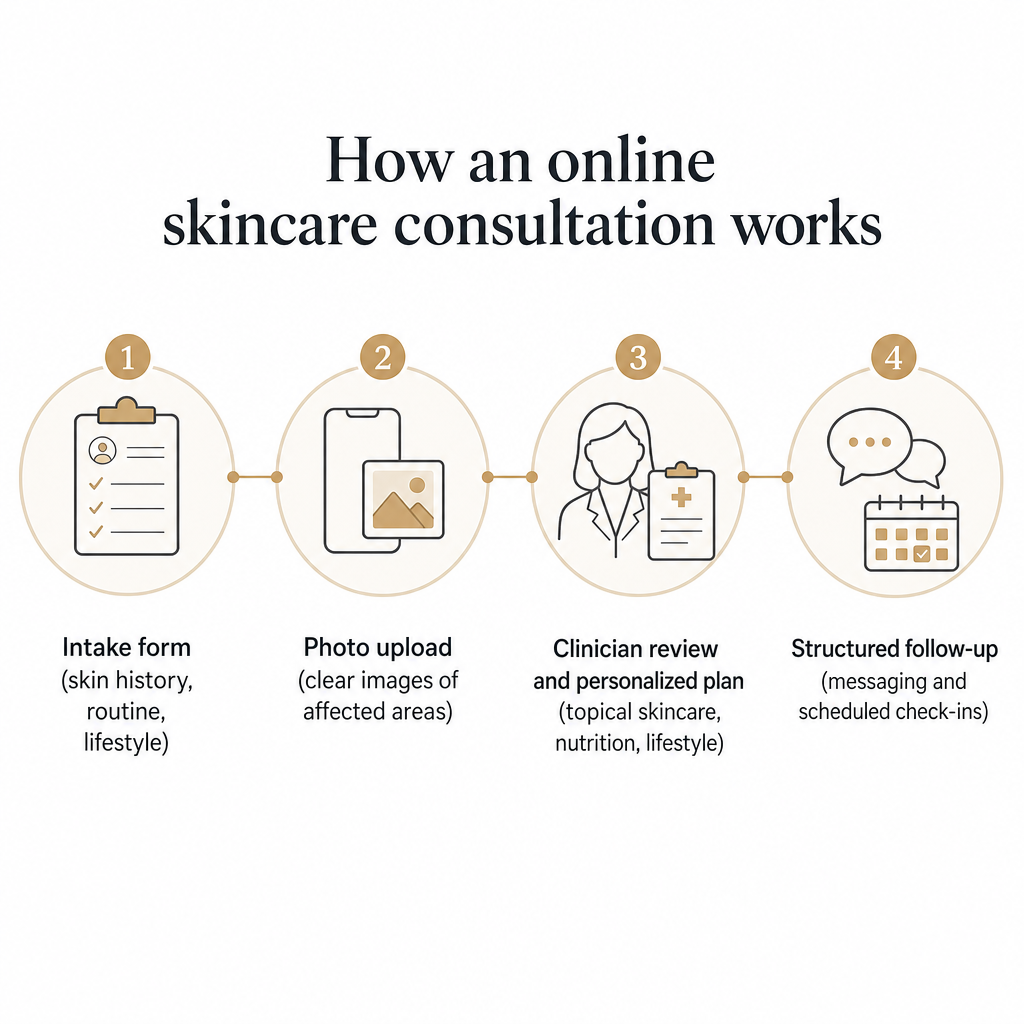
The mechanism is simpler than most people expect, and the evidence behind it is stronger than the format suggests. You complete a structured intake form covering your skin history, current routine, and lifestyle, then upload high-quality photographs of the affected areas. A clinician reviews that combination of images and history, arrives at an assessment, and builds a treatment plan. Follow-up then happens through messaging or scheduled check-ins so the plan can be adjusted as your skin responds.
What makes this clinically credible is that the remote medium mainly changes how information is collected, not the reasoning applied to it. Reviews of teledermatology report that management plans and outcomes are typically equivalent to conventional in-person consultations, with strong diagnostic agreement in appropriate cases, according to a peer-reviewed overview of teledermatology. For acne specifically, a systematic review of teledermatology for acne management found severity-score reductions comparable to in-person care, with one included study reporting an 87.94% reduction in Global Acne Grading System scores.
At Macherre, this translates into a four-part flow: you fill out the form, send photos, receive your consultation, and follow the recommendations while we stay reachable throughout. The output is not a product list. It is an individualized plan that combines topical skincare with nutrition and lifestyle guidance, because visible skin problems are rarely solved by a single cream.
Types of remote skin care and what separates them
"Online skincare consultation" is often used loosely, so it helps to separate the models by how much clinical judgment and follow-up they actually include.
The first distinction is asynchronous versus synchronous care. Asynchronous (or store-and-forward) review means you submit photos and history and a clinician responds later; synchronous care adds live video or messaging exchanges. In practice many effective programs combine both: asynchronous photo review to assess and plan, then synchronous follow-up to adjust doses, monitor side effects, and coach adherence.
The second distinction is automated versus clinician-led. Some services rely on a questionnaire and an algorithm to generate a routine. A clinician-led consultation, by contrast, means a qualified professional interprets your specific images and history and takes responsibility for the plan. Our consultations are led by a cosmetologist, so assessment and planning are handled by a person, not a template.
The third distinction is one-off advice versus structured programs. A single review can be useful, but chronic conditions rarely resolve after one message. This is where follow-up design becomes decisive. Research comparing acne follow-up in teledermatology versus outpatient care found that remote patients could be less likely to attend early follow-ups without built-in structure, which points to the value of scheduled check-ins. Our signature ProAcne Program is built around exactly that logic: bi-weekly touchpoints across a multi-month course so the plan is refined as your skin changes, rather than set once and forgotten.
The final distinction is scope. Remote consultation excels at assessment, planning, and monitoring for visually clear conditions. When a case needs a physical procedure, that becomes a hybrid pathway rather than a purely online one, which we cover in the judgment criteria below.
Why it matters for chronic acne, pigmentation, and sensitive skin
For the people we most often help, the remote model solves a specific frustration: cycling through over-the-counter products without a coherent reason behind any of them. Structured, photo-based care replaces trial and error with a plan tied to your actual skin.
For chronic or hormonal acne, the clinical case is well documented. A randomized trial comparing teledermatology with face-to-face follow-up for mild-to-moderate acne found optimal severity reduction in both groups with no significant difference between them. Even in higher-risk pathways, a study of teledermatology management for patients on isotretinoin found no significant difference in reaching clear skin and similar therapeutic and adverse-effect rates versus in-person care. That evidence supports treating acne remotely when cases are appropriately selected and monitored, which is exactly what our acne treatment consultation is designed to do.
For pigmentation and post-acne marks, the value is that these concerns are legible in good photographs, so a clinician can distinguish post-inflammatory discoloration from other patterns and design a targeted routine. That applies across our post-acne and discoloration treatment and our age spots and hyperpigmentation care.
For rosacea and other chronic inflammatory skin conditions, long-term teledermatology data shows the model works for ongoing disease control and flare management when photos and history are sufficient. That is the reasoning behind our rosacea management consultation, where the priority is reducing redness and heading off flare-ups over time.
And for sensitive, dehydrated, or texture-troubled skin, the benefit is a professionally designed routine instead of guesswork. Reactive skin in particular is easy to worsen with the wrong actives, which is why a considered plan through our sensitive skin care consultation tends to serve these clients better than another OTC experiment.
There is also a practical fit worth naming: because we work bilingually in English and Russian and are not tied to a single local market, remote consultation reaches people who want experienced cosmetology input but do not have easy access to it nearby.
How to judge whether online consultation fits your skin
This is a judgment call, and a few criteria make it clearer.
Is your concern visually assessable and non-urgent? Acne, post-acne discoloration, hyperpigmentation, rosacea, texture, and dryness usually show clearly in photos and change gradually, which suits remote care. Sudden systemic symptoms or a rapidly changing, worrying lesion do not.
Might you need a hands-on procedure? Remote consultation can assess and plan, but it cannot perform a biopsy, dermoscopy, in-office laser, or extensive extraction. Broad reviews note that pure remote diagnosis from images can be less accurate than a face-to-face exam for some lesions, so suspicious moles or complex rashes still warrant physical evaluation. When a procedure is likely, the honest answer is a hybrid path: online assessment and planning paired with an in-person provider where you live.
Are you ready for structured follow-up? The evidence is consistent that remote results depend on staying engaged. If you want a single message and nothing more, a program built on regular check-ins is not what you are looking for. If you want sustained improvement, that structure is the point.
Are you comfortable communicating remotely? Patient satisfaction with teledermatology for acne is high when platforms are clear and easy to use, so comfort with photo-based, message-driven care is a genuine part of the fit.
One note on outcome claims: we track our results and report a high success rate for the clients we treat, but you should read any single figure as our internal outcome tracking rather than an independently audited statistic. The stronger reassurance is the published evidence that this model performs comparably to in-person care for the conditions we focus on.
Choosing your next step with Macherre
If your concern is a chronic, visible condition and you are ready for a plan you actually follow, online consultation is a reasonable and evidence-supported starting point. The decision comes down to matching your specific skin to the right consultation focus and being honest about whether a procedure might eventually be needed.
The simplest next move is to tell us what you are dealing with. Share your concern, your history, and clear photos, and we will assess whether remote care fits and what a tailored plan would look like for your skin. If you are weighing several concerns at once, tell us the areas you want to address so we can point you to the right starting focus and prepare a suitable recommendation.
Frequently asked questions
Is an online skincare consultation as effective as seeing a dermatologist in person?
For many acne, pigmentation, and rosacea cases, published research shows teledermatology produces outcomes comparable to in-person care when cases are appropriately selected and monitored. Some lesions and complex rashes still need a physical exam.
What conditions is online skincare consultation best for?
Visually assessable, non-urgent conditions such as chronic or hormonal acne, post-acne discoloration, hyperpigmentation, rosacea, sensitive or dehydrated skin, and texture concerns. We build tailored plans for each of these.
Do I need special equipment to send skin photos?
No. Clear photos from a modern phone camera in good lighting are generally sufficient for assessment. Our intake form guides you on what to include.
Can online consultation replace in-person procedures?
Not for procedures themselves. Remote care handles assessment, planning, and monitoring; a biopsy, laser, or extensive extraction requires an in-person provider. In those cases the online plan works alongside local care.
Why does follow-up matter so much in remote skin care?
Evidence suggests remote patients can skip early follow-ups without built-in structure, and chronic skin conditions need adjustment over time. That is why our programs are designed around scheduled check-ins rather than one-off advice.