





What Is Involved in an Online Acne Consultation?
This article is educational and does not diagnose a condition or replace care from a qualified medical professional.
If you are wondering what is involved in an online acne consultation, the short answer is a structured review of your skin history, current routine, photographs, past treatment response, and goals — followed by a personalised skincare plan and a clear decision about how your progress will be watched. It replaces guesswork with a plan built around your skin, rather than a single product recommendation you are left to apply alone. At Macherre, this assessment can stand on its own or become the entry point to our longer Virtual ProAcne programme, where your routine is reviewed and adjusted as your skin responds. What it is not is a guaranteed cure or a universal routine that suits everyone; the right path always depends on the individual assessment.
Table of contents
Why a consultation beats trial-and-error skincare
Most people arrive at an online consultation after a drawer full of half-used products and no clear sense of what helped. The purpose of a structured assessment is to swap that cycle for a considered plan.
Acne rarely has a single cause. It can involve clogged pores, excess oil, inflammation, sensitivity, or irritation left behind by previous products — often several of these at once. Spots that look identical can also come from different conditions, including rosacea or folliculitis. A consultation gives a specialist room to read the wider picture instead of reacting to the most visible blemish.
In practice, this means we can help you describe what your breakouts look and feel like, review what you have already tried, flag routines that may be irritating or overloaded, discuss hormonal and lifestyle patterns, and decide whether a gradual topical plan is a sensible fit — or whether in-person or medical assessment is the better call. That is a different exercise from handing out a single "best acne routine," because appropriate care depends on the type and severity of acne, previous treatment response, skin sensitivity, and safety.
What you prepare before the call
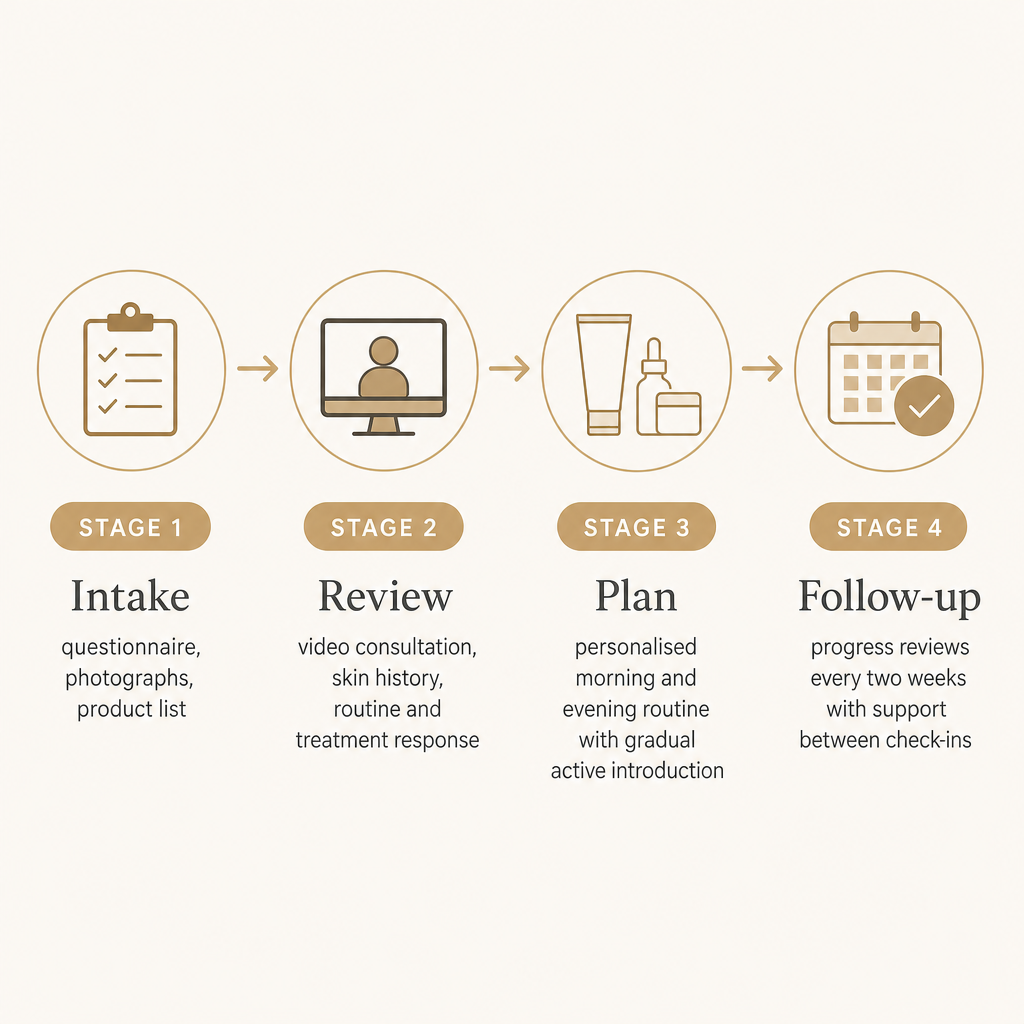
The quality of a remote assessment depends heavily on what you bring to it. You will generally complete an intake questionnaire and supply clear photographs, so it helps to gather a few things in advance.
- A list of your current skincare products and their active ingredients.
- Any prescription or non-prescription acne treatments, and how long you have used each.
- Reactions you have noticed, such as dryness, burning, peeling, or worsening.
- When your breakouts began and whether they follow a recurring pattern.
- Relevant health details: conditions, medication, allergies, and pregnancy or plans for pregnancy.
- Your main concern, whether that is active acne, painful spots, post-acne marks, sensitivity, or recurring flare-ups.
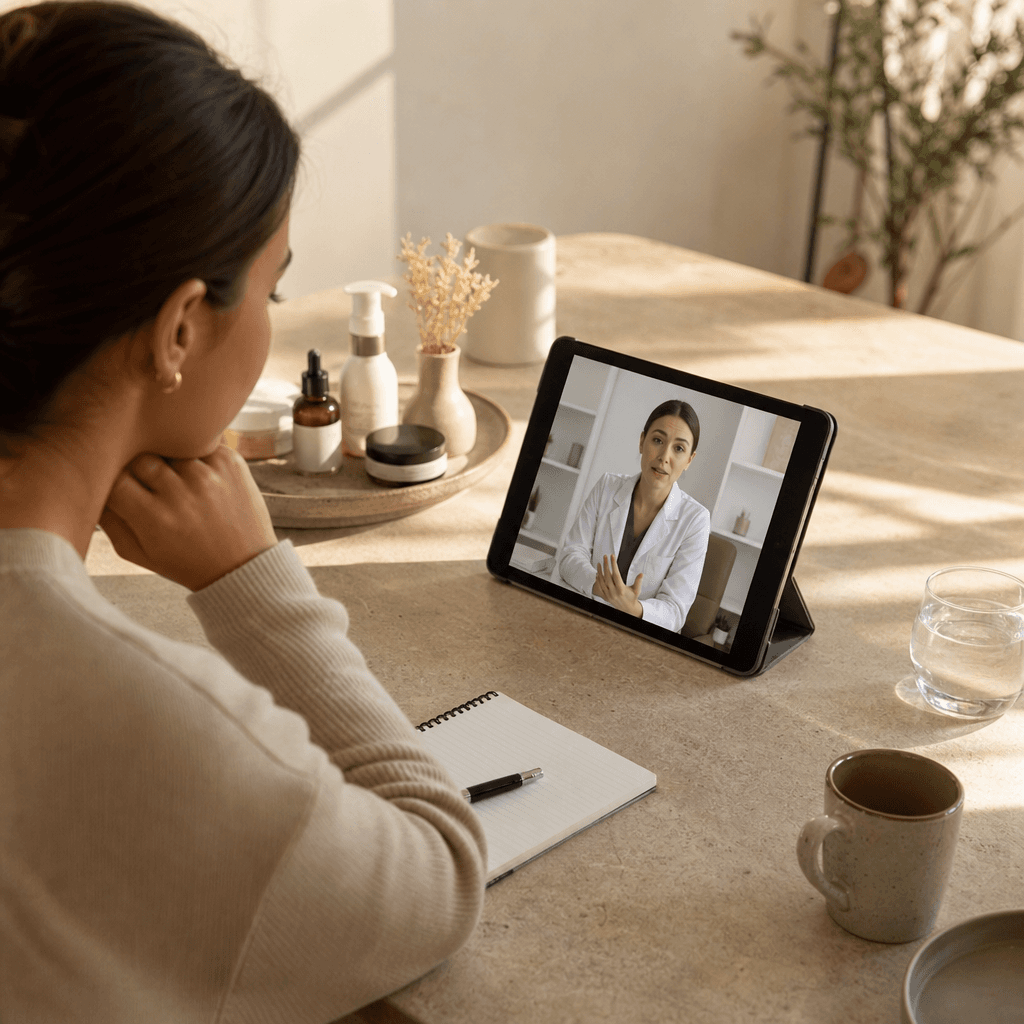
At Macherre, our Virtual ProAcne page describes an initial extended consultation that includes this questionnaire, photographs, a video call, and a review of your skin history, current treatment plan, routine, lifestyle, and any blood-test results you choose to share.
One honest limitation is worth naming early. Photographs cannot replace every part of an in-person examination. Lighting, image quality, how your skin tone reads on camera, and the absence of physical touch all shape what can be assessed remotely — which is exactly why preparation and good photos matter so much. If you are unsure how to capture usable images, we cover the details separately in how to take skin photos for your consultation.
What actually gets discussed
The conversation itself tends to move through three areas: your acne history, your current routine, and what you can realistically follow.
Your acne history
Expect questions about when the acne started, where it appears, and whether lesions are superficial or deep and painful. We may ask whether breakouts are persistent or cyclical, whether they reach the chest or back, whether they leave brown marks, red marks, or textural scars, and what has improved or worsened things. This history helps separate a short-lived flare from a persistent problem, and often reveals that a past product caused irritation rather than progress.
Your current routine
We look closely at cleanser, moisturiser, and sunscreen use, the acne actives you apply and how often, plus exfoliation, scrubs, masks, haircare, and makeup that touch your skin. A common finding is simply too much, too fast. A routine that is too aggressive creates dryness and irritation that masks whether anything is actually helping, so a personalised plan often starts with a simpler foundation before layering in active products.
Your goals and real-world constraints
A plan only works if you can live with it. So we discuss whether you prefer a topical-only approach, your tolerance for dryness or temporary irritation, product availability in your country, budget, and how much time your routine can take. If pigmentation, rosacea, or sensitivity sit alongside your acne, that shapes the plan too. For international patients, product access, language, time zones, and local rules on prescription treatment all affect how a remote plan runs in practice.
What a personalised acne plan can include
The exact plan follows from the consultation, but it typically covers a morning and evening routine, specific product options, and a gradual schedule for introducing active products.
Current acne guidelines support several topical categories, including benzoyl peroxide, topical retinoids, topical antibiotics, clascoterone, salicylic acid, and azelaic acid. The American Academy of Dermatology acne guidelines also support combining topical treatments that work through different mechanisms when appropriate, and limiting systemic antibiotic use.
That does not mean everyone should use every active. A responsible plan weighs tolerance, contraindications, previous reactions, pregnancy-related precautions, the possibility of a different diagnosis, and whether medical care is needed. For more severe or treatment-resistant acne, guidelines include options such as isotretinoin that require appropriate medical assessment and monitoring — these are not automatically suitable for an online cosmetology skincare plan.
Gradual introduction is the part people most often skip. Starting several actives at once makes it impossible to tell which one caused the irritation, so a good plan specifies which product to begin with, how often to use it, when to increase frequency, which symptoms mean you should pause, and what supporting cleanser, moisturiser, and sunscreen to pair with it. Our Virtual ProAcne plan is built this way, with the exact starter set chosen individually after the extended consultation rather than pre-packaged. Pricing and the current programme length are set on the live Virtual ProAcne programme page, which is the place to confirm the latest details before booking.
Where follow-up fits in
For persistent acne, follow-up is not an optional extra. Skin can become dry, irritated, or more reactive once a new routine begins, and reviews are how we tell whether the plan is being tolerated and whether it needs changing.
Our Virtual ProAcne programme includes progress reviews every two weeks, drawing on fresh photographs, your feedback, and how your skin has responded. These can run through a short video call or a structured chat review, and messenger support between check-ins covers questions, dryness, irritation, or unexpected reactions. The programme is currently described as lasting roughly four to six months, though the precise duration depends on your starting point, response, and consistency.
That window is best understood as a planned support period, not a promise that acne clears within a fixed number of months. Acne fluctuates, and post-acne marks or scars often follow a different course from active breakouts. If you want a fuller picture of the rhythm, we walk through it in what to expect from an online acne program.
When an online consultation is not enough
Remote care has clear limits, and recognising them protects you. An online consultation may be unsuitable as your only source of care when acne needs a medical examination, prescription treatment, laboratory assessment, or urgent evaluation.
Arrange medical advice if your acne has not improved after appropriate self-care, you have many spots or deep painful lesions, it is leaving scars, the skin is hot, swollen, or very red with possible infection, it is affecting your mental health, you develop nodules or cysts, or it is rapidly worsening or no longer resembles your usual acne. The NHS acne guidance specifically advises seeking help for acne that is persistent despite self-treatment, deep or painful, scarring, possibly infected, or affecting mental health.
An online skincare consultation should never delay urgent care, diagnose a suspicious lesion, manage a serious infection, or start prescription medication that requires medical supervision. If you are weighing this up, our overview of when to see a professional for acne sets out the warning signs in more detail.
Who tends to benefit most
Remote support is worth considering if you have persistent but stable acne and want structure, you are unsure which products are irritating you, you have tried several over-the-counter products without a clear plan, or you want ongoing reviews rather than a single recommendation. It also suits people whose acne sits alongside sensitivity, rosacea, or post-acne discoloration, and international patients who need a consultation in an available language.
It is a weaker fit if you need urgent assessment, have severe or scarring acne, suspect infection, or require prescription treatment and monitoring that the service cannot provide.
For concerns that linger after breakouts settle, our Post-Acne and Discoloration Treatment option addresses marks and uneven tone. If redness, flushing, or reactivity is part of the picture, the Rosacea Management and Sensitive Skin Care consultations are built for exactly that.
Frequently asked questions
Is an online acne consultation the same as seeing a dermatologist?
No. A remote consultation can provide assessment, routine guidance, and follow-up, but it does not automatically replace an in-person dermatologist or doctor. The right service depends on acne severity, symptoms, diagnosis, medication needs, and local healthcare requirements.
Do I need blood tests to take part?
Not necessarily. Our programme reviews blood-test results when you provide them, but it does not require blood tests from every client. Bring any recent results you already have, and we can factor them in.
Can I keep using my current acne treatment?
Bring your current products and treatments to the consultation so we can consider them alongside your treatment-response history. Do not stop any prescribed medication without first discussing it with the clinician who prescribed it.
Does the programme guarantee clear skin?
No. We do not promise a specific result. The duration and the adjustments we make depend on your individual starting point and how your skin responds over time.
What should I do if a new product causes burning or a rash?
Stop using it and ask us about the reaction rather than pushing through. Our between-review support covers dryness, irritation, and unexpected reactions. Severe swelling, blistering, breathing difficulty, or signs of infection need prompt medical care straight away.