



When to See a Professional for Acne: Key Signs
This article is educational and does not diagnose a condition or replace care from a qualified medical professional.
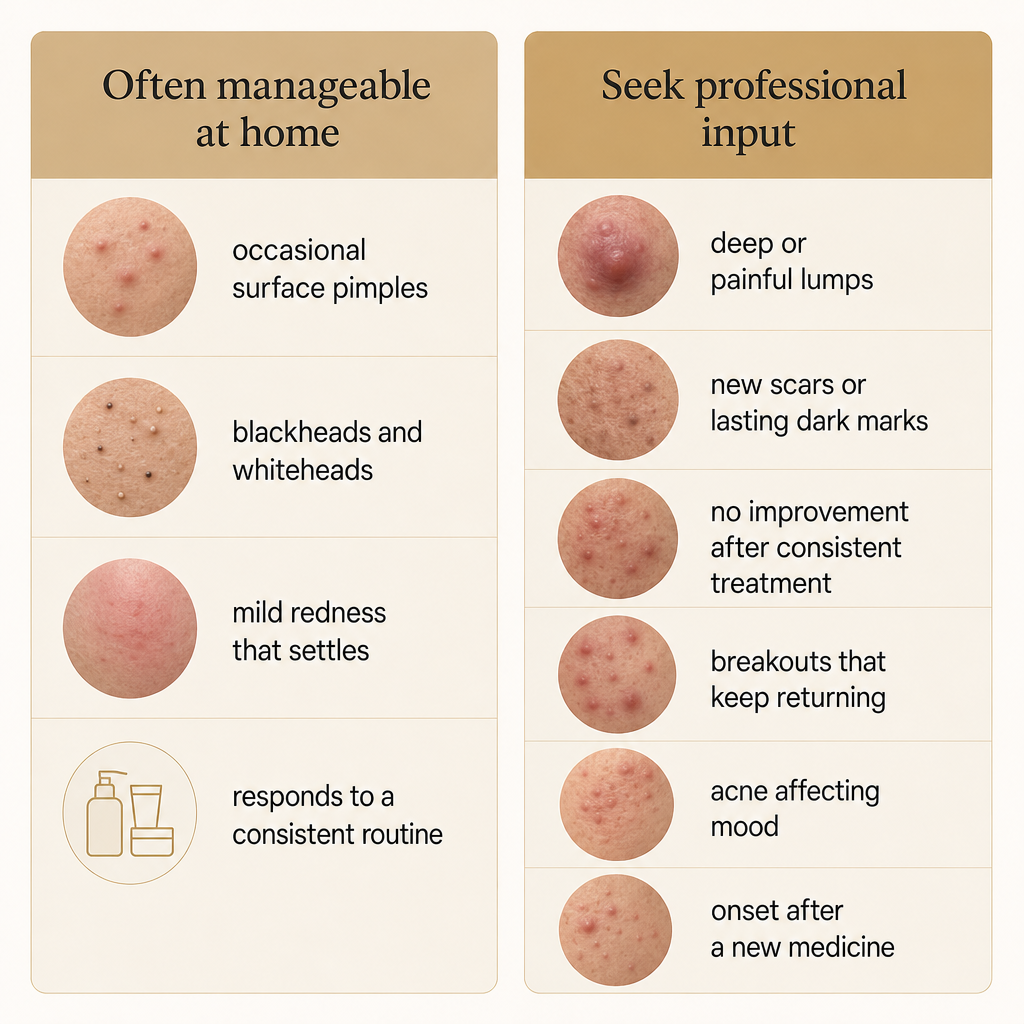
You should consider seeing a professional for acne when breakouts turn deep or painful, leave scars or stubborn dark marks, keep returning despite consistent effort, start eroding your confidence, or appear suddenly after a medication change. If you have been wondering when should I see a professional for acne, the honest answer is that it is rarely about whether your skin looks "bad enough." It is about whether the pattern you are seeing points to something that a structured, informed assessment can untangle faster than another trip to the pharmacy aisle.
Professional input is not reserved for the most severe cases. An assessment can clarify whether the problem is acne, another skin condition, or a mix of concerns, and whether you need skincare guidance, medical treatment, or an in-person referral.
This article offers general education, not a diagnosis or a personal treatment plan. A doctor or qualified skin professional needs to assess your individual symptoms, history, medicines, pregnancy status, and treatment needs.
Table of contents
What a professional assessment actually decides
The question a good assessment answers is not "how bad is this?" but "what is driving it, and what kind of care does it need?" Acne develops through several interacting processes: excess oil, dead skin cells blocking pores, shifts involving skin bacteria, and inflammation. Deeper inflammation can produce nodules or cysts, which are more likely to be painful and to scar.
An experienced reviewer weighs several things at once rather than any single symptom:
- the type of lesions, from blackheads and whiteheads to papules, pustules, nodules, or cysts;
- how deep, painful, widespread, or persistent the breakouts are;
- whether scars or colour changes are appearing;
- how long each treatment has been used, and whether it was used consistently;
- whether products are irritating the skin or worsening dryness;
- whether another condition could be mimicking acne;
- how much the acne is affecting daily life and mood;
- whether remote skincare support is appropriate or in-person medical care is needed.
That last point matters. The goal of an assessment is to route you to the right level of care, not to push every concern down the same path.
The signs that it is time to seek help
Most people wait too long because they keep expecting the next product to be the one that works. These are the patterns that suggest a review would serve you better than another purchase.
Deep, painful, or nodular breakouts
Large, tender lesions that sit deep under the skin should not be treated like ordinary surface blemishes. Nodules and cysts take longer to settle and carry a higher risk of permanent scarring. Arrange an assessment if you notice painful lumps beneath the skin, cyst-like lesions, swelling that is hard to control, repeated breakouts along the jaw, cheeks, chest, back, or shoulders, or acne that makes sleeping, exercising, or everyday activities uncomfortable. Avoid squeezing or puncturing deep lesions, which tends to worsen inflammation and raise the risk of scarring or infection.
Scars or persistent dark marks
Professional advice is especially worthwhile when new spots are followed by dents or pits, raised scars, lingering red or brown marks, texture changes, or darkening that continues after the active acne has settled. The sooner ongoing acne is addressed, the sooner you can discuss ways to reduce further inflammation and prevent additional marks. Existing scars and post-acne discoloration are related but distinct concerns, which is why our post-acne and discoloration treatment is handled separately rather than assuming every mark is a scar.
Over-the-counter products have not helped
If you have used suitable over-the-counter products consistently and your acne is not improving, a review can help identify why. Common explanations include a routine that does not target the main acne processes, too many active products irritating the skin barrier, treatment stopped before it had a fair chance, a product that does not suit your acne type, a condition that is not actually acne, or hormonal and medication-related factors.
NICE recommends reviewing an acne treatment course after 12 weeks, and considering specialist referral when mild-to-moderate acne has not responded adequately to two different 12-week courses. That does not mean you must wait 24 weeks before asking for help. Painful acne, scarring, significant distress, or rapidly worsening symptoms are all reasons to seek advice sooner. You can read how a review and personalised routine are structured in our explainer on what to expect from an online acne program.
Acne that keeps returning
Recurring breakouts often mean a routine is controlling individual spots without addressing what repeatedly triggers new ones. A review can look at where and when breakouts occur, menstrual or other hormonal patterns, hair and makeup products, friction and picking, medicines and supplements, and previous treatments and side effects. Adults whose skin clears briefly before new breakouts appear usually benefit more from a structured review than from continually adding products.
Acne that is affecting your mental health
Acne can take a toll well beyond appearance. Consider support if you avoid social events or photographs, feel persistently embarrassed or low, spend excessive time checking or concealing your skin, feel distressed by scarring or discoloration, or sense that acne is affecting work, relationships, or confidence. NHS guidance advises seeking medical help when acne affects mental health, and NICE recommends considering specialist referral when acne of any severity contributes to persistent psychological distress. If you are in immediate danger or having thoughts of harming yourself, contact your local emergency or crisis-support service now.
An uncertain diagnosis
Not every acne-like eruption is acne vulgaris. An assessment is sensible when bumps are unusually itchy or burning, concentrated around the mouth, eyes, or nose, linked with flushing or persistent redness, appearing mainly in the armpits, groin, or thighs, suddenly widespread, or accompanied by scaling, crusting, fever, or feeling unwell. Our guide on the difference between acne and rosacea explains how these conditions overlap while remaining distinct. When the diagnosis is unclear, an in-person medical assessment may be wiser than starting another active product.
Breakouts that began after a medicine
Tell a healthcare professional if your acne started or changed after beginning a medicine or supplement, especially within the last several months. Do not stop a prescribed medicine without discussing it with the prescriber. Bring a list of prescription medicines, hormonal contraception or hormone therapy, corticosteroids, supplements and gym products, recent changes, and topical products used on the affected area. A clinician can then judge whether the medicine may be contributing or whether another explanation needs investigation.
When acne needs urgent medical assessment
Most acne does not require emergency care, but sudden severe acne with systemic symptoms is different. Seek same-day medical assessment for rapidly worsening, ulcerated, or crusted acne accompanied by fever, joint pain, marked tiredness or feeling generally unwell, severe swelling, or bleeding and open ulcers. NICE advises urgent same-day referral for suspected acne fulminans because it can make a person seriously unwell and may require hospital care.
Also seek prompt care for skin that becomes hot, increasingly swollen, and very red, particularly alongside feeling unwell. Redness can be harder to see on brown or black skin, so warmth, pain, swelling, and systemic symptoms matter just as much as visible colour.
Doctor, dermatologist, or skincare professional?
The right professional depends on the concern, and the two paths overlap less than people assume.
| Situation | Where to start |
|---|---|
| Deep, severe, or rapidly worsening acne | Doctor or dermatologist |
| Possible need for prescription treatment | Doctor or dermatologist |
| Uncertain diagnosis or onset after a medicine | Doctor or dermatologist |
| Pregnant, conceiving, or breastfeeding | Doctor or dermatologist |
| Fever, joint symptoms, ulcers, or infection signs | Same-day medical care |
| Persistent but non-urgent acne | Skincare consultation |
| Repeated irritation from multiple products | Skincare consultation |
| Help introducing products gradually with follow-up | Skincare consultation |
A skincare consultation can also be useful when you want to address acne alongside sensitivity, rosacea, or post-acne discoloration with structured follow-up. What it cannot do is replace urgent examination, diagnostic testing, or in-person treatment when those are needed. A responsible remote service should recognise when to refer or escalate.
How our online acne support fits
Our acne treatment consultation is built for personalised, acne-related skincare guidance. The current Virtual ProAcne Program describes a 4–6 month online pathway that begins with an extended consultation, moves into a personalised routine with gradual product introduction, and continues with progress reviews every two weeks plus support between check-ins. Treatment length is determined individually, and the listed duration is a framework rather than a promise that everyone needs the same length of care or will reach the same result.
Pricing, availability, products, and currency can change, so we ask that you check the live program page and the appropriate language or regional version before booking rather than relying on a figure quoted elsewhere. This approach can suit adults seeking remote, structured skincare support, including people concerned about chronic or hormonal acne, sensitivity, pigmentation, or routines that have stopped working. It is not a substitute for urgent medical assessment or specialist care when the red flags above are present.
What to prepare for an acne consultation
A useful consultation starts with accurate information, not a cart full of new products. It helps to note when the acne began and whether it is changing, which areas are affected, and whether lesions are painful, itchy, or deep. Record menstrual or other hormonal patterns if relevant, take photographs in clear natural light, and list every product you currently use with its frequency. Add previous treatments and what happened, your medicines, supplements, and allergies, and whether acne affects your mood, sleep, work, or social life.
One practical caution: avoid starting several new active ingredients right before an assessment. They can irritate the skin and make it far harder to tell what is helping and what is causing a reaction.
Frequently asked questions
When should I see a professional for acne instead of trying another product?
See a professional if acne is painful or deep, leaves scars or persistent marks, keeps returning, affects your mental health, or has not improved after a consistent and appropriate treatment attempt. You do not need to wait for severe scarring before asking for help.
How long should I try an acne treatment before seeking advice?
Many clinical acne plans are reviewed at around 12 weeks, but the right timing depends on the treatment and your symptoms. Seek advice earlier for deep painful acne, scarring, severe irritation, rapid worsening, or emotional distress.
Can an online acne consultation diagnose me?
A remote consultation can review your history, photographs, products, and goals, but it has limits. It may not suit cases where the diagnosis is uncertain, symptoms are severe, or you need a physical examination, prescription monitoring, testing, or urgent care.
Is the ProAcne Program a fixed six-month treatment?
No. The current program page describes a 4–6 month framework, with length determined individually. A six-month package is one payment option, not a statement that everyone needs the same duration or will have the same outcome.
Can I use your service if I need medication?
Ask during the consultation and confirm what we can provide in your location. Medication decisions depend on your medical history, local rules, pregnancy status, and whether in-person care is necessary. Do not begin, stop, or change prescribed medication without the relevant healthcare professional.