





Acne Treatment For Hormonal: Hormonal Acne Treatment That Actually Works: A Cosmetologist's Approach
This article is educational and does not diagnose a condition or replace care from a qualified medical professional.
Hormonal acne is acne driven by fluctuations in androgen hormones that push your skin to produce more oil, clog pores, and trigger inflammation, most often along the jawline, chin, and lower face in adults. Effective acne treatment for hormonal patterns is not a single product but a structured, months-long plan that works on oil, clogging, and inflammation together — which is exactly where a cosmetologist-led program earns its place.
At Macherre Medical Center, we work with adults whose breakouts keep returning despite a drawer full of over-the-counter products. This guide explains what hormonal acne actually is, how it differs from ordinary breakouts, why quick fixes tend to disappoint, and how to judge whether a guided, remote skincare program fits your situation. We keep the medical distinctions clear so you know when cosmetology-level care is the right centre of your plan and when a physician needs to be involved.
Table of contents
- What hormonal acne is and how it works
- The variants: how hormonal acne differs from other breakouts
- Why over-the-counter routines keep failing you
- How a cosmetologist-led approach fits into real treatment
- What to weigh before you choose a path
- Frequently asked questions
What hormonal acne is and how it works
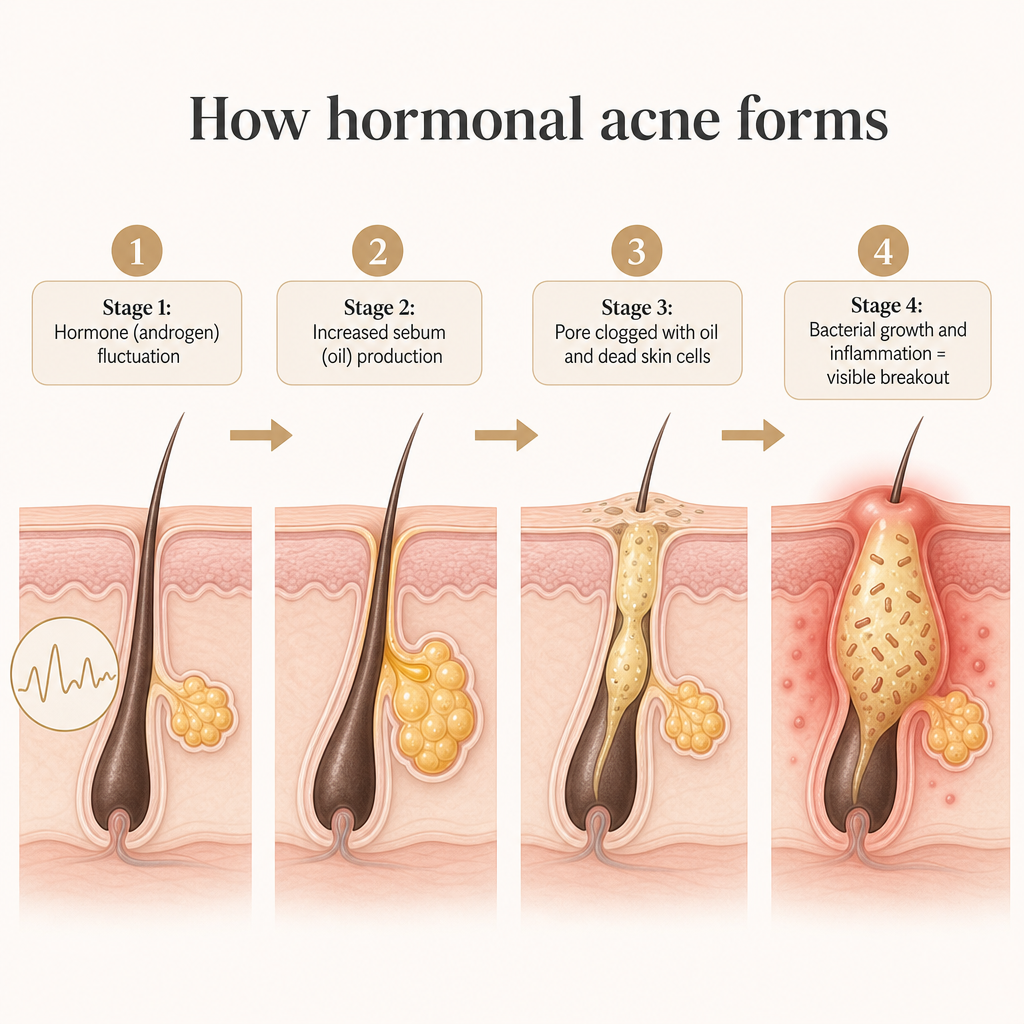
Hormonal acne is a pattern rather than a separate disease. The mechanism is a chain: fluctuations in hormones — particularly androgens — stimulate the sebaceous glands to produce more sebum. That excess oil mixes with dead skin cells inside the follicle, the pore becomes blocked, and bacteria multiply in the trapped environment. The result is inflammation that shows up as papules, pustules, or deeper, tender cysts. Cleveland Clinic describes this androgen-driven cascade as the core reason these breakouts persist, noting that although acne is associated with adolescence, hormonal acne commonly affects adults, and women in particular.
The part that surprises many of our clients is that the trigger sits upstream. You can cleanse the surface perfectly and still break out, because the oil overproduction is being signalled from inside. That is why hormonal acne tends to be stubborn and cyclical: it often flares in step with the menstrual cycle, times of stress, or other hormonal shifts, and it favours the lower third of the face. The same follicular mechanism — excess sebum, dead cells, bacteria, inflammation — applies whether or not the trigger is purely hormonal, which is why the treatment logic overlaps with acne generally while the timing and distribution give the hormonal pattern away.
Understanding the chain matters because it tells you where treatment has to act. A durable plan targets more than one link at once: reducing how much oil sits in the pore, keeping the follicle from clogging, and calming the inflammation that produces visible spots. A product that only exfoliates the surface, or only kills surface bacteria, addresses one link and leaves the others intact — which is one reason single-product routines stall.
The variants: how hormonal acne differs from other breakouts
Not every breakout is the same, and the differences shape what care makes sense. Broadly, dermatology sources describe acne along a spectrum of severity, and hormonal acne can appear anywhere on that spectrum.
Comedonal acne is the non-inflamed variant: blackheads and whiteheads formed by clogged pores without much redness. Standard care focuses on normalising cell turnover so pores stop plugging.
Inflammatory acne brings the redness and swelling — papules and pustules — where bacteria and inflammation are active alongside the clogging. Care here works on bacteria and inflammation as well as the clog.
Nodulocystic acne is the deep, painful variant with nodules and cysts. Cleveland Clinic and other clinical sources are clear that moderate-to-severe or cystic acne often calls for systemic treatment — oral antibiotics, isotretinoin, or in appropriate cases hormonal medication — under a physician's supervision, and sometimes steroid injections for individual cysts.
What makes the hormonal label distinct is the pattern layered over these variants: adult onset or persistence, jawline and chin distribution, cyclical timing, and resistance to routines that would clear ordinary teenage acne. Hormonal therapies specifically — combined oral contraceptives, spironolactone, and the topical anti-androgen clascoterone — are described in NIH-hosted reviews as effective options for women whose acne is severe, resistant, or clearly linked to hormonal fluctuation. These are prescription medical interventions requiring physician oversight, not cosmetic products, and clascoterone in particular is highlighted as a prescription agent rather than a shelf item.
The practical distinction for your decision is this: the milder, cyclical, comedonal-to-moderate inflammatory patterns respond well to optimised topical and lifestyle care, while the deep, scarring, resistant forms need medical assessment. Both can be hormonal. The severity, not the label alone, tells you where the centre of gravity should sit.
Why over-the-counter routines keep failing you
Most people arrive at hormonal acne treatment after a long detour through drugstore products, and the frustration is understandable. Several evidence-based sources directly challenge the assumptions that keep that detour going.
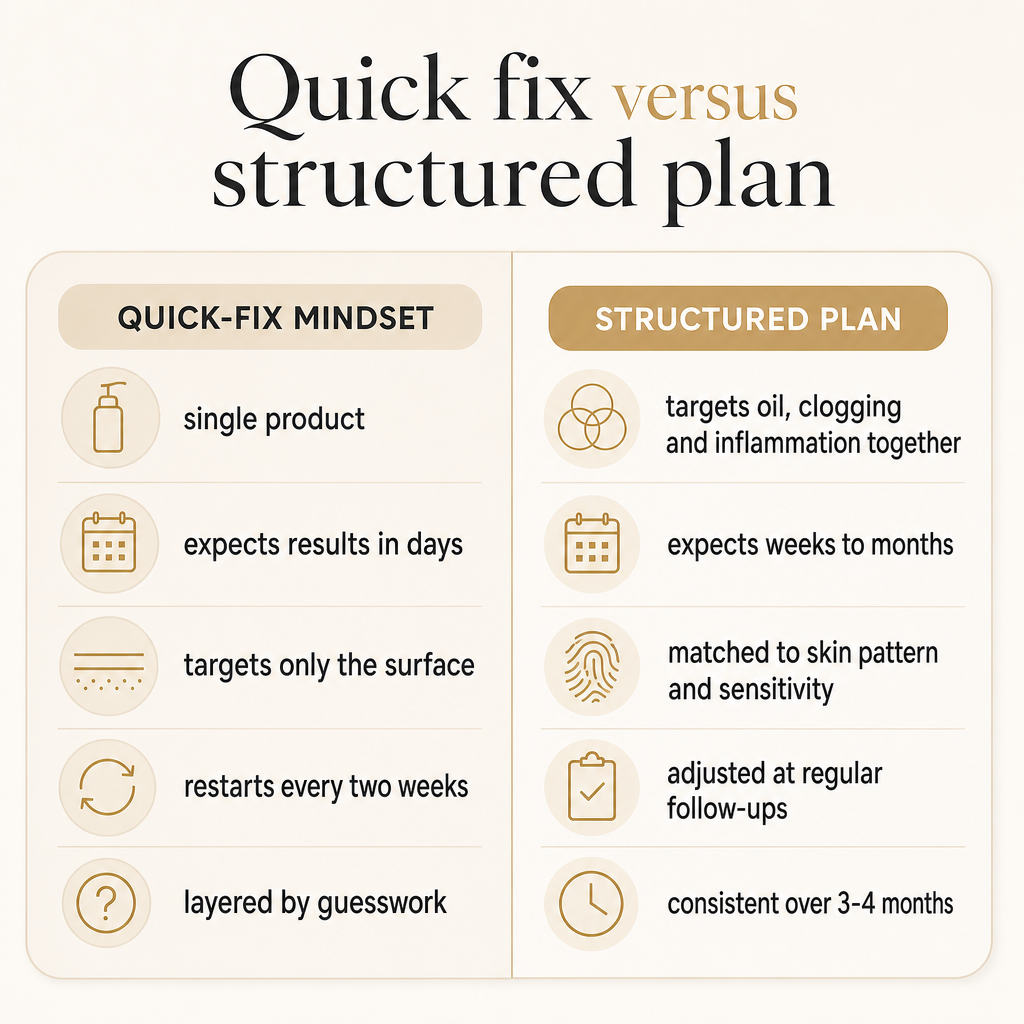
The first misconception is that washing more will fix it. Because the oil is being overproduced from within, aggressive cleansing strips the surface without touching the cause — and often irritates the skin into producing more. The second is that a single over-the-counter product is enough. Sources such as Healthline and WebMD are direct that consistent, medically guided plans, and when appropriate hormonal or prescription therapies, are frequently required for moderate-to-severe hormonal acne, and that lifestyle and cosmetics alone tend to underperform against integrated care.
The third misconception is about time. Meaningful improvement in hormonal acne typically takes several weeks to months, not days. When a two-week experiment with a new cleanser shows nothing, people abandon it and start again with something else — a cycle of restarts that never gives any single approach the runway it needs. Active ingredients like retinoids can even cause a temporary worsening before they help, which reads as failure to someone expecting a fast result.
There is also a matching problem. Benzoyl peroxide, salicylic acid, azelaic acid, and retinoids each act on different links in the chain, and the right combination depends on your skin's sensitivity, your specific pattern, and how your skin tolerates introduction of actives. Buying them one at a time and layering by guesswork frequently produces irritation, which then masquerades as more acne. This is where guided plans separate from self-treatment: the plan is chosen for your pattern and adjusted as your skin responds, rather than assembled from whatever a review recommended.
How a cosmetologist-led approach fits into real treatment
Effective hormonal acne management usually combines three things: topical therapies, possible systemic or hormonal medication in the right candidates, and consistent skincare and lifestyle support sustained over months. Our model at Macherre is built for that third pillar — and it is a larger pillar than most people assume, because adherence and correct application are where a great deal of real-world treatment succeeds or fails.
Our professional acne consultation is the entry point. We take a comprehensive approach to the different types of acne, working to identify the cause and build an effective, individual plan rather than handing over a generic routine. The consultation is remote by design: you describe your skin concerns and goals, upload clear photos through a secure portal, and Dr. Maria reviews the full picture before developing a personalised plan covering topical skincare, nutrition, and lifestyle adjustments. Because we are cosmetology-led, our centre of gravity is optimising skincare selection, application schedules, and habits — not prescribing systemic hormonal drugs, which remain the domain of a supervising physician.
For chronic and persistent breakouts, our ProAcne Program is the structured flagship. It begins with an in-depth skin assessment, sets a tailored multi-month plan, and then runs bi-weekly follow-ups across a 3-4 month course so the plan can be adjusted as your skin responds and progress can be tracked with regular photo check-ins. That cadence is not arbitrary. It matches the time horizons clinical reviews cite for acne, where improvement is gradual and depends on sustained adherence. A plan that is set once and never revisited cannot respond to how your skin actually behaves; the repeated follow-ups are what turn a good starting plan into a working one.
The remote format is the point rather than a compromise. Hormonal acne is a pattern-based condition — location, timing, and persistence carry much of the diagnostic weight — which is well suited to assessment through detailed history and photographs. That makes considered, expert planning accessible to busy adults and to international clients who would otherwise struggle to reach in-person care. When you share your skin concerns, goals, photos, and history with us, we can prepare a recommendation matched to your specific pattern rather than a generic routine — so tell us where and when your breakouts appear and how long they have persisted, and we will tailor the plan accordingly.
Hormonal acne care also does not end when active spots settle. Once inflammation is controlled, the concerns that remain often shift — marks, sensitivity, and texture. We treat those as part of the same journey through dedicated services for post-acne marks and discoloration and for reactive, sensitive skin, so the plan follows your skin from clearing breakouts to restoring an even, calm surface. If blackheads and whiteheads are a persistent part of your pattern, we also address those directly through our blackheads and whiteheads removal service, so comedonal clogging is not left to fester alongside the inflammatory spots.
What to weigh before you choose a path
Deciding whether a cosmetologist-led online program is right for you comes down to a few honest judgments rather than a checklist. These are the criteria we would want you to think through.
Your severity and type. If your pattern is mild to moderate — cyclical jawline breakouts, persistent comedones, papules and pustules that flare and fade — cosmetologist-guided topical and lifestyle planning can sensibly be the centre of your care, with medical input added if needed. If you have deep nodules or cysts, active scarring, or acne that has resisted everything including prescription treatment, clinical sources are consistent that dermatology assessment and often systemic therapy should lead. In that case a guided skincare program is a supporting player, not the whole solution, and coordinating with a physician matters.
Your expectations about time. A structured plan asks for patience. If you are ready to commit to weeks and months of consistency and to adjust along the way, the model works with you. If you are looking for a result in days, no legitimate approach — ours included — can meet that, and it is better to know that before you start.
Your appetite for medication. Many of the adults we work with specifically want a non-medication, guidance-focused path, or want to optimise skincare and lifestyle before considering systemic drugs. That preference fits our scope well. It is also why safety framing matters: isotretinoin and systemic hormonal medications carry significant risk profiles and must be prescribed and monitored by qualified healthcare professionals. Please do not self-start prescription hormonal or retinoid treatments, and do involve a local physician when systemic therapy might be indicated.
Your circumstances. If in-person dermatology is hard to reach because of location, schedule, or language, a bilingual remote program removes a real barrier while keeping expert oversight. If you have signs pointing to an underlying endocrine issue, that is a reason to loop in a physician alongside skincare care, not a reason to skip either.
A useful way to decide is to describe your own acne in three words: where, when, and how long. If the answers are lower face, cyclical or persistent, and months-to-years despite over-the-counter products, you are almost certainly dealing with a hormonal pattern that rewards a structured, guided plan over another shelf experiment. If your answers include deep painful cysts and scarring, treat a physician visit as the first move and bring skincare support in alongside it.
When you are ready, our acne consultation is where an individual assessment and plan begin, and the ProAcne Program is there when your pattern is chronic enough to warrant months of guided follow-up.
Frequently asked questions
How do I know if my acne is hormonal?
The strongest clues are pattern-based: breakouts concentrated along the jawline, chin, and lower face; timing that tracks with your cycle or periods of stress; adult onset or persistence; and stubbornness against routines that would clear ordinary acne. Cleveland Clinic ties this pattern to androgen-driven oil production. A remote assessment using your history and photos can help confirm whether your case looks hormonal.
Can hormonal acne be treated without prescription medication?
Often, yes, for mild-to-moderate patterns. Optimised topical care, thoughtful product selection, application schedules, and lifestyle and nutrition support can be the centre of treatment, which is exactly the cosmetology-led work we do. For severe, cystic, scarring, or treatment-resistant acne, clinical sources emphasise that systemic or hormonal medication under a physician is frequently needed, and skincare support then works alongside that medical care.
Does Macherre prescribe hormonal therapy or isotretinoin?
Our focus is cosmetology-led care: expert assessment, personalised skincare and lifestyle planning, and remote monitoring over time. Systemic hormonal medications and isotretinoin carry significant risks and must be prescribed and monitored by qualified physicians. When your situation points toward those treatments, we would encourage coordinating with a local doctor while we support the skincare and adherence side of your plan.
How long before I see results?
Meaningful improvement in hormonal acne typically takes several weeks to months rather than days, and often requires changes to both products and habits. Some actives can cause a temporary flare before they help. That timeline is why our ProAcne Program runs bi-weekly follow-ups across a 3-4 month course, so the plan can be adjusted as your skin responds instead of being abandoned early.
Is an online consultation as good as an in-person visit for acne?
Hormonal acne is largely a pattern-based condition, where location, timing, and persistence carry much of the assessment weight, so it lends itself well to remote evaluation through detailed history and clear photos. Our model is built to approximate many parts of in-person skincare planning while making expert care reachable for busy and international clients. For cases that need hands-on examination or systemic medication, we would point you toward in-person medical care as well.
What happens to the marks and texture left after breakouts clear?
Controlling active inflammation is the first goal, but hormonal acne often leaves post-inflammatory discoloration or texture changes behind. We treat that as a continuation of the same plan through our dedicated services for post-acne marks, discoloration, and sensitive or reactive skin, so your care follows through from clearing spots to restoring an even, calm complexion.