






ProAcne Program Explained: How It Works
This article is educational and does not diagnose a condition or replace care from a qualified medical professional.
If you have been searching for the proacne program explained, you are likely trying to work out one thing: is this a single online appointment, or a treatment journey you commit to over several months? At Macherre, ProAcne is the second. It is a structured, remote acne-support pathway lasting roughly four to six months, built around an extended consultation, a personalized skincare roadmap, progress reviews every two weeks, and message support between those reviews. It is designed to help you implement evidence-based acne care steadily and safely over time, not to sell you a single product or promise a fixed result.
The distinction matters because acne responds to consistency and adjustment, not to one perfect cream. Below we explain exactly what the program is, how it runs in real life, why a structured course helps acne more than scattered routines, and how to decide whether it fits where you currently are in your care.
Table of contents
What the ProAcne Program actually is
ProAcne is our flagship follow-up pathway for chronic and hormonal acne. The core idea is repeated online review rather than a one-off visit. You start from an extended consultation, then we follow your skin through bi-weekly reviews and adjust the plan as your skin adapts.
In practical terms, the Virtual ProAcne Program is:
- An online course lasting roughly four to six months, with two structured check-ins each month.
- A plan that begins from your extended consultation findings, then evolves through regular reviews.
- A cosmetology-led, largely topical and lifestyle-based support system that can sit alongside local medical care when that is needed.
So you are not buying a miracle product or a single prescription. You are committing to a guided, multi-month process that mirrors how professional acne treatment is recommended to work: combination care applied consistently over months, with ongoing monitoring rather than quick fixes. That framing comes straight from how major dermatology guidance treats acne as a condition managed over time.
If you want the broader context of how remote care itself functions before focusing on this specific program, our overview of how remote skincare consultation works explains the assessment and follow-up model that ProAcne is built on.
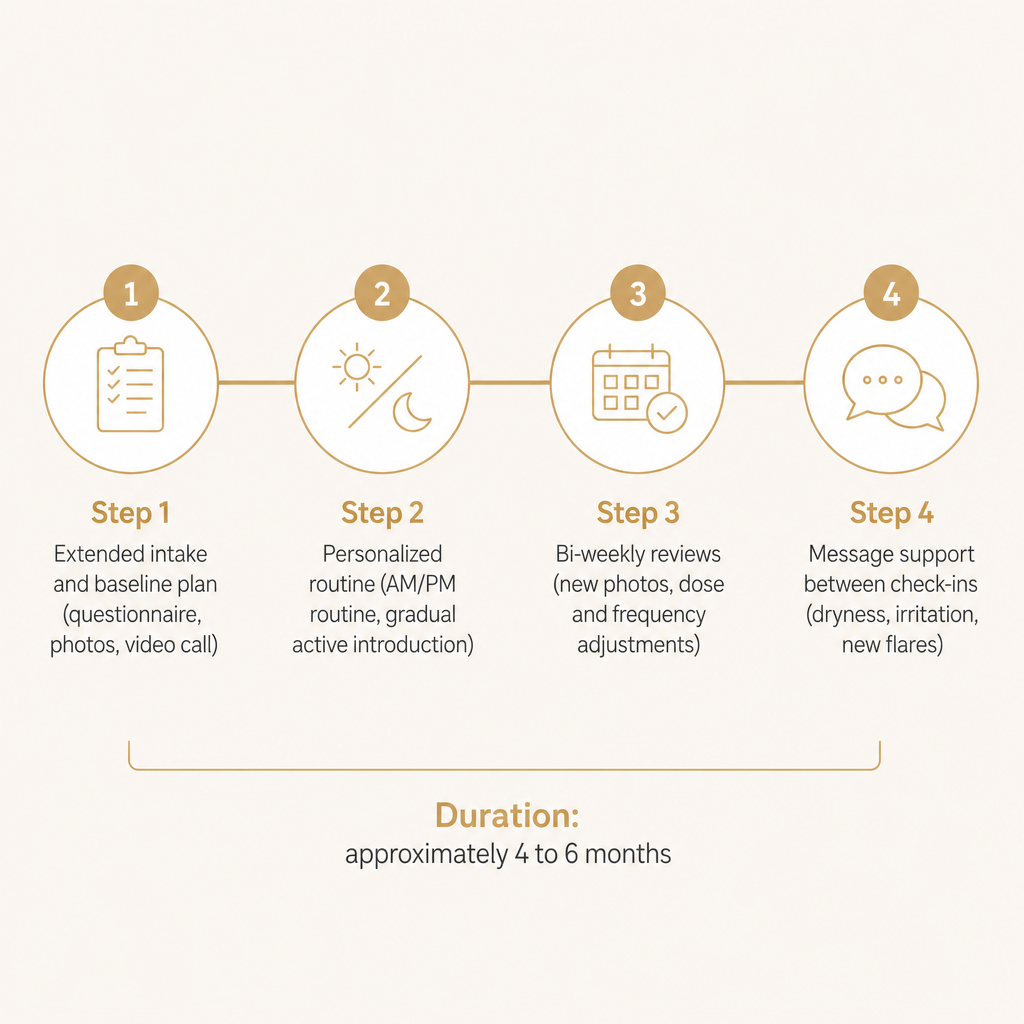
How the program runs over four to six months
The details are tailored to each person, but the framework stays consistent.
Extended intake and baseline plan. Before or at the start, you complete a questionnaire, send clear skin photos, and, if available, share lab results or current prescriptions. During a video call we review your skin history, breakout pattern, current routine, lifestyle, and any medical treatment you already use. From that, you receive a morning and evening routine matched to your skin type and acne severity, specific product suggestions with alternatives at different price points, and a gradual schedule for introducing stronger actives such as retinoids so your barrier is protected and irritation stays limited.
Bi-weekly reviews and adjustments. Every two weeks we review your progress using new photos and your feedback, typically through a focused video call or structured chat. We look for new breakouts, pattern changes, dryness, or irritation, then update which products you use and how often, the strength or type of actives involved, and lifestyle or trigger-management advice. This is where the program earns its value: the plan keeps moving with your skin instead of staying frozen after the first appointment.
Message support between check-ins. Between formal reviews you can ask questions if you experience stinging, unexpected reactions, or a new flare. This support exists to prevent panicked product swaps. Instead of abandoning the plan or experimenting alone, you get help adjusting dose or frequency safely.
The course is described as lasting about four to six months, which aligns with the twelve-week-or-longer timelines that major guidelines recommend for topical acne courses and ongoing maintenance. Pricing and treatment length depend on the option you choose and your individual plan, and fees can change over time. Please confirm the current duration and fees on the official Virtual ProAcne Program page before you decide, using the appropriate locale and currency for your region.
Why a structured course helps acne
Acne is driven by several overlapping mechanisms at once: clogged follicles, excess sebum, overgrowth of acne-related bacteria, and inflammation. No single product safely addresses all of these together, which is why current dermatology guidance favors combination topical therapy over months rather than a one-ingredient quick fix.
The evidence-supported pillars that a structured plan draws on include:
- Topical retinoids such as adapalene or tretinoin, to normalize cell turnover inside pores and reduce both comedonal and inflammatory lesions.
- Benzoyl peroxide, to reduce acne-causing bacteria and help limit antibiotic resistance when used alongside antibiotics.
- Azelaic acid and salicylic acid, for additional comedolytic, anti-inflammatory, and pigment-fading effects, which also help post-inflammatory marks.
- Maintenance therapy over time rather than stopping abruptly once skin improves, which guidelines highlight for preventing relapse.
ProAcne is built to put these principles into practice in a way that respects your skin's tolerance and daily routine. It matches actives to severity and skin type instead of applying one standard formula to everyone. It introduces stronger ingredients gradually, which reduces burning, peeling, and barrier damage. And it revisits the plan every two weeks so dosages, frequencies, and combinations can shift as your skin adapts. This does not guarantee clear skin by a fixed date, but it follows how evidence-based acne treatment is meant to work: slowly, steadily, and with ongoing monitoring.
If hormonal patterns are a large part of your picture, our deeper explainer on hormonal acne treatment for adult breakouts covers the specific drivers a plan like this accounts for.
Topical-only and integrated paths
The program suits two broad situations. The first is people who want topical and lifestyle changes as their main strategy, with careful routine design, barrier care, and trigger management. The second is people who already have a medical plan, such as oral antibiotics or hormonal therapy, and need expert guidance on compatible skincare and long-term maintenance.
The Virtual ProAcne description notes that your current treatment plan and any blood-test results can be considered alongside your skincare roadmap. That lets us avoid product choices that clash with physician-prescribed medication and support barrier repair during stronger systemic courses.
What ProAcne does not do is replace the role of a dermatologist or doctor in prescribing and monitoring systemic medication, screening for side effects, or assessing scarring risk. For moderate-to-severe or nodular acne, major guidelines still recommend considering oral therapies and in-person review. In those cases, think of ProAcne as the structured skincare layer that works around medical treatment, not instead of it.
Related concerns rarely travel alone, so the program can integrate with dedicated consultations for post-acne discoloration or rosacea management rather than treating each issue in isolation.
How to decide if ProAcne fits you
The practical question is where this program sits in your overall care. ProAcne tends to be a strong fit when:
- Your acne is chronic or cyclical, especially jawline or lower-face breakouts with a hormonal rhythm.
- You have tried several over-the-counter routines without lasting improvement and feel unsure which actives to use, and in what order.
- You want expert guidance but cannot easily access regular in-person dermatology, or prefer to keep prescriptions minimal while optimizing topical care.
- You also have post-acne discoloration, rosacea-type redness, sensitivity, or texture concerns that should be folded into one coherent routine.
You should seek local medical care first, and treat ProAcne as a later maintenance layer, if your acne is suddenly severe, painful, or scarring quickly; if you have systemic symptoms such as fever, marked weight changes, or hair loss that might point to a broader condition; or if you are pregnant, breastfeeding, or have a complex medical history, since many common acne actives and medications may be unsuitable in those situations. In each of these cases the safest first step is a clinician who can examine you in person.
What the program cannot promise
Guidelines are clear that acne is a chronic condition that can relapse, so an honest explainer has to keep expectations realistic.
- No guaranteed cure or fixed outcome. Individual response depends on acne type, hormonal context, genetics, and how consistently you follow the plan.
- Possible irritation and purging. Retinoids, acids, and benzoyl peroxide can cause redness, peeling, or temporary worsening if introduced too fast. The gradual schedule and message support are designed to reduce this, but cannot remove the risk entirely.
- Remote limitations. A video consultation cannot fully replace a physical exam or in-clinic procedures such as comedone extraction, intralesional injections, or laser therapy when those are clinically indicated.
- Scope boundaries. ProAcne focuses on acne and related cosmetic concerns. Suspicious lesions, systemic symptoms, or complex medical questions should go to your local healthcare provider.
The program's real contribution is support and structure over several months, not a universal timeline or a promised success rate.
To make this concrete, here are three simplified scenarios, offered as illustrations rather than guarantees. An adult with premenstrual jawline breakouts might use ProAcne to build a retinoid-based routine, tune benzoyl peroxide frequency, and align skincare with any hormonal treatment prescribed locally, with check-ins focused on dosing, tolerability, and fading post-acne marks. Someone with both breakouts and facial redness might enter after a sensitivity-focused consultation, so the plan leads with barrier repair, gentle cleansers, non-comedogenic sunscreen, and carefully titrated actives, balancing acne control against flare risk at each review. An international client already taking oral antibiotics from a local dermatologist might use ProAcne to design a compatible topical and maintenance routine, avoid duplicating actives, and plan the transition to topical-only maintenance once the oral course ends. The same framework adapts to each person without promising identical results.
Frequently asked questions
Is ProAcne a single consultation or a multi-month program?
It is a structured support program lasting about four to six months, built on an initial extended consultation and reviews every two weeks rather than one appointment.
Can I join ProAcne if I already see a dermatologist?
Yes. The intake reviews your current treatment plan and any lab results so your skincare routine can complement, not conflict with, medical prescriptions.
Does it rely only on products, or does it include lifestyle advice?
It combines a personalized topical routine with guidance on triggers, lifestyle, and barrier care, which matters especially for hormonal and inflammatory patterns.
How often is my routine updated?
Your plan is formally reviewed every two weeks through online check-ins, with message support in between for dryness, irritation, or new flares.
Can ProAcne replace medical treatment for severe acne?
For moderate-to-severe, nodular, or scarring acne, major guidelines recommend considering systemic therapies and in-person review. In those cases ProAcne is best used as a complementary skincare-structure program, not a replacement for medical care.