





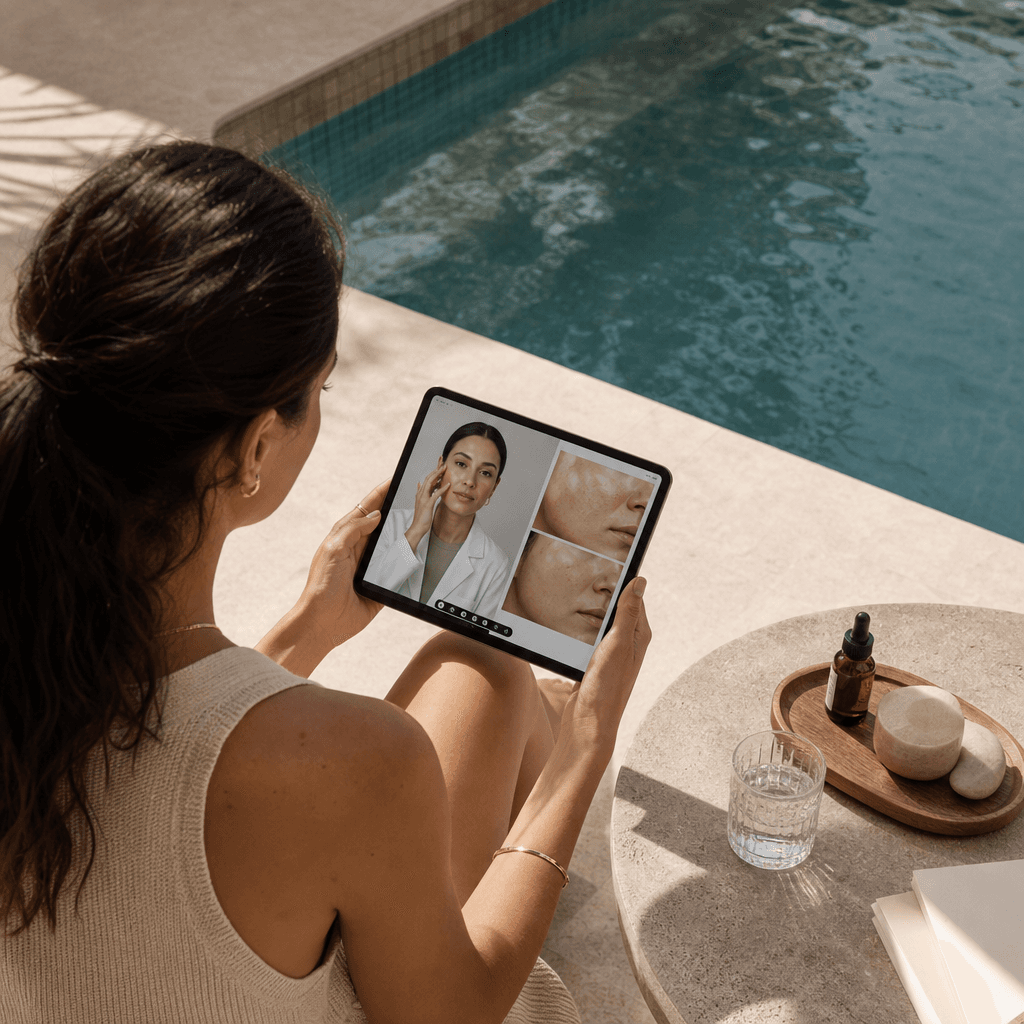
How Remote Skincare Consultation Works
This article is educational and does not diagnose a condition or replace care from a qualified medical professional.
If you have spent months swapping cleansers and acids with little to show for it, a remote skincare consultation offers a different path: structured, professional guidance delivered through video calls, clear photos, and secure messaging instead of in-clinic visits. Understanding how remote skincare consultation works matters before you commit, because the format decides whether you get a quick product tip or a monitored plan that adapts to your skin over several months. At Macherre, our Virtual ProAcne program is built around the second approach — an extended assessment, a tailored routine, and regular reviews for acne, pigmentation, rosacea, and sensitivity.
This guide is for general education and to explain how our remote service works. It does not replace a personal medical examination, diagnosis, or treatment plan.
Table of contents
What remote skincare consultation actually is
In dermatology, telemedicine — often called teledermatology — means consulting a skin specialist through your smartphone or computer by video, phone, or photo-based tools instead of attending the clinic in person, as described by the American Academy of Dermatology on telemedicine. It is considered suitable for many visible skin, hair, and nail conditions, including acne, eczema, psoriasis, and common rashes, because these can often be assessed visually using high-quality images combined with follow-up conversation.
For acne and related concerns such as post-inflammatory hyperpigmentation, rosacea, and sensitivity, the consultation focuses on your skin history, current routine, lifestyle factors, and past treatments. From that picture we build a plan that can be monitored and refined online. This suits chronic or hormonal acne, and it suits people who have tried over-the-counter products without lasting results but want to emphasize topical care and lifestyle changes before or alongside medication.
The core distinction is simple: a remote consultation is not a one-time product list sent by email. It is an assessment and a relationship over time. That is why photographs, symptom reports, and scheduled reviews carry so much weight — they replace the single in-room glance with an evolving record of how your skin behaves week to week.
How the Virtual ProAcne program works at Macherre
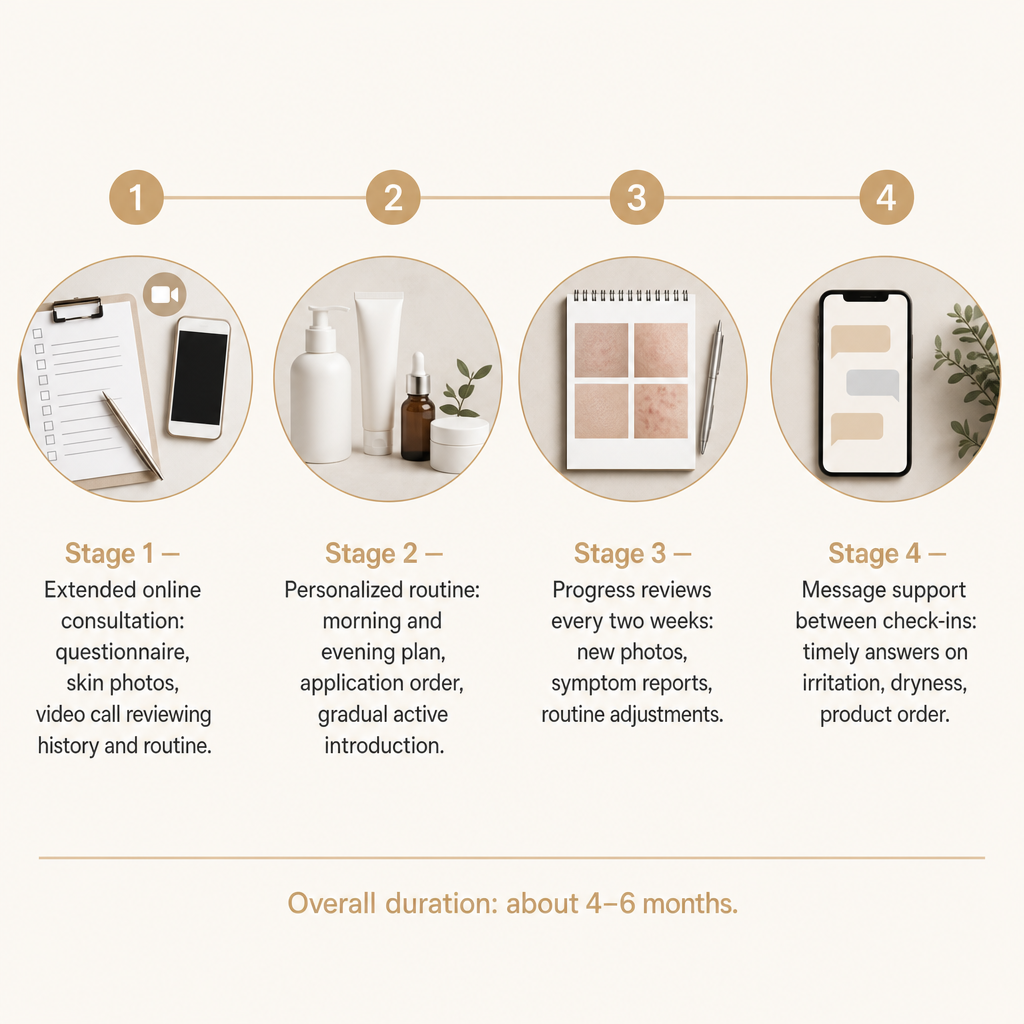
We treat remote consultation as a structured, multi-month support program rather than a single recommendation. Our Virtual ProAcne program is built around four elements: an extended initial consultation and assessment, a detailed routine and introduction plan, progress reviews every two weeks, and message support between those check-ins. Although individual experiences vary, the program typically runs for about four to six months — long enough to introduce active products gradually, observe how your skin responds, and make careful changes when needed.
The extended consultation: building the picture
At the start you complete a questionnaire and provide clear photos of your skin, which let the specialist see current breakouts, redness, scarring, or pigment changes. During the first video call we review your skin history, previous treatments, current routine, lifestyle patterns, and any lab results you choose to share — for example, hormone or nutrient tests your own doctor has ordered.
This conversation helps separate likely triggers and aggravating factors — product misuse, friction, lifestyle patterns — from signs that may need medical evaluation, such as severe painful nodules or systemic symptoms, which we refer back to your local healthcare provider. The aim of this stage is not a guaranteed diagnosis or cure. It is a clear map of what your skin is doing now and which non-medication strategies are most appropriate to try first.
Personalized routine and gradual introduction
After the consultation you receive a morning and evening routine with specific product types, application order, and a schedule for introducing or adjusting actives such as exfoliating acids or retinoids. The structure is deliberate: it reduces trial-and-error experimentation, introduces potent actives slowly to lower the risk of irritation, and aligns skincare with any current medical treatment — for example, tailoring cleansers and moisturizers around topical prescriptions your dermatologist has prescribed.
Remote care is particularly useful at this stage because recommendations rest on both your photos and your own report of how your skin feels over time, rather than a single snapshot in a clinic chair.
Reviews every two weeks and support in between
Progress is formally reviewed every two weeks through a short video call or a structured chat review using new photos and symptom reports. That rhythm is intentional. Reviews focus on changes in breakout pattern, redness, and pigmentation; how your skin tolerates products, including dryness, stinging, or flares; and lifestyle events such as stress, travel, or cycle changes that may correlate with flare-ups. From there the plan is adjusted — changing the frequency of actives, simplifying the routine during irritation, or adding supportive products. The goal is steady, realistic progress, not overnight transformation.
Between scheduled reviews, message support is available for practical questions like dryness, unexpected irritation, or confusion about product order. This ongoing contact is a central advantage of remote care: it allows small, timely corrections that can keep a minor reaction from escalating into a full flare or a reason to abandon the routine. Message support is not emergency care, however. Major dermatology guidance stresses that online services cannot fully replace in-person visits in every situation, especially with severe symptoms, rapidly worsening lesions, or signs of systemic illness, where prompt local medical attention is the right step.
The program is offered as a structured package with defined duration and payment options — described as lasting around four to six months, with the choice to pay monthly or commit to a full six-month package. Current pricing and currency options are published on our Virtual ProAcne page and may be updated over time, so we recommend checking that page directly when budgeting for care.
What the clinical evidence says about remote acne care
Teledermatology has grown because it widens access to specialist expertise while maintaining quality standards. Position statements from dermatology organizations note that appropriate telemedicine use can deliver high-value care by connecting patients to specialists who guide management of chronic skin conditions remotely, as set out in this teledermatology position statement.
For acne specifically, a randomized trial of teledermatology follow-up found that patients with mild-to-moderate acne followed remotely over six months had similar improvement in acne severity compared with those seen in person, while requiring less overall time from patients. A broader review of virtual acne management likewise concluded that remote visits can achieve comparable outcomes to clinic visits on several standard acne grading scales, supporting their use for ongoing care and routine adjustments.
These findings do not mean every individual responds the same way or that remote care is universally appropriate. They support teledermatology for structured follow-up, monitoring, and optimization in suitable cases — exactly the role our Virtual ProAcne program is designed to fill for chronic, non-emergency acne and related concerns.
When remote consultation fits — and when it doesn't
Choosing a remote program is both a clinical and a personal decision. The comparison below can help you judge whether an online path aligns with your current situation.
| Consideration | Remote consultation suits you | In-person visit is more appropriate |
|---|---|---|
| Condition severity | Chronic or hormonal acne, post-acne marks, rosacea, sensitivity, or pigmentation that is stable | Severe painful nodular or cystic acne, or rapidly spreading lesions |
| Treatment preference | Topical skincare and routine design, with or without concurrent prescriptions | Likely need for immediate systemic medication or procedures |
| Warning signs | No systemic symptoms | Fever, weight changes, joint pain, or scarring worsening quickly |
| Diagnostic certainty | Visible, recognizable concern | Suspicious moles or rashes needing physical exam and testing |
| Practical setup | Can take clear, well-lit photos and join video calls privately | Requires hands-on examination |
Dermatology organizations emphasize that telemedicine cannot entirely replace office visits, especially in complex or severe situations, and should be used as one tool within a wider care system. For many people with persistent but non-emergency acne and discoloration, remote consultation offers a practical way to receive expert guidance while keeping everyday life intact. If photos or symptoms point to severe or rapidly worsening disease, we recommend in-person evaluation with a local dermatologist rather than managing serious change online.
Related skin concerns we support remotely
Virtual ProAcne is our flagship program for acne-prone skin, but we offer consultation pathways for several related concerns using the same remote principles: detailed assessment, tailored routine design, gradual introduction of actives, and scheduled reviews that adjust the plan as your skin responds. The emphasis stays on topical care and non-invasive strategies, with clear boundaries when medical or procedural treatment belongs with a local provider.
- Blackheads and whiteheads removal for clearer, smoother skin
- Post-acne and discoloration treatment for post-inflammatory marks and scarring
- Rosacea management to reduce redness and limit flare-ups
- Sensitive skin care for reactive skin types
- Age spots and hyperpigmentation treatment for sun damage and uneven tone
Each pathway follows the same monitored rhythm rather than a single product suggestion, which is what lets us refine the plan every two weeks as your skin changes.
Frequently asked questions
Can remote skincare consultation replace seeing a dermatologist in person?
It can manage many visible conditions, especially mild-to-moderate and chronic acne, by using photos and video for assessment and follow-up. It does not fully replace in-person visits in every situation, particularly for severe, rapidly changing, or diagnostically uncertain problems where a physical examination and tests may be necessary.
What technology do I need for a Virtual ProAcne program?
In most cases, a smartphone or computer with a stable internet connection, a camera that produces clear, well-lit photos, and access to the secure video or chat tools we use. Headphones and a quiet, private space help you discuss sensitive topics comfortably.
How long does the program last, and how are fees structured?
The support program is described as lasting around four to six months, with progress reviews every two weeks and message support in between. Fees are organized into monthly payments and a full six-month package; current amounts and currencies are listed on our Virtual ProAcne page and may be updated over time.
I already take prescription acne medication. Is a remote program still useful?
For many people, remote consultation runs alongside medical treatment to optimize cleansers, moisturizers, sunscreens, and active topicals so they support rather than irritate medicated skin. Any changes are planned around your existing prescriptions, and systemic medication decisions stay between you and your prescribing clinician.
Does this program guarantee my acne will clear within a certain time?
No. Clinical research and real-world experience both show that acne responses differ widely between individuals. Our Virtual ProAcne program aims to provide structured, evidence-informed guidance, reduce trial-and-error, and support you consistently over several months, but it does not guarantee a cure, a fixed timeline, or a single universal treatment path.