





Acne Treatment For Hormonal: Hormonal Acne Treatment: What Actually Works for Adult Breakouts
This article is educational and does not diagnose a condition or replace care from a qualified medical professional.
Adult breakouts along the chin and jawline that flare a few days before your period, resist every drugstore cleanser you try, and heal into stubborn dark marks are rarely a hygiene problem. For many women in their twenties, thirties, and forties, the right acne treatment for hormonal patterns is not a single miracle product but a coordinated plan that combines proven topical actives, sensible lifestyle adjustments, and enough patience to let skin cycle through several months of change. That is exactly the gap Macherre Medical Center is built to fill: a remote, bilingual clinic led by Dr. Maria, a cosmetologist with around five years of experience in acne, rosacea, pigmentation, and sensitive skin, who reviews your photos and history and designs a structured routine instead of leaving you to guess.
This piece explains what genuinely helps adult hormonal acne according to current medical understanding, where systemic medication belongs and why it needs a local doctor, and how Macherre's consultation and ProAcne Program turn that knowledge into a realistic treatment journey you follow with expert feedback rather than alone.
Table of contents
- What "hormonal acne" really means in adults
- What actually works: medical treatments and when they are needed
- How Macherre treats hormonal acne online
- Beyond breakouts: pigmentation, redness, texture, and aging
- Is Macherre right for your hormonal acne
- Frequently asked questions
What "hormonal acne" really means in adults
Hormonal acne is a recognized adult pattern rather than teenage acne that simply overstayed. It tends to concentrate on the lower face: the chin, jawline, and sometimes the neck. The lesions are often deeper and more inflammatory than surface whiteheads, appearing as tender papules or occasional cysts that sit under the skin for days. Many women notice a predictable rhythm, with flares clustering in the week before menstruation and calming afterward.
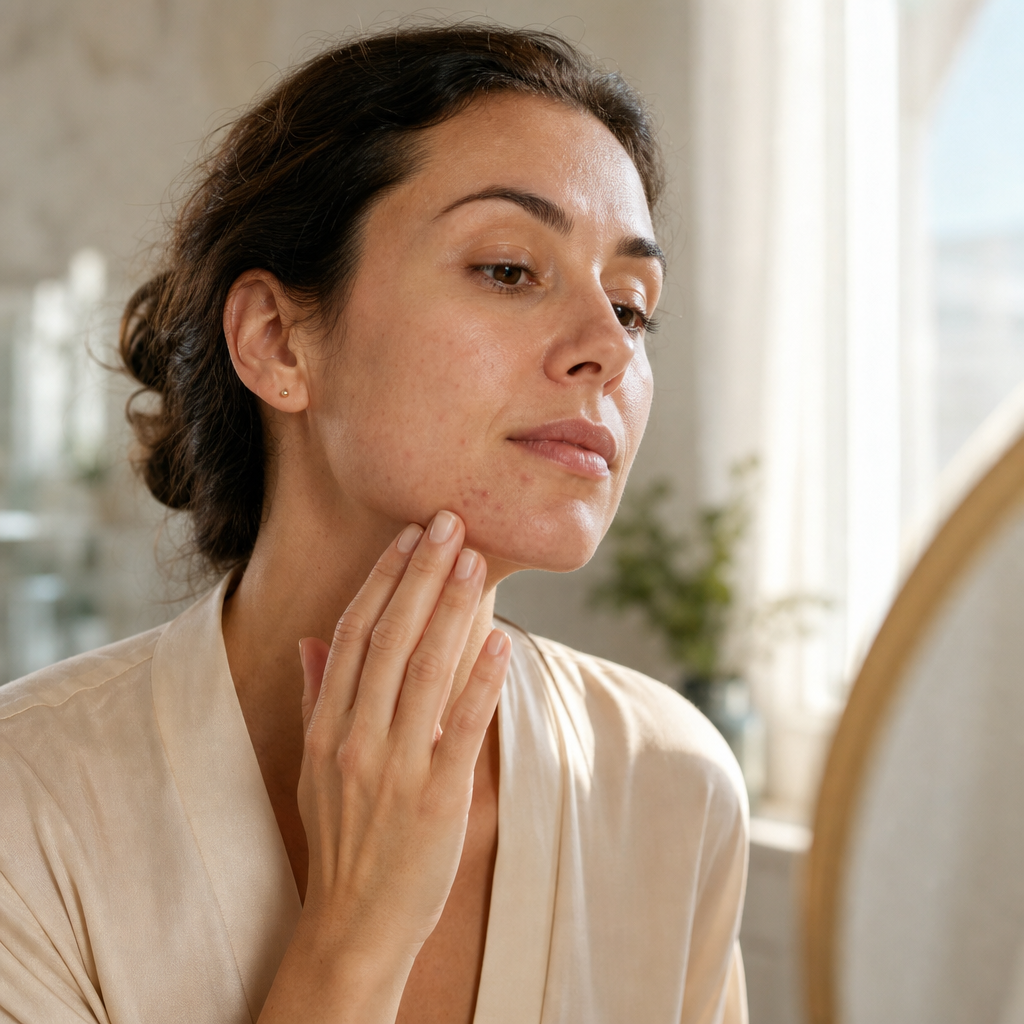
The reason it strikes at these ages is that fluctuating androgen sensitivity influences how much oil the skin produces and how quickly the lining of the follicle sheds. When shed cells and oil block a pore and inflammation follows, a breakout forms. According to Cleveland Clinic's overview, hormonal acne can be driven by these shifts and is commonly managed with a mix of topical and, in some cases, hormone-based approaches depending on severity. What separates adult hormonal acne from adolescent acne is not only location but context: adult skin is frequently drier, more reactive, and already carrying marks or early aging concerns, so aggressive scrubbing and stacking of strong actives tends to backfire.
There is also a diagnostic trap worth naming. Redness and small bumps around the central face can look like acne but behave like rosacea, and the two respond to different care. Persistent flushing, visible vessels, and stinging point away from classic acne. Distinguishing them early matters, because a routine that suits acne can worsen a rosacea-prone barrier. A careful intake that reviews your history and photographs is how that distinction gets made before any product is recommended.
What actually works: medical treatments and when they are needed
Effective treatment for adult hormonal acne is almost always layered, and topical therapy is the near-universal starting point. Cleveland Clinic and multiple dermatology sources describe a familiar set of building blocks: topical retinoids to normalize how the follicle sheds cells, benzoyl peroxide for its antibacterial and anti-inflammatory effect, salicylic acid to keep pores clear, azelaic acid for inflammation and tone, and topical antibiotics in selected cases. These categories form the backbone of first-line care whether the products are prescription strength or thoughtfully chosen over-the-counter formulations.
The practical challenge for most adults is not learning that retinoids exist. It is sequencing them without wrecking the barrier, matching strength to a sensitive adult complexion, and staying consistent long enough to judge results. This is precisely the work that suits a guided remote routine: the active categories are medically standard, but the way they are introduced, spaced, and adjusted is where outcomes are won or lost.
Hormonal therapies occupy a different tier. Clinical guidance on adult female acne notes that hormonal agents such as combined oral contraceptive pills and spironolactone are recommended for specific situations: severe oiliness, clear premenstrual flares, inflammatory acne that resists standard treatment, or when oral contraception is already desired. Reviews indexed on PubMed and guidance from the American Academy of Dermatology identify oral contraceptives and spironolactone as effective options for stubborn, resistant acne in women. These can be genuinely powerful, but they are not products you start on your own.
Systemic hormonal and antibiotic treatments require in-person medical evaluation, appropriate lab testing, and ongoing monitoring by a licensed physician.
The same principle applies to oral antibiotics and to isotretinoin, which sits at the more intensive end for severe or scarring disease. For moderate to severe or scarring cases, in-office procedures such as chemical peels, light or laser therapy, drainage of cysts, and cortisone injections may also be part of a plan. The honest framing is this: Macherre's strength is expert design of topical and lifestyle care and recognizing when a pattern calls for a prescription conversation. When your history shows the hormonal or resistant features described above, the responsible next step is evaluation by a local doctor who can prescribe and monitor those medications safely.
How Macherre treats hormonal acne online
Macherre is a remote-first clinic, and the process is designed so that distance never means guesswork. It begins with an initial comprehensive acne consultation that starts from $95. You complete a detailed form covering your acne history, cycle patterns, current medications, previous products, and lifestyle, then upload clear facial photographs. Dr. Maria uses that information to identify the acne type, whether it leans inflammatory or comedonal, gauge severity, and flag suspected triggers along with co-existing concerns such as pigmentation or sensitivity.
From that analysis comes a personalized plan built around three pillars rather than a single cream. The first is a tailored topical routine: a suitable cleanser, treatment steps using medically standard active categories such as retinoid-containing or acid-based products where appropriate, a moisturizer chosen to protect the barrier, and daily sun protection. The second is nutrition and lifestyle guidance grounded in what dermatology sources consistently recommend, including gentle twice-daily cleansing, non-comedogenic makeup, and attention to sleep, stress, and diet quality. The third is honest triage: if your pattern suggests hormonal evaluation, the plan says so and points you toward a local physician instead of pretending topicals alone will fix everything.
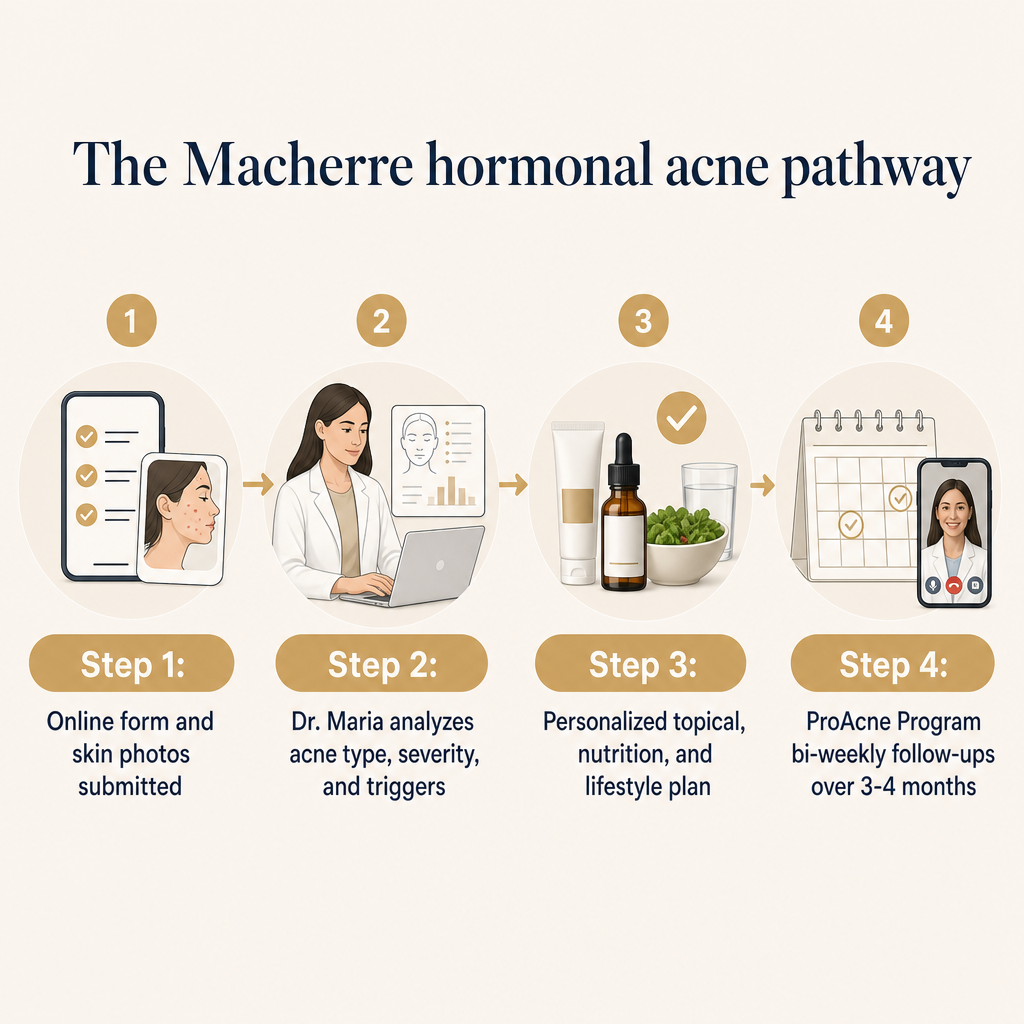
For chronic hormonal patterns, care continues through the signature ProAcne Program. This is a structured course of bi-weekly online follow-ups over three to four months, a timeframe that matches how slowly acne genuinely improves. During those check-ins the routine is adjusted for irritation, dryness, or new flares, and other services are folded in when needed. Macherre reports a 95% success rate for this program; that figure is a first-party clinic claim rather than an independently verified statistic, and it is worth reading in that light. What the structure reliably offers is accountability and expert course-correction, which is often the missing ingredient when adults cycle through products alone.
Because reactive, over-treated skin is common in this group, the plan can be paired with gentle care for sensitive and reactive skin so that actives are introduced without triggering constant stinging or redness. The point of the remote model is not convenience for its own sake. It is continuity: a named expert who sees your progress in real photographs and refines the approach as your skin and hormonal rhythm shift.
Beyond breakouts: pigmentation, redness, texture, and aging
Clearing active lesions is only the first chapter for most adults with a long acne history. The marks left behind often outlast the breakouts themselves, which is why Macherre's portfolio is built to support the whole arc rather than a single flare. Post-inflammatory discoloration is the most frequent complaint: brown or reddish patches where a spot used to be. Treatment for post-acne discoloration and marks addresses that hyperpigmentation and the uneven tone it creates, which is a distinct project from calming the acne.
For women whose long-standing adult acne overlaps with sun-related discoloration, the same team can steer care toward the broader pigment picture, including age spots and diffuse hyperpigmentation, once active breakouts settle. Where chronic breakouts have left small bumps, roughness, or enlarged pores, work on uneven skin texture helps restore smoothness once inflammation is under control. And because many adults are managing acne and early aging at once, a routine can be steered so that retinoid-based care supports both goals, connecting naturally to early signs of aging prevention.
This breadth changes how you should think about the first consultation. You are not booking a one-time fix but starting a relationship with a clinic that can shift focus as your skin settles: from clearing lesions, to fading marks, to protecting tone and texture over the years that follow. That long-term view is what a single product purchase can never provide. It also means the plan you begin for breakouts is not discarded later; it evolves, with the same expert carrying forward everything already learned about how your skin tolerates actives, which triggers matter, and how quickly you respond.
Is Macherre right for your hormonal acne
Macherre suits a specific reader well and is honest about who should look elsewhere first. It is a strong fit if you want expert-guided, non-systemic care as your starting point, are frustrated with self-directed experimentation, and are ready to commit to a three-to-four-month program with bi-weekly adjustments rather than expecting results in a fortnight. It is especially useful if you are hesitant about jumping straight to birth control pills, spironolactone, or isotretinoin and want a considered topical and lifestyle plan first. The bilingual, remote format also removes a real barrier for international and Russian-speaking patients without convenient local cosmetology access.
Use a few concrete decision criteria to judge fit. Choose the guided remote route if your acne is mild to moderate, if you have already tried scattered over-the-counter products without a coherent plan, if you value having a named expert read your progress photos every two weeks, and if you can commit to consistent daily application while tolerance to actives builds. Lean toward booking a local physician first if your breakouts are deeply cystic and scarring, if you notice signs suggesting an endocrine cause, or if a well-run topical regimen has already failed you. Many readers sit between these poles, and in that case starting with a consultation to get a clear read on your pattern is itself the useful step, because it tells you which path you are actually on.
There are also clear signals that you should involve a local physician either before or alongside this care. Severe, deeply cystic acne that is scarring, breakouts accompanied by signs of an underlying endocrine issue, or acne that has already resisted well-run topical treatment are patterns where prescription hormonal therapy or in-office procedures may be indicated. In those cases Macherre's role is to recognize the pattern, guide the conversation you have with your doctor, and continue supporting the skincare and lifestyle side of your plan. Dr. Maria practices as a cosmetologist, and this care centers on topical, nutritional, and lifestyle design rather than prescribing systemic medication.
The practical decision comes down to what you are choosing between. On one side is continued trial and error with over-the-counter products and no feedback. On the other is a named expert reviewing your photos and history, a structured plan using medically standard active categories, and regular check-ins that adjust the approach as you go. If the second describes what you have been missing, an initial consultation is the natural first move.
Frequently asked questions
Do I need blood tests for hormonal acne?
Not for a topical and lifestyle plan. Blood tests and hormonal workups belong to a physician's evaluation, typically considered when there are signs of an underlying endocrine issue or when hormonal medication such as spironolactone or oral contraceptives is being weighed. Macherre's consultation focuses on your skin history, photographs, and patterns; if those suggest a hormonal evaluation is warranted, you will be encouraged to arrange testing with a local doctor who can order and interpret the right panels for your situation.
Can hormonal acne be treated without medication?
Often, yes, particularly for mild to moderate cases. Topical actives such as retinoids, benzoyl peroxide, and acids, combined with gentle cleansing, non-comedogenic products, sun protection, and lifestyle adjustments, are standard first-line care and can meaningfully improve adult hormonal acne. That non-systemic approach is exactly what Macherre designs and adjusts over successive check-ins. Resistant or severe cases may still need prescription therapy from a physician, and part of the value of a structured plan is recognizing early when that threshold has been reached rather than persisting with topicals that are not enough.
How long until I see results?
Realistic improvement takes time. Acne responds slowly, which is why the ProAcne Program runs over three to four months with bi-weekly follow-ups. Early weeks are about establishing tolerance to actives without irritating the barrier, and visible change typically builds over successive cycles rather than days. Consistency across that window matters far more than any single product, and the follow-up structure exists precisely to keep you on track when early progress feels slow and the temptation to quit or switch products is strongest.
What if I am already on birth control?
That is useful context rather than a barrier. If you are already taking an oral contraceptive, your plan can be built around it, focusing on the topical routine, barrier support, and lifestyle factors that complement what your prescription is doing. Any changes to the medication itself remain a decision for the prescribing doctor, but your skincare strategy can be optimized alongside it, and sharing your current medications during intake helps Dr. Maria avoid recommendations that would clash with what you are already taking.
Can I treat acne and aging at the same time?
Yes, and the two goals often overlap. Retinoid-based routines can address both breakouts and early signs of aging, so a plan can be steered to serve both purposes without piling on extra products. Once acne is under control, care can shift toward pigmentation, texture, and aging prevention as a continuous journey rather than separate treatments, which keeps your routine focused and avoids the barrier stress that comes from stacking too many strong actives at once.
Is online treatment enough for severe cystic acne?
Severe, scarring cystic acne usually needs in-person medical management, which may include prescription therapy or procedures such as drainage or cortisone injections that a remote skincare clinic does not perform. In those situations Macherre's role is to recognize the severity, recommend evaluation by a local physician, and support the surrounding skincare and lifestyle plan, including later care for scarring and discoloration once the active disease is controlled. The remote model works best as a complement to that medical care rather than a replacement for it.