





Online Skincare Consultation: How It Works and What to Expect
This article is educational and does not diagnose a condition or replace care from a qualified medical professional.
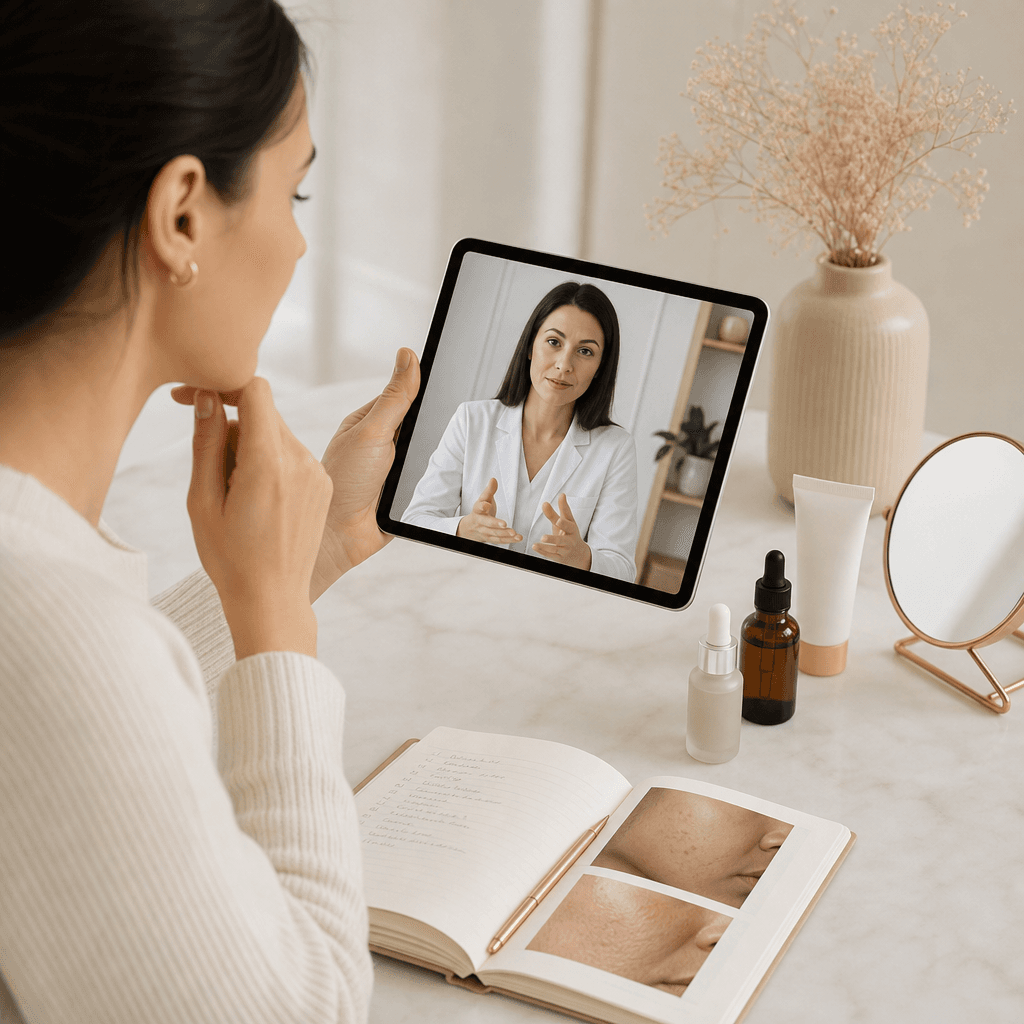
An online skincare consultation lets you get a structured, personalized skin plan without ever sitting in a waiting room, and at Macherre Medical Center it starts with something as simple as a form and a few clear photos of your skin. Instead of guessing which serum might finally calm your breakouts or fade the marks left behind, you submit your concerns and images, and Dr. Maria, a cosmetologist with five years of experience in acne, rosacea, pigmentation, sensitive skin, and early signs of aging, builds a plan around your actual skin. The model is remote-first by design: intake, photo review, a written plan, and regular follow-ups over several months rather than a single rushed appointment.
That structure matters because skin problems like chronic acne, post-acne discoloration, and rosacea rarely resolve in a week. They respond to consistent, adjusted care. Below, you'll see exactly how Macherre's process works step by step, what happens after you receive your plan, how the signature ProAcne Program is paced, and how the same remote pathway handles concerns beyond acne. You'll also find honest notes on where online care fits best and where in-person evaluation still belongs.
Table of contents
- What an online skincare consultation actually is
- The four-step Macherre process, step by step
- Inside the ProAcne Program: pacing and adjustments
- Beyond acne: pigmentation, rosacea, and sensitive skin
- Is online skincare care right for your case
- What it costs and what to expect for your money
- Frequently asked questions
What an online skincare consultation actually is
An online skincare consultation replaces the physical exam with a carefully guided combination of a written intake and photographic assessment. You describe your symptoms, history, current routine, and goals in a form, then upload photos that serve as the visual basis for evaluation. A qualified practitioner reviews everything and returns a tailored plan, then stays involved as you follow it.
This is not a novelty. Independent research supports the approach for the exact concerns Macherre focuses on. A randomized trial published in JAMA Dermatology found that online follow-up visits for mild to moderate acne produced clinical outcomes equivalent to office-based follow-up, with no significant difference in patient or physician satisfaction and meaningful time savings for patients. Broader reviews of teledermatology reach similar conclusions: acne, in particular, is well suited to remote management when images, follow-up, and treatment adjustments are handled properly. You can review the randomized trial on online acne follow-up visits directly if you want the primary source.
Macherre's version of this is deliberately medical in style rather than spa-like. The emphasis is evidence-based cosmetic dermatology: understanding your acne type, barrier tolerance, and pigmentation patterns, then building a plan around topical skincare, nutrition, and lifestyle adjustments. For readers who have been burned by over-the-counter products or who prefer a topical-first, non-medication approach, that framing is the point. The consultation is designed to explain the why behind each recommendation, not simply hand you a product list.
The clinic also serves both English- and Russian-speaking clients, which removes a common barrier for international patients who want careful, nuanced skin guidance in their own language. Precision matters when you are describing how your skin reacts, and being able to communicate clearly is part of getting an accurate plan.
The four-step Macherre process, step by step
Macherre organizes the whole experience into a simple, four-step workflow so you always know what comes next. Each step has a clear job, and none of it requires you to leave home.
Step one: fill out the form. You start by sharing your skin problems and goals through an online intake form. This is where you describe the history that a practitioner cannot see in a photo: how long you've had breakouts, whether they flare with your cycle, which products you've already tried, how your skin reacts to actives, and what a realistic result would look like for you. The more specific you are, the more targeted your plan can be.
Step two: send photos. You take and upload photos of your skin, which become the visual diagnostic foundation. Photo quality directly affects how accurately your skin can be assessed, so it's worth following simple guidance. Teledermatology practice guidelines recommend multiple views at different distances, images captured in good, even lighting, inclusion of the affected area alongside nearby normal skin, and no filters or editing. Following that same principle for your Macherre submission gives Dr. Maria the clearest possible picture of texture, redness, lesion type, and pigmentation.
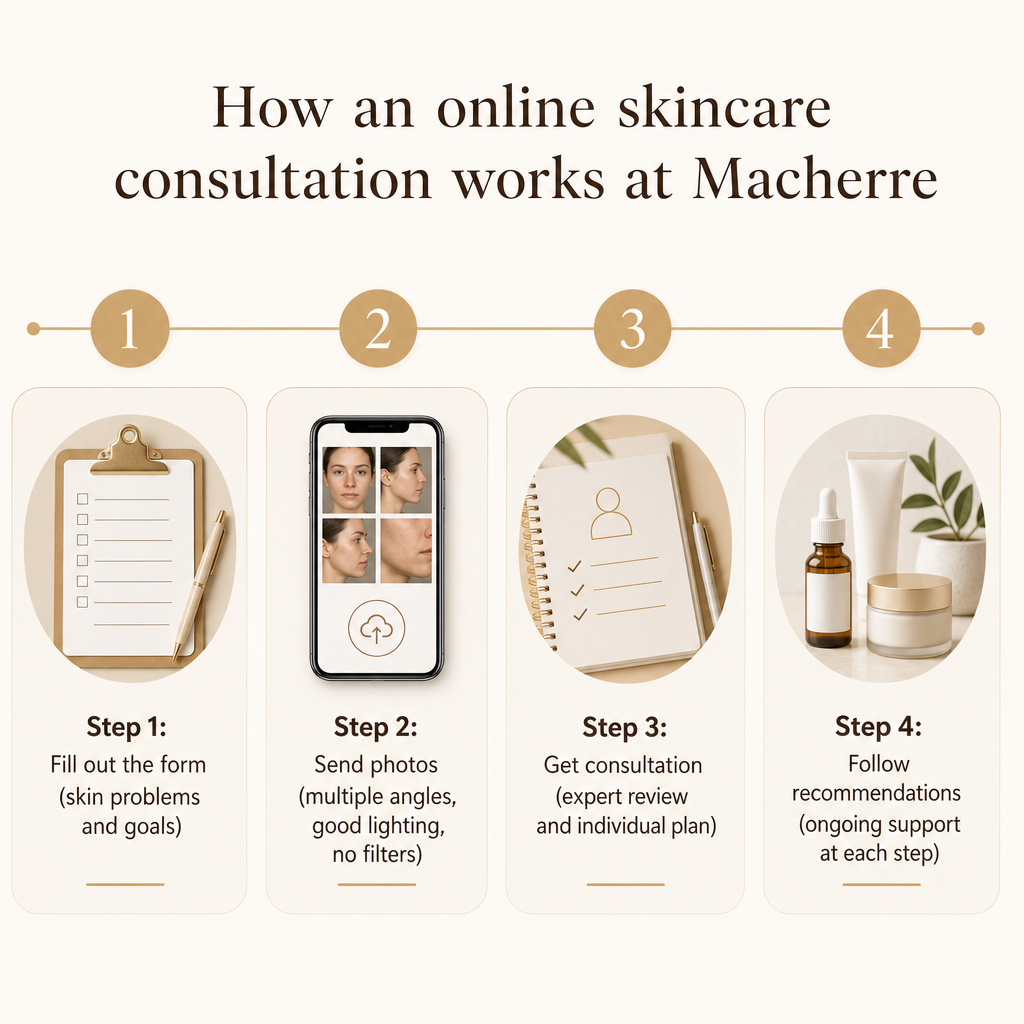
Step three: get consultation. An expert reviews your form and images and develops an individual plan. This is the interpretive core of the service. The review considers your skin type, the kind of acne you have (comedonal, inflammatory, hormonal, or mixed), how well your barrier tolerates active ingredients, and any post-acne marks. The output is a written plan covering a daily routine, product recommendations or constraints, nutrition and lifestyle guidance, and clear cues for when to report back on your progress.
Step four: follow recommendations. The clinic stays with you at each step as you implement the plan. This is where remote care earns its keep. After the consultation, you receive your personalized treatment plan and are typically contacted twice a month over a total course lasting three to four months, depending on your case. Those check-ins exist so the plan can evolve with your skin rather than remaining a static prescription. If you're comparing routes, follow the comprehensive acne treatment consultation as the natural entry point when breakouts are your main concern.
This sequence closely mirrors what independent guidelines describe as good store-and-forward teledermatology: structured intake, high-quality unedited images that become part of a secure record, expert interpretation, and scheduled follow-up to adjust treatment based on real-world response.
Inside the ProAcne Program: pacing and adjustments
For chronic and hormonal acne, Macherre's flagship pathway is the ProAcne Program. It is structured as a course with bi-weekly follow-ups over roughly three to four months, and the clinic reports a 95% success rate for acne treatment. It's important to be clear about that figure: it is the clinic's own internal claim, stated without published methodology, sample size, or defined outcome measures, so treat it as internal experience rather than independently validated data. What can be verified is that the program's shape matches what clinical research associates with good results.
The program is built on a simple but demanding truth about acne: improvement is measured in weeks, not days. Stubborn breakouts and post-acne pigmentation often need around twelve weeks of supervised treatment before you see the full picture, which is why a three-to-four-month course exists rather than a one-time recommendation. Every two weeks, your plan is reviewed and adjusted so that products, usage frequency, and lifestyle advice evolve as your skin responds. If a routine is too aggressive and your barrier is complaining, it gets dialed back. If your skin is tolerating actives well and progress is slow, the plan can be intensified.
This iterative rhythm is exactly why online programs work for acne. External literature on teledermatology repeatedly ties good outcomes to adherence support and regular check-ins, not to a single perfect prescription. One review of teledermatology during the pandemic found telemedicine to be an effective and safe option for acne management that improved adherence and quality of life, with a long-term study where roughly half of patients preferred telemedicine even when in-person visits were available. Bi-weekly contact is the mechanism that keeps you consistent through the awkward middle weeks when it's tempting to quit.
Skin that responds well is skin that is being watched and adjusted, not skin that was handed a routine and left alone.
A few honest caveats belong here. The exact inclusions of the ProAcne Program, such as whether product costs are bundled or billed separately and how many check-ins are guaranteed, are not fully spelled out in public materials, so it's a fair thing to confirm when you enquire. The program is also positioned around topical care, nutrition, and lifestyle rather than centering prescription drugs, which suits people looking for a topical-first approach.
Beyond acne: pigmentation, rosacea, and sensitive skin
The same remote pathway extends well past active breakouts. Macherre maintains dedicated consultation topics so that each concern is approached on its own terms while running through the identical form, photo, plan, and follow-up structure.
Post-acne is a good example of why personalization matters. Fresh breakouts and the marks they leave behind are treated differently even though they arrive together. New inflammatory lesions call for one strategy; lingering discoloration calls for another. The post-acne and discoloration treatment path focuses specifically on post-inflammatory hyperpigmentation and scarring, which typically need patient, long-term care and careful sun-related habits rather than a single fading product.
Rosacea and reactive skin sit at the opposite end of the intensity spectrum. Here the goal is to reduce redness and prevent flare-ups without provoking the barrier, which means gentle, tolerance-first routines rather than aggressive treatment. The rosacea management consultation is designed around exactly that restraint, and the same philosophy carries into care for reactive, easily irritated skin where the priority is calming and protecting before anything else.
Pigmentation and prevention round out the picture. Age spots, sun damage, and other forms of hyperpigmentation are well suited to detailed photo analysis followed by a sustained plan, because uneven tone shifts slowly and needs consistency to change. Early-aging concerns follow the same logic: proactive routines built to preserve skin quality over time. In every one of these tracks, the remote assessment and long-horizon plan are the default, which is precisely why photo quality and honest form answers do so much of the work.
Is online skincare care right for your case
Online consultation is powerful, but it is not universal, and being honest about that builds the trust the service depends on. A few practical criteria help you decide whether the remote path fits your situation.
Condition type and severity. Teledermatology is strongly suited to mild and moderate acne, rosacea, and pigmentary disorders, especially when the concern is visible and chronic. These are the areas Macherre concentrates on. More complex or systemic cases can sometimes be managed remotely under strict medical protocols, but that depends heavily on local regulation and provider scope. Because Macherre's public materials don't detail its role in severe nodulocystic acne or systemic therapy, it's safest not to assume the online program is the right container for those cases without confirming directly. A responsible remote practice triages and routes anything severe or suspicious toward in-person evaluation.
Comfort with photos and digital tools. The entire assessment rests on your images. If you're comfortable photographing your skin clearly, in good light, from multiple angles, without filters, and sharing them securely, remote care works smoothly. Guidelines are unambiguous that image quality is decisive for accurate remote diagnosis, so this is the single most controllable factor on your side.
Willingness to commit over months. Acne and pigmentation reward follow-through. If you expect a quick fix, the medium-term rhythm of a three-to-four-month course with regular check-ins may feel long. If you're ready to be consistent and report back, that same rhythm is exactly what produces results.
Your view on prescriptions versus cosmetic care. Some services lean heavily on prescription medication. Macherre's approach emphasizes topical skincare, nutrition, and lifestyle, which appeals to people who want a non-medication or topical-first strategy. External evidence confirms that lifestyle guidance and adherence support are genuine parts of successful acne management, so this focus is clinically reasonable rather than a compromise.
One more point on safeguards. Sound teledermatology practice treats your images and messages as part of a secure, retrievable record and expects unedited photos. For pigmented lesions specifically, guidelines note that remote care should only replace an in-person exam when the clinician is comfortable doing so. That is a reason to be candid on your intake form about anything unusual, changing, or worrying, so it can be flagged appropriately.
What it costs and what to expect for your money
Macherre lists consultations from $95, positioning the service as premium yet accessible relative to a series of in-person dermatology visits in many markets. The value is not just the assessment itself; it's the structure around it. Your fee initiates a personalized, written plan and a supervised course rather than a single product suggestion, and independent research consistently links this kind of ongoing, adjusted care to strong outcomes.
There are a couple of things worth clarifying when you enquire, because public materials don't fully specify them. It isn't detailed whether every subsequent check-in, product recommendation, or additional service is covered by the initial fee or billed separately, so confirm what your $95 starting point includes for your specific plan. Earlier communications also referenced different pricing at various points, and the current remote model uses the from-$95 figure, so use that as your reference and verify the total scope directly.
It's also useful to know that an online consultation can lead, where appropriate, to recommendations for more advanced in-clinic procedures. The clinic's broader offering references treatments such as chemical peels, LED light therapy, microneedling, and other procedures that are recommended only after consultation. In other words, the remote consultation is the accessible front door; it can escalate into procedural care if your skin genuinely needs it, but it never assumes that from the start.
Where teledermatology consistently wins on value is convenience. Studies report high patient satisfaction with remote visits, largely because they save travel time and fit around real life. When you add the clinic's stated round-the-clock messaging support and bilingual communication, the practical case for starting online is clear for the concerns Macherre handles.
Frequently asked questions
How long until I see results from an online skincare plan?
Expect weeks rather than days. Acne and post-acne pigmentation typically need around twelve weeks of consistent, supervised treatment for meaningful change, which is why Macherre's course runs three to four months with bi-weekly adjustments. Independent research aligns with this timeline for mild to moderate cases.
Are my photos and information kept private?
Sound teledermatology practice treats your images, messages, and the clinician's responses as part of a secure, retrievable record, and recommends that photos not be altered after capture. Following the clinic's guidance for clear, unedited images in good lighting supports both accuracy and appropriate handling of your information.
Is online acne care really as effective as seeing someone in person?
For appropriate cases, the evidence is reassuring. A randomized trial in JAMA Dermatology found online follow-up for mild to moderate acne produced outcomes equivalent to office visits, and broader teledermatology reviews report comparable results when images, follow-up, and adjustments are handled properly. Severe or complex cases may still need in-person evaluation.
What if my skin problem turns out to be too severe for remote care?
Responsible remote practice includes triage. Mild and moderate acne, rosacea, and pigmentation are well suited to online management, while severe, systemic, or suspicious concerns should be routed toward in-person care. Because Macherre's materials don't detail its role in severe cases, confirm suitability directly if your condition is advanced.
Does the plan rely on prescription medication?
Macherre's approach emphasizes topical skincare, nutrition, and lifestyle changes, which suits clients seeking a non-medication or topical-first strategy. External evidence confirms that adherence and lifestyle support are genuine parts of successful acne management, so this focus is clinically grounded.
What exactly do I do to get started?
Complete the online intake form describing your symptoms, history, current routine, and goals, then prepare and upload clear photos from several angles in good lighting with no filters. From there, you receive an individual plan and begin the follow-up schedule that keeps it adjusted to your skin.
If your skin has been unresponsive to guesswork, the most useful next move is straightforward: complete the consultation form and prepare your photos. That first step from $95 doesn't buy a one-off product tip; it opens a structured, supervised plan built for your skin, with regular check-ins to keep it working over the months that real change actually takes.