





Online Skincare Consultation: How Expert Skin Care Works From Home
This article is educational and does not diagnose a condition or replace care from a qualified medical professional.
You have tried the serums that promised to clear your skin in two weeks, cycled through cleansers your friends swore by, and still catch yourself covering the same jawline breakouts or the dark marks they leave behind. When over-the-counter routines keep missing, the problem usually is not willpower or the number of products on your shelf. It is the absence of someone trained to read your specific skin and adjust the plan as it responds. An online skincare consultation closes that gap by putting a qualified practitioner in your corner without asking you to travel to a clinic. At Macherre Medical Center, that is not a bolt-on feature. The clinic was built from the ground up as a remote-first practice, led by Dr. Maria, a cosmetologist with five years of experience in acne, rosacea, pigmentation, sensitive skin, and early signs of aging.
This article walks through what expert skincare from home actually involves, how Macherre structures its process, and how to judge whether a remote consultation fits your concern.
Table of contents
- What online skincare consultation really means today
- Inside Macherre Medical Center's remote-first model
- How your consultation works, step by step
- The ProAcne Program for chronic and hormonal acne
- Remote care for rosacea, pigmentation, and sensitive skin
- Is online skincare consultation right for you?
- Frequently asked questions
What online skincare consultation really means today
Getting expert help for acne, rosacea, or stubborn discoloration no longer requires a waiting room. Over the past few years, virtual skincare and teledermatology have moved firmly into the mainstream. Editorial coverage of the field, including Harper's Bazaar's roundup of online dermatologist services, describes established platforms handling concerns such as acute acne, rosacea, and dermatitis entirely online, with prices commonly ranging from roughly £40 to £150 per consultation or as part of a monthly plan.
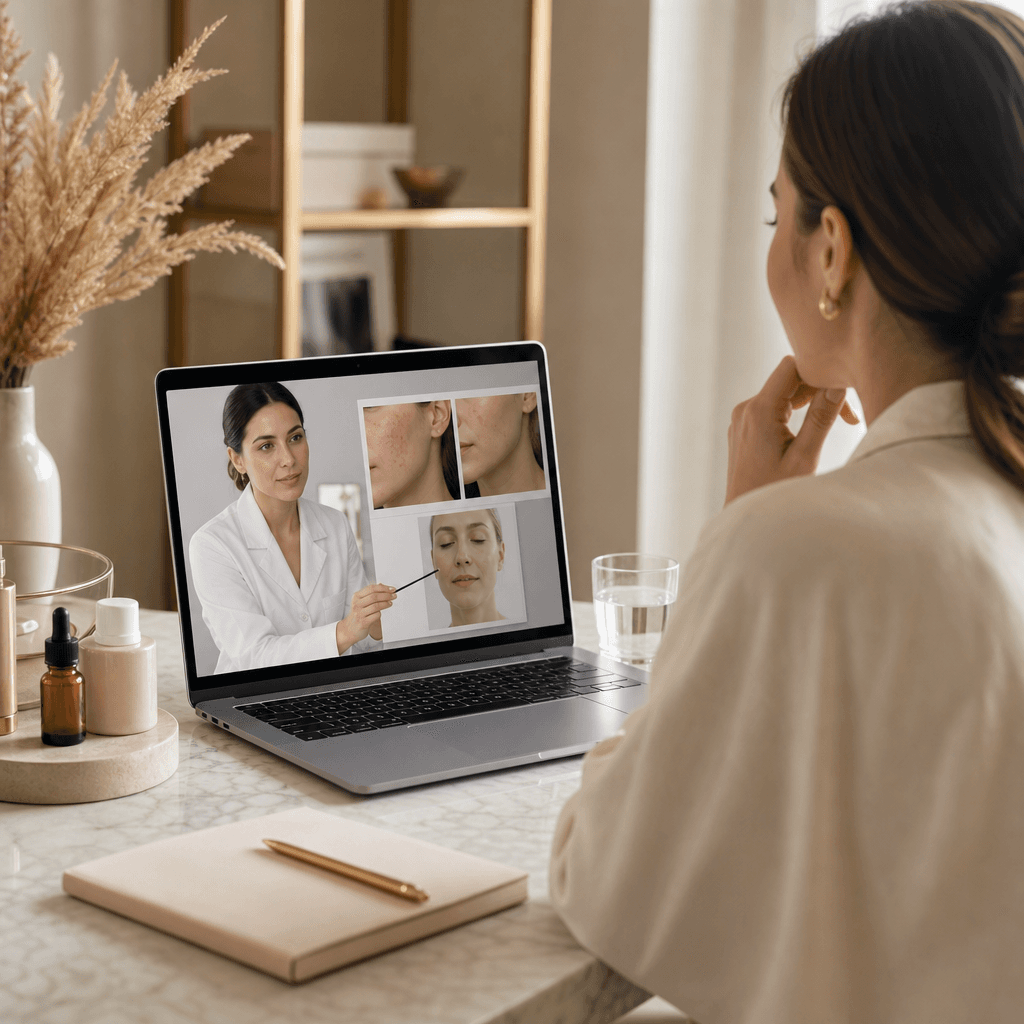
The format varies, but the core idea is consistent. A structured virtual skincare consultation typically involves a session of around 20 to 60 minutes, a personalized plan, and ongoing access for follow-up questions. Practitioners assess your skin, review your current routine, and recommend a path forward without you leaving home. Professional bodies in the field note that video or online consultations let trained skincare specialists evaluate skin condition, examine existing routines, and guide product choices remotely while keeping the client relationship intact.
What makes this work is not the technology on its own but the combination of good information and expert interpretation. A clear intake form captures your history, a set of well-lit photos captures your skin, and a specialist connects the two into a plan. That is the same logic behind a good in-person visit, minus the travel and the scheduling friction. For chronic conditions like acne, rosacea, and non-urgent pigmentation, this remote pathway is well suited, because these concerns are managed over weeks and months rather than resolved in a single appointment.
Inside Macherre Medical Center's remote-first model
Macherre Medical Center is an online skincare consultation clinic, not a physical practice that added telehealth as a convenience. That distinction shapes everything about how care is delivered. Every step, from your first form to your final follow-up, is designed to happen through your phone or laptop.
Care is led by Dr. Maria, a cosmetologist with five years of experience. Her focus areas map directly onto the concerns that bring most people to virtual skincare: chronic and hormonal acne, rosacea, pigmentation and post-acne discoloration, sensitive skin, and early signs of aging. Rather than spreading across every procedure imaginable, the clinic concentrates on the concerns where a topical and lifestyle-driven approach can do the most consistent work.
Three things distinguish the Macherre approach. First, it leans toward non-medication and topical-first strategies, which appeals to people who are wary of jumping straight to systemic treatment. Second, plans go beyond product lists to include nutrition and lifestyle guidance, addressing the sleep, stress, and dietary factors that feed inflammation and breakouts. Many product-focused platforms stop at curation, while Macherre treats the routine as one piece of a wider picture. Third, the clinic operates in both English and Russian, with a dual-language website and consultations, which matters for Russian-speaking and international clients who want to describe their skin in their own language.
Consultations start from $95. That figure sits comfortably within the normal range for professional online skin care, where teledermatology and virtual consults commonly begin around that price point. The positioning is deliberate: premium enough to reflect genuine expert time, accessible enough to serve people who have been let down by cheaper, generic fixes.
How your consultation works, step by step
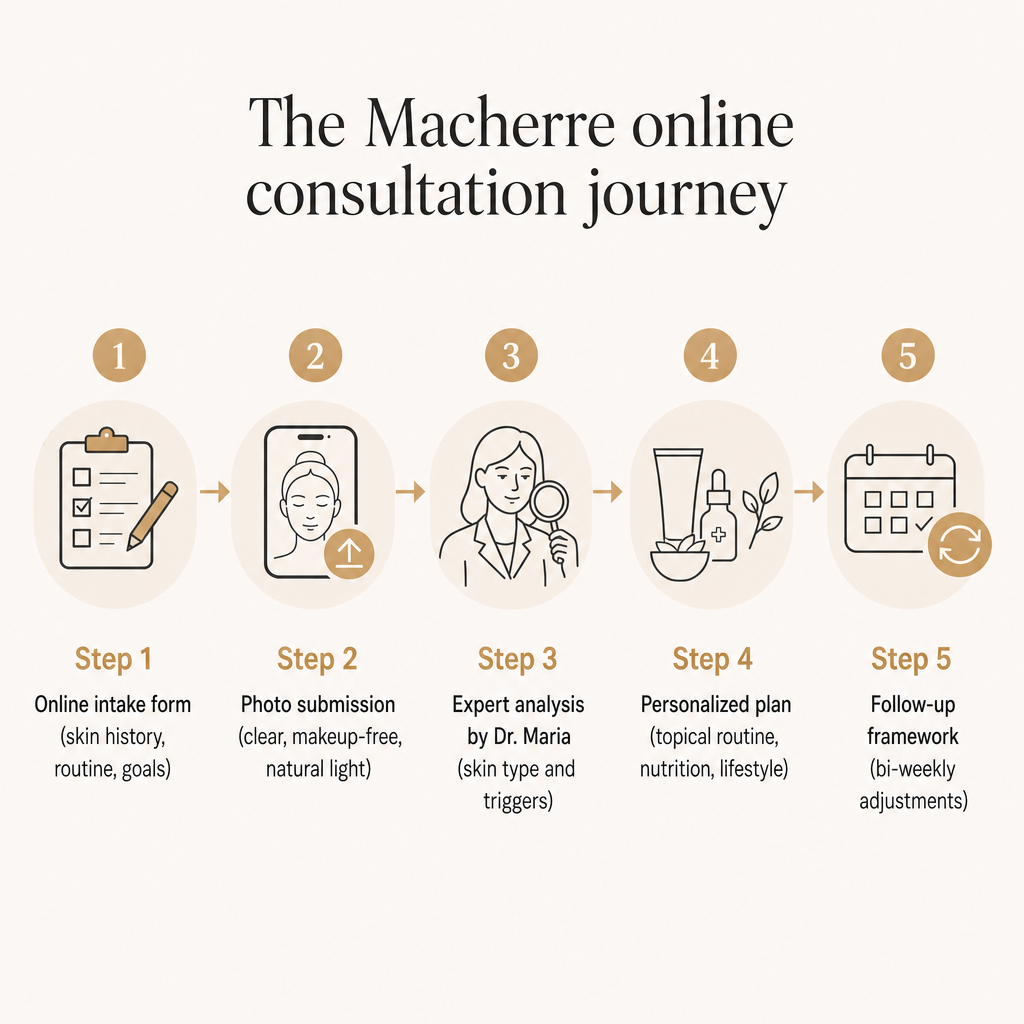
The process is built to give Dr. Maria a complete picture of your skin before she designs anything. It follows a sequence that mirrors best practice across virtual skincare while adding Macherre's own structure.
Step one is the online intake. You complete a detailed form covering your skin history, current routine, lifestyle, triggers, and goals. This is where you record how breakouts behave across your cycle, which products you have already tried, past reactions, and the outcomes that matter most to you. The quality of this form directly shapes the quality of the plan, so specificity helps.
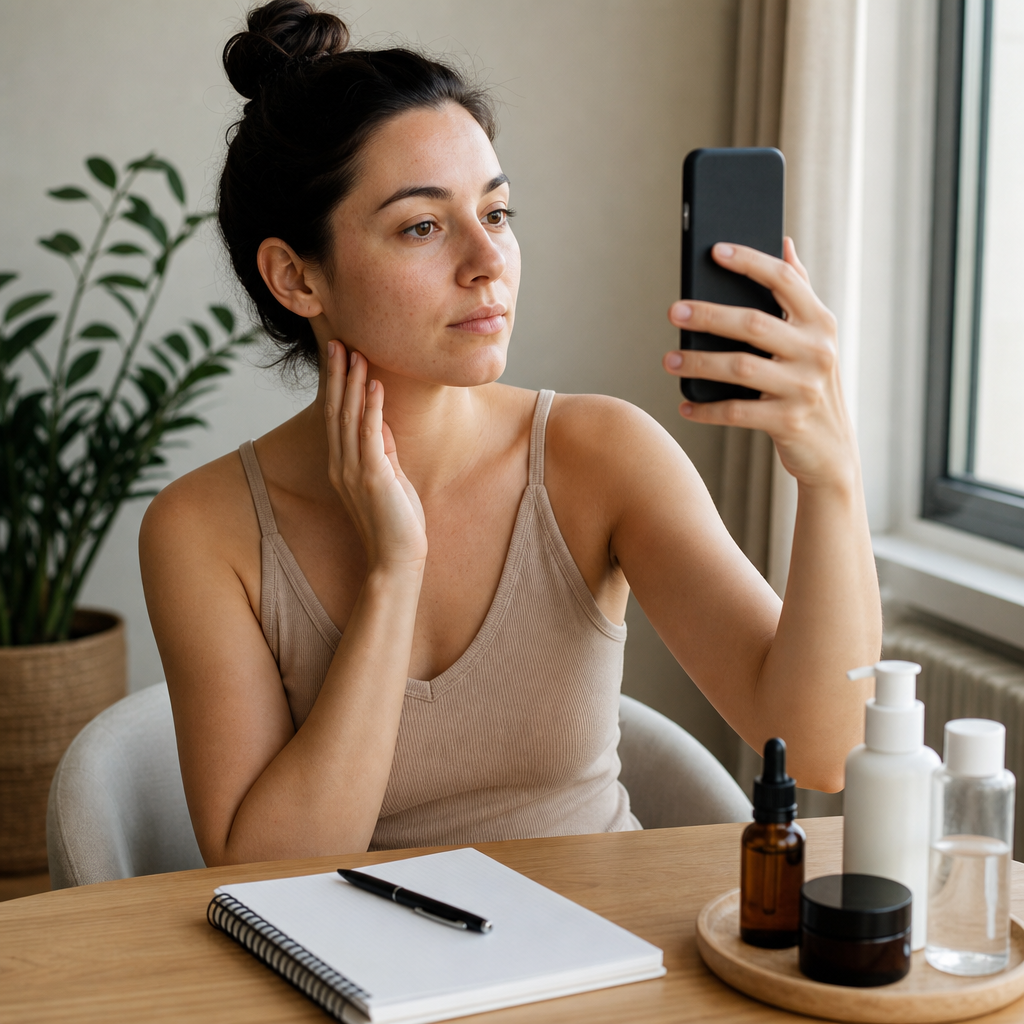
Step two is photo submission. From home, you upload clear skin photos taken in good, natural light and without makeup. This is standard for serious virtual skincare assessment, because good images let a practitioner see texture, tone, active lesions, and patterns of redness or pigmentation that a form alone cannot convey.
Step three is expert analysis. Dr. Maria reviews your form and images together, identifies your skin type, and works out the pattern behind your concern, whether that is hormonal jawline acne, a rosacea presentation, or the difference between active inflammation and the discoloration it leaves behind. Reading these patterns correctly is what separates a tailored plan from a generic one.
Step four is your personalized plan. This has three layers. A topical routine sets out cleansers, active ingredients, moisturizers, and sun protection, calibrated to your sensitivity so your skin can tolerate the plan rather than react to it. Nutrition guidance targets the dietary factors linked to inflammation and breakouts. Lifestyle advice addresses sleep, stress, environment, and daily habits that quietly influence your skin. If you want to understand which concern each part of your plan is built around, the clinic's dedicated pages, such as acne treatment, lay out the focus of each stream.
Step five is the follow-up framework. Skin does not change on a fixed schedule, so plans need adjustment. For acne and similar chronic concerns, this structured follow-up takes the form of the ProAcne Program, with regular check-ins over several months. As your skin responds, actives are dialed up or down and the routine is refined. This ongoing contact is one of the strongest predictors of a good outcome in remote skincare, because it lets a specialist course-correct before small problems derail progress.
The ProAcne Program for chronic and hormonal acne
For people whose acne is persistent or hormonally driven, a single consultation rarely holds. Skin shifts across weeks, actives need to be introduced gradually, and the early phase often looks worse before it looks better. The ProAcne Program is Macherre's answer to that reality: a structured course rather than a one-off visit.
The program runs over three to four months with bi-weekly follow-ups, roughly every two weeks. That rhythm exists for a reason. Effective acne routines usually start conservatively and build, so the strength and frequency of actives can be raised only as your skin proves it can tolerate them. Regular check-ins let Dr. Maria manage that progression carefully, easing you through purge phases where breakouts temporarily increase, and pushing forward again when a plateau sets in. Instead of guessing on your own whether a flare means the plan is failing or simply working, you have a specialist interpreting each stage.
The accountability matters as much as the adjustments. Knowing that someone will review your progress in two weeks keeps a routine consistent, and consistency is where most home skincare efforts quietly fall apart. The program also keeps nutrition and lifestyle in the frame, so dietary and stress-related triggers are addressed alongside the topical work rather than treated as an afterthought.
Macherre reports a 95% success rate for the ProAcne Program. This is a clinic-reported figure from its own client outcomes, not a published clinical-trial result, so it is best read as a reflection of the clinic's internal experience rather than an independently verified statistic. If precise outcome definitions matter to your decision, ask the clinic directly what the figure measures. What the program structure reliably offers, regardless of the headline number, is sustained expert oversight through the months when acne is most likely to test your patience.
Remote care for rosacea, pigmentation, and sensitive skin
Acne is Macherre's most developed program, but the same remote methodology extends across the clinic's other specialties. The underlying logic does not change: intake, photos, expert reading of the pattern, a calibrated plan, and follow-up as your skin responds.
Rosacea is a good example of why careful remote management helps. It flares in response to specific triggers, and progress depends on reducing redness while avoiding products that provoke it. The clinic's rosacea management stream is built around exactly this balance, introducing anti-redness support gradually and adjusting for seasonal or lifestyle triggers like sun exposure and stress.
Pigmentation needs a different kind of precision. There is a meaningful difference between the discoloration left after a breakout and other forms of pigmentation, and the plan changes accordingly. Macherre separates these concerns into dedicated streams so the approach fits the cause, whether that is post-acne and discoloration treatment for marks left by inflammation or a targeted plan for age spots and hyperpigmentation from sun damage and other sources. Brightening actives are introduced as your skin tolerates them, which is safer to manage with regular check-ins than to attempt alone.
Sensitive and reactive skin threads through all of this. When your skin overreacts easily, the sequencing and strength of actives become the whole game, and a plan that ignores that will simply cause irritation. The clinic's sensitive skin care approach keeps tolerance at the center, which also protects the acne, rosacea, and pigmentation plans for anyone whose concerns overlap. In practice, many people arrive with more than one issue at once, and the personalized structure is designed to account for those interactions rather than treat each concern in isolation.
Is online skincare consultation right for you?
Remote care fits some situations better than others, and being honest about that helps you get value from it. It suits you well if you are dealing with chronic or hormonal acne after OTC routines have stopped working, if you have pigmentation, post-acne discoloration, or rosacea that needs patient management, or if you prefer a topical and lifestyle-led approach over jumping to systemic medication. It also suits Russian-speaking and international clients who want expert cosmetology guidance in English or Russian without hunting for a local specialist who speaks their language.
The practical advantages are straightforward. There is no travel and no waiting room; everything runs through your phone or laptop. The clinic's specializations line up closely with the concerns that virtual skincare handles most often, so you are matched with relevant expertise rather than a generalist. And the program model, rather than a single appointment, gives you the ongoing contact that tends to improve results, because someone stays with your progress instead of sending you off with a routine and no feedback loop.
There are limits worth respecting. Online consultation is designed for non-urgent, chronic concerns. Anything that is rapidly worsening, a suspicious lesion, a severe skin infection, or a condition that needs hands-on or emergency evaluation belongs with an in-person practitioner. Editorial coverage of the field consistently makes the same point: virtual services are appropriate for non-emergency conditions, and serious or acute issues still require face-to-face assessment. A responsible remote clinic works within that boundary rather than promising to solve everything from a distance.
If your concern is chronic acne, persistent discoloration, rosacea, or sensitivity that has not responded to what you have tried, the sensible next step is to choose the concern that best describes your skin, complete the intake form, and upload your photos so Dr. Maria can build a plan around your actual skin rather than a template.
Frequently asked questions
How long does it take to see results from an online consultation?
Skin responds gradually, especially with acne, rosacea, and pigmentation, which are managed over weeks and months rather than days. That is why the ProAcne Program runs across three to four months with regular check-ins, and why plans are adjusted as your skin responds. Expect steady progress with course corrections along the way rather than an overnight change.
What kind of photos should I submit?
Clear, makeup-free photos taken in good natural light. This is standard for virtual skincare assessment because it lets Dr. Maria see texture, tone, active breakouts, and areas of redness or discoloration accurately. Better images lead to a more precise reading of your skin and a better-calibrated plan.
How do the follow-ups work?
For acne and similar chronic concerns, the ProAcne Program provides bi-weekly follow-ups, roughly every two weeks, over the three-to-four-month course. At each check-in, your progress is reviewed and your routine is adjusted, easing you through purge phases and pushing forward through plateaus. The same review logic of tracking photos, symptom changes, and triggers applies to rosacea, pigmentation, and sensitivity plans.
Does Macherre offer consultations in Russian?
Yes. Macherre serves both English and Russian-speaking clients, with a dual-language website and consultations, which is one reason it works well for international and Russian-speaking clients who want to describe their skin in their own language.
How much does a consultation cost?
Consultations start from $95. That figure sits within the normal range for professional online skin care, where teledermatology and virtual consults commonly begin around that price, positioning Macherre as a premium but accessible alternative to in-person visits.
When should I see someone in person instead?
Online consultation is best for chronic, non-urgent concerns such as acne, rosacea, non-urgent pigmentation, and sensitivity. Anything rapidly worsening, a suspicious lesion, a severe infection, or a condition needing emergency or hands-on evaluation should be seen in person. If you are unsure whether your concern fits remote care, it is reasonable to ask the clinic before starting.