





Clear Skin: How to Achieve Clear Skin: A Cosmetologist's Complete Roadmap
This article is educational and does not diagnose a condition or replace care from a qualified medical professional.
Clear skin is a stable, well-functioning skin state: breakouts under control, inflammation calmed, tone reasonably even, texture smooth, and the barrier intact. It is not poreless perfection and it is not a single product. It develops over months of consistent, condition-specific care — which is exactly what our remote cosmetology roadmap at Macherre Medical Center is built to deliver.
Dr. Maria, our cosmetologist with five years of focused experience in acne, rosacea, pigmentation, sensitive skin, and early signs of aging, works from a simple premise: skin does not respond to enthusiasm, it responds to accuracy and repetition. Below we explain what clear skin actually means biologically, which distinct problems hide under that phrase, and how we decide which path a person belongs on before a single product is recommended.
Table of contents
- What clear skin actually means, and how it works
- The layers of clear skin: distinct concerns, distinct paths
- Why guided care outperforms trial and error
- What to weigh before starting a clear-skin roadmap
- Where you likely fit in our consultation map
- Frequently Asked Questions
What clear skin actually means, and how it works
The phrase hides several separate biological stories. Understanding which one is playing out on your face is the difference between a plan that works and eighteen months of product rotation.
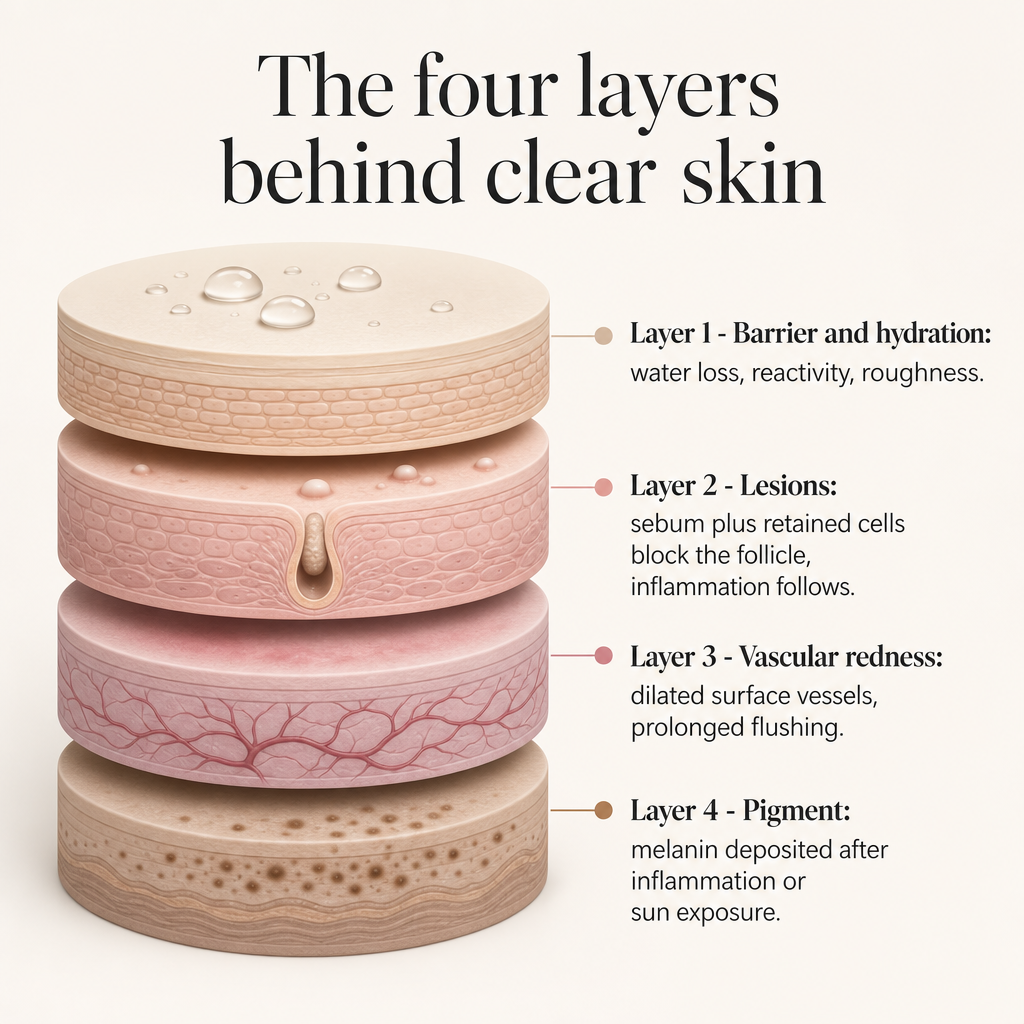
Acne lesions begin inside the follicle. Sebum production combines with retained dead cells, the pore becomes blocked, and the resulting environment favours bacterial overgrowth and inflammation. Whether that surfaces as a closed comedone, an open blackhead, or a deep inflamed papule depends on how blocked the follicle is and how strongly the immune system reacts.
Rosacea-type redness is a vascular and inflammatory pattern, not a clogging problem. Blood vessels near the surface dilate readily, flushing lasts longer than it should, and over time visible redness can become semi-permanent. Treating it like acne — with strong drying actives and vigorous cleansing — usually makes it worse.
Pigmentation is melanin behaving disproportionately. After an inflamed spot resolves, pigment cells often keep depositing colour into the healed area, which is why a face can have zero active breakouts and still look far from clear. Sun exposure and time produce a related but separate pattern in age spots and diffuse sun damage.
Barrier dysfunction underlies almost everything else. When the outer layer loses water faster than it retains it, skin becomes reactive, rough, dull, and less tolerant of the very ingredients that would treat the original concern. Independent health guidance is consistent on this point: gentle cleansing, appropriate moisturising, and products matched to skin type are foundational rather than optional, and harsh scrubbing or over-washing tends to aggravate the problem. Both Medical News Today's overview of clear skin strategies and Healthline's evidence-based acne guidance also make the timeline plain: there is no instant route, and results come from sustained daily habits.
That timeline is not a disclaimer, it is the mechanism. Skin cells turn over on their own schedule, inflammation subsides gradually, and pigment fades slowly. A plan that expects results in ten days is fighting biology.
The layers of clear skin: distinct concerns, distinct paths
When someone tells us they want clear skin, our first job is translation. The same sentence can describe nine different clinical pictures, and we structure our consultations accordingly.
Active inflammatory acne. Papules, pustules, cysts, recurring in predictable zones or flaring with hormonal cycles. This is the territory our acne treatment consultation addresses, where the priority is identifying the driver — hormonal, occlusive, dietary, product-induced — before selecting actives.
Comedonal congestion. Blackheads across the nose and chin, closed bumps under the surface, skin that feels grainy in good light. There may be almost no inflammation at all. The work here is decongestion and prevention rather than anti-inflammatory treatment, and it is handled through our blackheads and whiteheads pathway.
Post-acne marks. Brown or red patches where spots used to be, sometimes accompanied by shallow scarring. Many people arriving here have already solved their acne and are frustrated that their skin still does not read as clear. This belongs to our post-acne and discoloration consultation.
Sun-related and age-related pigmentation. Diffuse unevenness, discrete darker patches, a general loss of tonal uniformity that predates or outlives any acne history — the focus of our age spots and hyperpigmentation pathway.
Alongside these sit four further paths that are easy to misclassify. Rosacea management targets persistent redness and flare-up prevention. Sensitive skin care rebuilds tolerance in reactive skin that stings at everything. Skin texture work addresses roughness and unevenness that is not primarily about breakouts. Dehydrated and dry skin solutions restore moisture balance where tightness and dullness dominate. Early signs of aging prevention treats fine lines, dullness, and initial texture shifts proactively rather than reactively.
| Concern pattern | What you mainly see | What the plan prioritises |
|---|---|---|
| Inflammatory acne | Painful, recurring spots | Identifying the cause, then targeted actives |
| Comedonal congestion | Blackheads, bumpy texture | Decongestion and prevention |
| Post-acne marks | Colour left after healing | Pigment management, sun protection |
| Rosacea-type redness | Flushing, persistent redness | Calming, trigger control |
| Reactive or dehydrated skin | Stinging, tightness, dullness | Barrier repair before actives |
Most real faces present a combination. A person with hormonal acne frequently also has post-inflammatory marks and a compromised barrier from previous over-treatment. Sequencing those three problems correctly — which to treat first, which to protect, which to postpone — is the part that trial and error rarely gets right.
Why guided care outperforms trial and error
Self-treatment fails in reasonably predictable ways, and independent sources document the same patterns we see in consultation photographs.
Over-washing and harsh scrubs strip the barrier, which increases irritation and can worsen the inflammation they were meant to reduce. Picking and squeezing raises infection risk and makes scarring more likely. Excessive exfoliation, often stacked from several products at once, produces a face that is simultaneously oily, flaking, and stinging. Product hopping — abandoning a formulation after three weeks because nothing visible has happened — means no active ever gets the run it needs to work.
There is also a diagnostic problem. Redness treated as acne, dehydration treated as oiliness, and fungal-pattern bumps treated as bacterial acne all lead somewhere unproductive. Neutral medical guidance repeatedly recommends professional input when skin problems are persistent, scarring, or affecting quality of life, precisely because the correction is usually in the assessment rather than the shelf.
Our model addresses this remotely. Clients complete a detailed intake form and submit standardised skin photographs, which lets Dr. Maria assess lesion type and distribution, skin type and sensitivity, the current routine, and the lifestyle factors surrounding it. The output is a written personalised plan covering topical skincare, nutrition, and lifestyle adjustments together, rather than a product list handed over in isolation.
Skin does not need more products. It needs the right few, used long enough, in the right order, for the right diagnosis.
For chronic and hormonal acne, our ProAcne Program adds the element that most self-directed attempts lack entirely: structure over time. It runs as a three to four month course with bi-weekly follow-ups, which exist so actives can be adjusted as tolerance builds, so early irritation does not end the plan prematurely, and so adherence has a checkpoint rather than relying on willpower alone. Across our own client experience with the program, we report a 95% success rate — our internal outcome observation rather than published trial data, and we describe it that way deliberately.
The follow-up rhythm matters for a structural reason. Purging, initial dryness, and slow-fading marks are all normal phases that feel like failure from the inside. Someone reviewing your photographs every two weeks can tell the difference between a plan that needs patience and a plan that needs changing.
What to weigh before starting a clear-skin roadmap
Before committing, it is worth being honest with yourself about four things.
Which concern actually bothers you most. People often describe acne when the thing they photograph and study in the mirror is discoloration. Naming the primary concern determines the path, and the paths differ meaningfully in method and timeline.
Your appetite for a medication-free approach. We work primarily through topical care, nutrition, and lifestyle adjustment, which suits clients who prefer to avoid systemic drugs or who want to try a structured non-medication route first. This is a genuine fork in the road, not a marketing preference — decisions about oral medication belong with a prescribing physician in your own jurisdiction, and nothing here replaces that conversation.
Your tolerance for routine and timeline. A clear-skin plan asks for daily consistency across several months, with lifestyle components attached: sleep, stress load, glycaemic patterns in the diet. Independent guidance links these factors to inflammatory load and skin outcomes, and our plans treat them as part of the treatment rather than as decoration. If the honest answer is that you want a cream and no behavioural change, results will be limited and it is better to know that now.
Whether remote assessment suits your case. Photograph-based consultation works well for the great majority of acne, congestion, pigmentation, texture, and sensitivity presentations. Where signs suggest something outside cosmetology's scope — severe cystic disease with scarring, sudden unexplained changes, or a lesion that looks clinically suspicious — the correct answer is in-person medical evaluation, and we will say so rather than start a plan.
One more consideration is language and access. We consult in English and Russian, which removes a practical barrier for international clients who want detailed skin guidance in their own language rather than a translated approximation of it.
Where you likely fit in our consultation map
Read the description that sounds most like your face in the mirror this morning.
If breakouts are active and recurring, with or without a hormonal pattern, the acne pathway is your entry point, and the ProAcne Program is the structured version of it for chronic cases. If your breakouts have settled but the marks have not, the post-acne and discoloration pathway is the right start. If the dominant feature is redness, flushing, and sensitivity to heat, alcohol, or temperature swings rather than spots, our rosacea management consultation fits better. If pigmentation is diffuse, sun-associated, or has accumulated over years, the age spots and hyperpigmentation pathway targets it directly.
When two of those descriptions apply, choose the one causing you the most distress and mention the other in your intake form. Combination pictures are ordinary, and the plan we write will sequence them rather than treating one and ignoring the rest.
What happens next on your side is short: a form, a set of clear photographs taken in consistent lighting, and an honest account of what you have already tried. What happens on ours takes longer — assessment, plan construction, and then the months of adjustment that turn a plan into a result. If you would rather talk it through before choosing a pathway, describe your concern, its history, and what you have used so far, and we will point you to the right consultation.
Frequently Asked Questions
How long does it realistically take to see clearer skin?
Meaningful change is measured in months, not weeks. Independent health guidance is unanimous that no instant route to clear skin exists, and our own program structure reflects that: the ProAcne course runs three to four months with bi-weekly follow-ups. Early signs — fewer new lesions, less inflammation, better tolerance — often appear before the visible tone and texture catch up. Pigmentation is typically the slowest layer to resolve.
Can I achieve clear skin without oral medication?
Many people can, and our model is built around topical care, nutrition, and lifestyle change for exactly that reason. Whether a non-medication route is sufficient depends on severity, scarring risk, and how your skin responds over the first weeks of a structured plan. If your presentation calls for medical treatment beyond cosmetology's scope, we will tell you rather than continue. Any decision about prescription therapy belongs with a physician licensed where you live.
What if I have both acne and pigmentation?
This is one of the most common combinations we see, because inflammation is what generates post-inflammatory pigment in the first place. The two are treated in relation to each other: calming active lesions reduces the production of new marks, while pigment management and sun protection address the existing ones. Trying to attack both aggressively at the same time usually irritates the barrier and prolongs everything.
Is a remote consultation enough for severe cases?
Photograph-based assessment covers most acne, congestion, pigmentation, texture, and sensitivity presentations well, provided the images are clear and the history is complete. For severe cystic acne with active scarring, rapid unexplained changes, or anything that looks clinically suspicious, in-person medical examination is the appropriate route. We would rather redirect you than start a plan that cannot address what you actually have.
Do I have to change my diet to see results?
Nutrition guidance is part of every plan we write because diet, sleep, and stress influence inflammatory load, and independent sources connect factors such as high sugar intake, poor sleep, and stress with harder-to-control acne. The adjustments we suggest are targeted to your intake responses rather than being a generic elimination diet. Clients who engage with the lifestyle component generally get further than those who treat it as optional.
Why do bi-weekly follow-ups matter so much?
Because the middle of a treatment course is where most self-directed attempts collapse. Initial dryness, a purging phase, or marks that fade slowly all feel like failure from the inside. Reviewing progress every two weeks lets us distinguish a normal adjustment phase from a plan that genuinely needs modification, raise or lower active concentrations at the right moment, and keep the routine consistent long enough to work.