


What Is Post-Acne Erythema? Red Marks Explained
This article is educational and does not diagnose a condition or replace care from a qualified medical professional.
Post-acne erythema is the flat pink, red, or purplish mark that lingers where an inflamed spot has already settled. Many people assume these marks are scars or that something went wrong during healing, but what is post-acne erythema in clinical terms is usually a temporary colour change tied to how skin repairs itself, not a permanent structural problem. Understanding what this redness is—and what it is not—changes every decision you make next, from the products you reach for to whether you need a professional opinion at all.
This guide is for general education. A red mark can have several causes, and an article cannot diagnose your skin. Persistent, painful, rapidly changing, or unexplained redness should be assessed by an appropriately qualified clinician.
Table of contents
What post-acne erythema actually is
Post-acne erythema is a flat pink, red, or sometimes violaceous mark that remains after an acne lesion has calmed down. You will also see it called post-inflammatory erythema, or PIE, and in clinical writing the more descriptive term acne-induced macular erythema appears for flat residual redness after acne. Terminology guidance has noted that "macular erythema" more accurately describes the appearance without assuming a single cause.
What separates it from an active breakout is usually straightforward. Post-acne erythema sits flat rather than raised, holds no pus, is not a freshly clogged pore, is not typically painful, and appears exactly where a previous inflamed blemish lived. The exact shade—pink, red, or purple—shifts with your skin tone, how deep and severe the original inflammation was, and how your skin is healing.
The most important distinction is this: post-acne erythema is a colour change, not automatically a scar. Redness can sit alongside a genuine acne scar, so the two should never be assumed to be the same thing.
Why red marks stay after a spot clears
Inflamed acne injures the skin. As the area heals, changes in the small blood vessels near the surface and thinning of the epidermis can leave visible redness behind. DermNet describes post-inflammatory erythema as linked to these microvascular changes and epidermal thinning during wound healing.
The intensity and duration of the original inflammation matter. More severe or longer-lasting inflammation raises the chance of a residual mark. Lesions that are picked, squeezed, or repeatedly irritated tend to heal more slowly and carry a higher risk of further post-inflammatory changes. The American Academy of Dermatology advises against picking or squeezing acne precisely because it can prolong healing and increase the risk of scarring and post-inflammatory hyperpigmentation.
That said, a red mark is not proof you did something wrong. Post-acne erythema can develop even when a blemish is left completely alone, simply as part of how your skin responds to inflammation.
Red marks versus brown marks: PIE and PIH
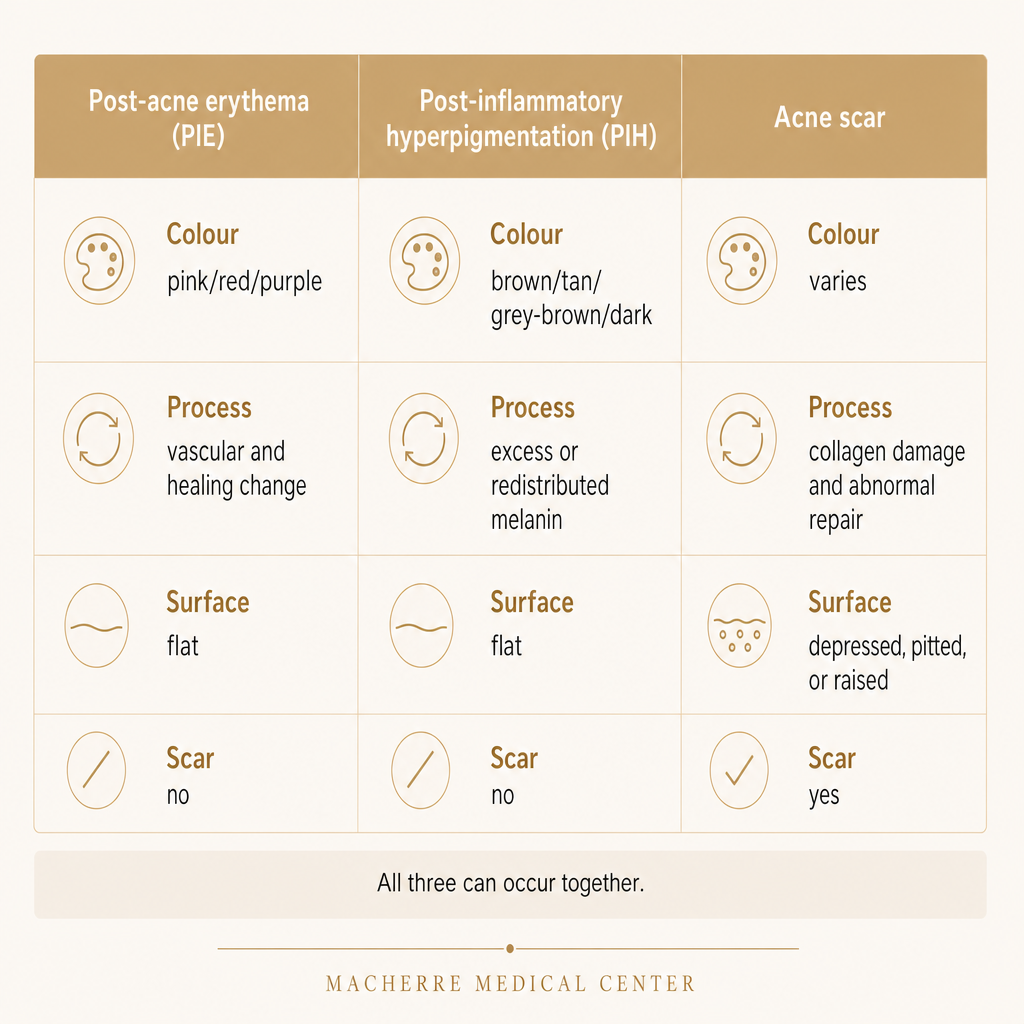
Red and brown post-acne marks are not the same, and treating them as interchangeable leads to wasted effort. Post-acne erythema is a redness-based change, while post-inflammatory hyperpigmentation, or PIH, comes from excess or redistributed melanin and shows up brown, tan, grey-brown, or simply darker than the surrounding skin.
| Feature | Post-acne erythema (PIE) | Post-inflammatory hyperpigmentation (PIH) |
|---|---|---|
| Typical colour | Pink, red, or purple | Brown, tan, grey-brown, or dark |
| Main process | Vascular and healing-related colour change | Increased or redistributed melanin |
| Surface | Usually flat | Usually flat |
| Automatically a scar? | No | No |
| Can both occur together? | Yes | Yes |
The distinction is practical, not academic. An ingredient or procedure chosen to fade brown pigment will not necessarily calm redness, and aggressive treatment aimed at the wrong target can prolong inflammation and create more colour change. Skin tone shapes what you tend to see: DermNet notes that post-inflammatory erythema is more common in lighter skin, while post-inflammatory hyperpigmentation after acne is more common in skin of colour. These are tendencies, not rules—anyone can experience either.
How to tell redness apart from a true scar
A flat red mark points toward a colour change; a scar points toward a change in texture. Acne scarring involves a structural change in the dermis and tends to show up as a depression or indentation, a narrow sharp-sided pit, a broad shallow dip, a firm raised area, or a thickened keloid-like region.
DermNet explains that acne scars form through collagen damage and abnormal repair. Atrophic scars reflect a net loss of collagen, while hypertrophic or keloid scars involve excess or abnormal collagen. Scars are often persistent, though their appearance can soften with time or treatment.
Here is where it gets genuinely tricky: you can have PIE, PIH, and textural scarring in the same area at once. A depressed scar might also carry a red or brown tint. If a mark is hard to classify by looking at it, an assessment is far more useful than cycling through product after product hoping one of them matches.
How long post-acne erythema usually lasts
There is no reliable universal timeline, and anyone promising you a fixed number of weeks is overselling. Some marks gradually fade until they are hard to spot; others linger for months or longer. DermNet states that acne-related colour changes often improve with time, but that this may take months or longer.
How long a mark appears to stay depends on several moving parts:
- The depth and intensity of the original inflammation
- Whether new acne keeps appearing in the same area
- Picking, squeezing, scrubbing, or using irritating products
- Your individual healing pattern
- Sun exposure and whether you use suitable photoprotection
- Whether the mark is actually PIE, PIH, rosacea-related redness, or a scar
A responsible expectation is not a countdown. The more useful goal is to control active acne, avoid preventable irritation, and watch whether the mark is slowly shifting. If it is static for a long time or you cannot tell what it is, that is a reason to ask rather than to escalate your routine.
What genuinely helps red marks after acne
The right approach depends on whether your main issue is active acne, residual redness, pigmentation, scarring, or some mix of these. Chasing redness in isolation often backfires.
Gentle skincare and irritation control. A routine your skin actually tolerates reduces avoidable irritation. In practice that usually means a gentle cleanser instead of abrasive scrubbing, a moisturiser suited to your skin, broad-spectrum sun protection matched to your needs, and steering clear of picking, harsh brushes, and constant product-swapping. Sun protection matters most when marks are also pigmented or when your skin leans toward uneven tone. The American Academy of Dermatology notes that acne can leave flat marks that may last a year or longer, and that appropriate treatment and skincare can help them clear sooner while preventing new marks. If marks are predominantly brown rather than red, our post-acne and discoloration treatment consultation is the service built around that concern.
Treating active acne. Every new inflamed lesion can leave a fresh residual mark, so controlling ongoing acne is part of the fix rather than a separate project. Current American Academy of Dermatology guidance supports evidence-based topical therapies, including combinations that work through different mechanisms, and identifies azelaic acid as an option that can unclog pores, address acne-related bacteria and inflammation, and help fade dark spots left behind. The right routine depends on factors such as pregnancy or breastfeeding, skin sensitivity, previous treatment, severity, medication use, and whether a medical diagnosis is needed—so we don't recommend starting prescription treatment on the strength of a general article. When ongoing breakouts are the real driver, our acne treatment consultation focuses on identifying the cause and building a plan.
In-office procedures. For persistent redness or established textural scarring, a qualified clinician may discuss vascular or non-ablative laser treatments, microneedling, or other approaches. A clinical review from the American Academy of Dermatology notes that post-inflammatory erythema may improve with vascular or light-based devices, non-ablative lasers, and microneedling-based approaches, while stressing realistic expectations, photography for monitoring, and control of active acne. These procedures are not risk-free—possible concerns include irritation, prolonged redness, pigmentary changes, infection, and further scarring. A procedure should never be chosen simply because a mark is red; the concern needs to be clarified first.
When redness needs a professional opinion
Some situations deserve a proper assessment rather than another round of trial and error. Consider professional advice when acne is deep, painful, recurring, or leaving scars; when redness keeps spreading or turns warm, swollen, itchy, or painful; or when flushing affects the cheeks, nose, or central face and is triggered by heat, alcohol, spicy food, or emotion.
It is also worth getting an opinion when marks appear without a clear history of acne, when your skin is reacting to several products, when you cannot tell whether the concern is PIE, PIH, rosacea, or scarring, when acne is affecting your mood or daily life, or when over-the-counter products have repeatedly irritated your skin or failed to settle ongoing breakouts. A clinician may need to separate acne-related erythema from rosacea, dermatitis, infection, or a medication reaction—and if central-face flushing is the dominant feature, our rosacea management consultation or sensitive skin care consultation may fit better than an acne-focused plan.
An online consultation can help when the main decision is how to organise ongoing acne-prone skincare, review a routine, or work out whether a remote plan suits you. It is not a replacement for urgent in-person assessment or every form of dermatological care. Our Virtual ProAcne programme is described as an individually determined pathway that begins with an extended consultation, followed by a routine and introduction plan, progress reviews every two weeks, and support between reviews, with treatment length decided case by case. Current duration, pricing, eligibility, and the appropriate care pathway should be confirmed on the live programme page before booking, and the programme is not a guaranteed cure or fixed result—not every case of persistent redness is suitable for remote skincare support.
Deciding what to treat first
The most useful question is not "which product removes PIE?" It is: what is the main problem—residual flat redness, ongoing acne, pigmentation, textural scarring, or a combination?
- Mostly flat red or pink marks after healed spots: this fits post-acne erythema; allow time for gradual change and avoid irritation.
- Brown, grey, or dark flat marks: this points toward post-inflammatory hyperpigmentation.
- Indentations or raised areas: this suggests acne scarring.
- New painful or inflamed lesions: prioritise acne management before worrying about marks.
- Flushing, burning, or central facial redness: consider whether rosacea or another condition needs assessment.
When several concerns overlap, a single personalised plan tends to work better than layering multiple "redness-fading" products at once and hoping something sticks.
Frequently asked questions
Is post-acne erythema permanent?
Usually not. Acne-related colour changes can improve over time, though DermNet notes improvement may take months or longer. Persistent marks are worth assessing if the diagnosis is uncertain or if they come with other symptoms.
Is PIE the same as post-inflammatory hyperpigmentation?
No. PIE generally refers to flat red or pink residual marks, while PIH refers to brown or darker marks from post-inflammatory melanin changes. Both can follow the same acne lesion.
Does having PIE mean I have acne scars?
No. PIE is usually a colour change rather than a structural scar. Colour changes and scars can, however, coexist in the same spot.
Can sunscreen remove red acne marks?
Sunscreen does not directly erase PIE. It helps reduce additional UV-related skin changes and matters most when post-acne marks also include pigmentation. Choose a product your skin tolerates and use it consistently.
Should I use strong exfoliants on PIE?
Not automatically. Strong acids, scrubs, or frequent product changes can irritate skin and prolong inflammation. The right approach depends on whether the concern is redness, pigmentation, active acne, sensitivity, rosacea, or scarring.
When should redness be assessed urgently?
Seek prompt medical assessment for rapidly spreading redness, marked warmth or swelling, severe pain, fever, pus, eye involvement, breathing symptoms, or a sudden reaction after a product or medication. These are not typical of an uncomplicated flat post-acne mark.