


What Is a Virtual Dermatology Consultation?
This article is educational and does not diagnose a condition or replace care from a qualified medical professional.
A virtual dermatology consultation is a remote skin-health appointment where a qualified professional reviews your concerns through video, clear photographs, written history, or a combination of these. Instead of sitting in a waiting room, you share images and detailed information, and a clinician or trained skincare specialist connects those images to your symptoms, routine, and goals before building a plan. It suits visible, assessable concerns such as acne, rosacea, pigmentation, and reactive skin, and it is not the same thing as receiving a generic product list after uploading a single selfie.
The real decision behind this question is rarely "what is it" in the abstract. It is whether your particular skin concern can be assessed and managed well from a distance, what a thorough remote appointment should actually include, and when you still need to be seen in person. We built our online skincare support around those boundaries, so this guide explains the mechanism, the limits, and the choices that help you judge whether remote care fits your situation.
Table of contents
How a virtual dermatology consultation actually works
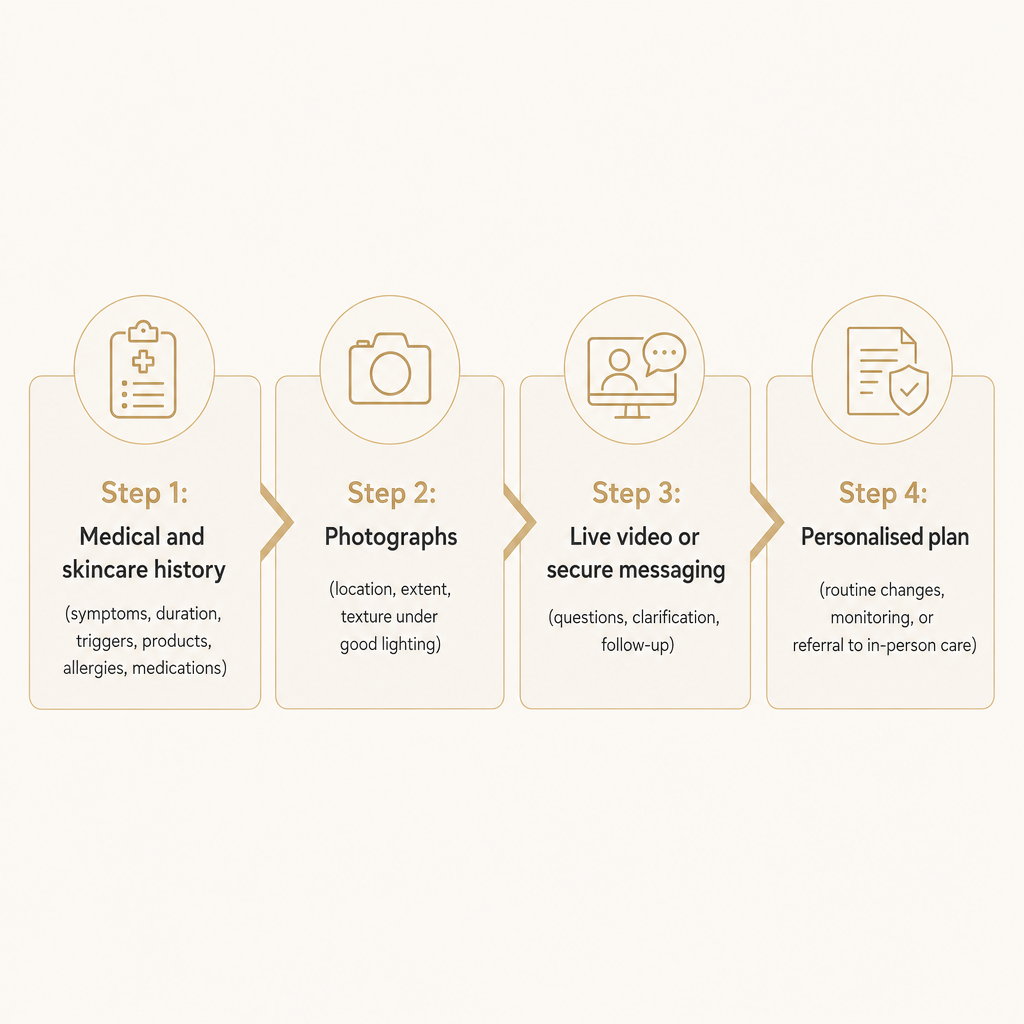
A meaningful remote consultation draws on several sources at once, not just a photo. Your history carries the symptoms, duration, triggers, previous products, allergies, and medications. Photographs show the appearance, location, and extent of a concern. A live video call or secure messages allow questions, clarification, and follow-up. From those pieces, the clinician builds a personalised plan that may involve routine changes, product guidance, monitoring, or a recommendation for in-person evaluation.
The NHS describes teledermatology as using digital images to triage, diagnose, monitor, or assess skin conditions without the patient being physically present, and it stresses that images must arrive with enough clinical information for the clinician to understand the concern and act on it. That distinction matters: a selfie with no context is weak evidence, while a focused set of images paired with a clear history can support real clinical reasoning.
The practical takeaway is that photo quality and history quality drive the value of the appointment. If you want a sense of how to prepare images and describe symptoms well, our guides on taking skin photos for your consultation and the underlying assessment process cover the detail, but the core idea is simple: give the clinician the context a physical visit would normally supply.
What remote skin care handles well, and what it does not
Remote care works best when the main concern is visible and can be reasonably assessed through photographs or video. That covers active acne and recurring breakouts, clogged pores, post-acne discoloration and uneven pigmentation, rosacea-related redness and sensitivity, dry or dehydrated reactive skin, some persistent inflammatory concerns, and follow-up for a condition that has already been assessed. The American Academy of Dermatology lists acne, rashes, eczema, psoriasis, and some suspicious spots among conditions that may be managed through telemedicine, while noting that an in-person appointment can still be necessary.
It is often especially practical when you live far from a suitable clinic, when over-the-counter products have not worked and you want to understand why, when your routine feels like it is making your skin more unpredictable, or when you want structured follow-up rather than a single appointment. A topical or skincare-focused approach, where clinically appropriate, also fits this format.
What it does not do is diagnose from a selfie alone. The clinician has to decide whether the available information is sufficient and whether your concern is suitable for online management. If the honest answer is no, a responsible service says so rather than forcing an online pathway. That boundary is the difference between a consultation and a sales funnel.
Inside the appointment: history, photos, routine, and plan
The exact format varies by provider and concern, but a thorough virtual consultation usually moves through four layers. First, your skin history: when the concern began, where it appears, whether it is painful, itchy, burning, or tender, whether it fluctuates with stress, menstrual cycles, seasons, or products, and what you have already tried. This context helps separate a short-term irritation from a recurring pattern, though it cannot guarantee a diagnosis or outcome.
Second, your photographs. Images show location and visible features, but quality changes everything. Use bright, even lighting, skip filters, flash glare, and heavy makeup, and take both wider shots showing location and close shots showing texture or colour. Photograph both sides of the face when symmetry matters, and never squeeze or irritate the skin beforehand. Even then, photos have blind spots: they may not capture texture accurately, and colour shifts with lighting, camera settings, and skin tone.
Third, your current routine. Reviewing what you use, how often, and whether several potentially irritating products were introduced together often explains unpredictable sensitivity better than any single ingredient. Fourth, the care and follow-up plan, which may include routine changes, usage guidance, progress monitoring, or a recommendation to seek in-person medical assessment. Good teledermatology services also explain how images are transferred, stored, and used, and obtain appropriate consent before any of this begins.
How our Virtual ProAcne support is structured
Our Virtual ProAcne Program begins with an Extended Acne & Rosacea Consultation. The live consultation is listed as lasting 60–90 minutes, with a starting price of $115 / €99. The ongoing support option is described as typically lasting 4–6 months, with current support pricing listed as $380–570 / €320–480, depending on the selected option and individual plan.
The program is built around an extended initial consultation, a personalised skincare routine, guidance on introducing that routine, progress reviews every two weeks, support between scheduled check-ins, and adjustments based on how your skin responds. These points describe the structure of the service, not a guaranteed result, cure, or universal timeline. The right plan, duration, and suitability depend on your concern and the assessment itself.
If your main concern is not acne, we work from the same remote framework across other areas. You can review the relevant pages for acne treatment, rosacea management, post-acne and discoloration treatment, sensitive skin care, or age spots and hyperpigmentation treatment. Please check the live program page for current language options, availability, pricing, and booking before arranging care, since those details can change.
When to choose in-person care instead
Online care can be unsuitable or incomplete when a concern needs direct examination, dermoscopy, testing, a procedure, or assessment of a site that is hard to photograph. Arrange an in-person medical assessment promptly if you have a mole or spot changing in size, shape, or colour; a lesion that is bleeding, ulcerated, or not healing; a rapidly spreading rash; severe pain, swelling, blistering, or signs of infection; eye involvement or significant facial swelling; a concern on an intimate area you do not want to photograph; symptoms that are widespread or rapidly worsening; or a condition that keeps being misidentified through remote care.
The NHS notes that image-based assessment can be harder for some rashes and for lesions on brown or black skin, as well as for certain anatomical sites, and it emphasises that patients should still have access to face-to-face care when remote assessment is not appropriate. For suspicious pigmented lesions, dermoscopic and clinical images may be required, and an in-person assessment may be necessary.
One rule overrides everything else: do not delay emergency care while waiting for an online consultation. If you have severe symptoms or feel acutely unwell, use the emergency or urgent-care service available where you are.
How to judge a virtual skincare service before booking
The quality of remote care depends heavily on who runs it and how. A few direct questions separate a structured consultation from a generic recommendation engine.
| Question to ask | What a sound answer looks like |
|---|---|
| Who will assess me? | A named professional with verifiable qualifications and a relevant licence or registration |
| Can I submit photos and full history? | The service collects enough information for a real assessment, not a one-line form |
| What if online care isn't suitable? | The provider recommends or helps arrange in-person care rather than forcing a plan |
| How is my information protected? | Secure communication, clear privacy terms, and transparent image-use policies |
| What does follow-up include? | Defined review intervals and support between appointments |
| Are price and duration current? | Clear scope, whether products are separate, and timeframes described as typical, not guaranteed |
The AAD advises patients to ask about provider credentials, medical history handling, consultation records, secure technology, and in-person follow-up arrangements, and to confirm whether a service accepts photographs, since accurate assessment is difficult without them. International patients carry an extra layer of checks: consultation language, payment, time zones, product access, and any location-specific prescribing or referral limits. A generic online recommendation may hand you a short product list from thin information; a genuine virtual consultation pairs structured assessment with clinical reasoning, privacy safeguards, and a clear escalation path. Neither format should promise that acne, rosacea, or pigmentation will be cured, because skin responds differently from person to person and a plan may need to change as new information appears.
Frequently asked questions
What is a virtual dermatology consultation?
It is a remote skin-health appointment using video, photographs, written information, or a combination of these. It can be used to assess, monitor, or guide care for suitable, visible skin concerns.
Can a virtual consultation diagnose acne?
It may help a qualified professional assess visible acne-like symptoms, but not every facial bump is acne. Severe, unusual, painful, scarring, or treatment-resistant symptoms may need an in-person medical assessment.
Can I receive prescription medication online?
That depends on the provider, the clinician's qualifications, your location, and local regulations. A skincare consultation may focus on topical or non-medication guidance, so you should not assume prescribing is included.
Is virtual care suitable for rosacea?
It can be useful for reviewing visible redness, sensitivity, triggers, and skincare products. Persistent, severe, eye-related, or uncertain symptoms should be assessed medically, especially if the diagnosis has not been established.
How long does our ProAcne support last?
We currently describe Virtual ProAcne support as typically lasting 4–6 months, with reviews every two weeks. The exact duration and price depend on the selected option and individual plan, so please confirm current details on the program page.