


What Are Closed Comedones? Causes and Signs
This article is educational and does not diagnose a condition or replace care from a qualified medical professional.
Closed comedones are small, raised bumps that form when a hair follicle becomes blocked beneath a thin layer of skin. Most people know them by a more familiar name: whiteheads. If you have been wondering what are closed comedones and why they keep appearing as tiny, flesh-coloured bumps that resist your usual routine, the short answer is that they are non-inflammatory acne lesions formed inside the follicle, not surface dirt you can wash or scrub away. The American Academy of Dermatology lists the closed comedo as the medical name for a whitehead.
Understanding how they form, how they differ from blackheads, and what tends to aggravate them changes how you treat them. The congestion sits inside the pore, so the goal is to influence what happens below the surface rather than to polish the top of it.
Table of contents
How a closed comedo actually forms
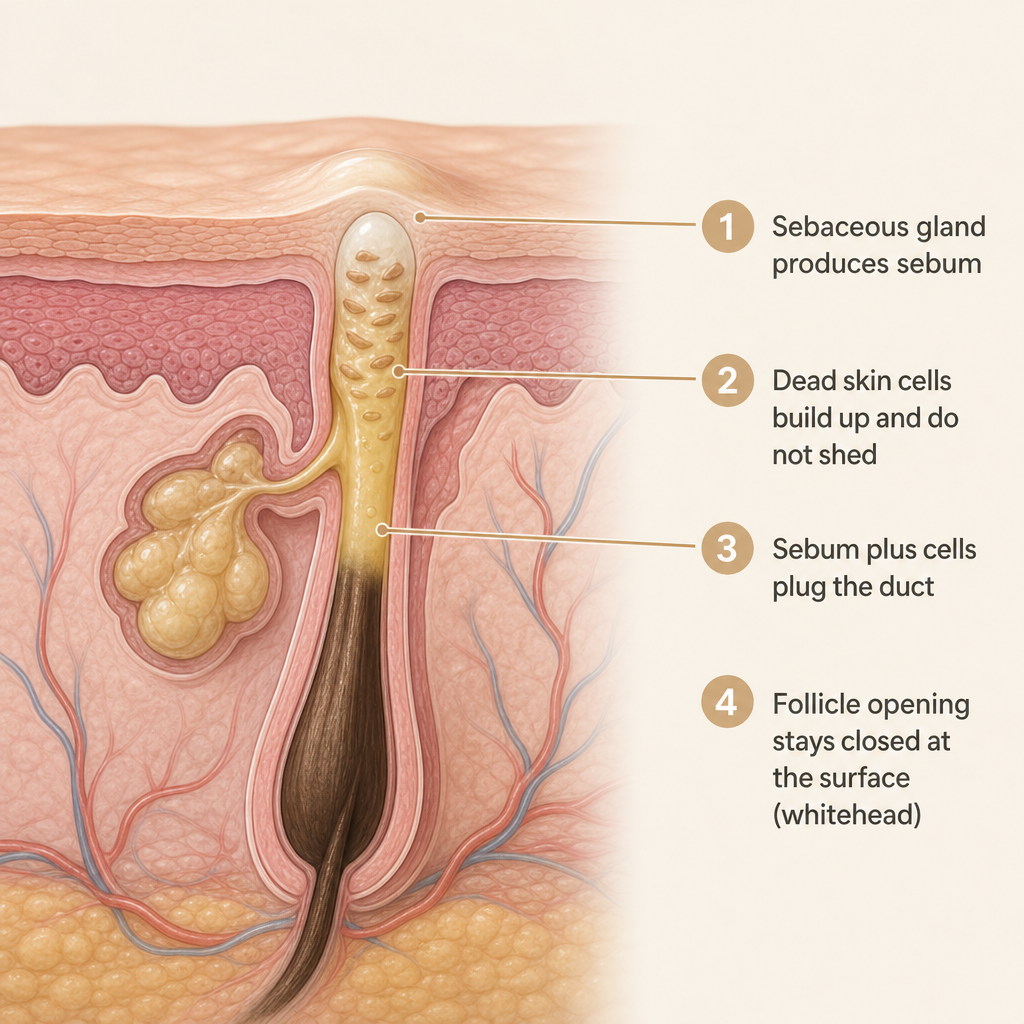
Every hair follicle is paired with a sebaceous gland that produces sebum, the skin's natural oil. A comedo develops when that follicle fills and clogs rather than draining normally. DermNet describes the mechanism as increased sebum production combined with abnormal shedding, or cornification, of the cells lining the sebaceous duct. The resulting debris plugs the duct and the follicle.
In a closed comedo, the opening at the surface stays covered by skin, so the plug has no visible exit. That single structural detail explains almost everything about how whiteheads behave: they look pale rather than dark, they feel like bumps rather than open pores, and they cannot be squeezed clean without damaging the surrounding skin.
Acne is rarely just a plug, though. Hormonal activity, the follicle environment, and the behaviour of Cutibacterium acnes bacteria all influence whether a quiet comedo stays quiet or tips into inflammation. That is why a routine aimed only at surface cleansing so often stalls.
What closed comedones look and feel like
Closed comedones are often easier to feel than to see. People frequently describe tiny bumps under the skin that only become obvious when light falls across the face at an angle. Typical signs include:
- Small, firm or slightly soft bumps
- A white, cream-coloured, or skin-coloured surface
- A relatively smooth top with no dark central dot
- Little or no tenderness
- Rough, uneven texture across an area rather than one isolated spot
- Clusters on the forehead, chin, cheeks, or jawline
Because they are usually not red, swollen, or painful, they are easy to dismiss. The catch is that they can be stubborn and persistent, and some progress into inflammatory acne. A larger, deeper closed comedo may be called a macrocomedone. Lesions that are unusually large, persistent, or appear on only one side of the face deserve a proper look rather than an assumption that they are ordinary whiteheads, because other conditions can resemble them.
Closed comedones versus blackheads
Whiteheads and blackheads are both comedones. The difference is simply whether the follicle opening is sealed or open at the surface.
| Feature | Closed comedone | Open comedone |
|---|---|---|
| Common name | Whitehead | Blackhead |
| Follicle opening | Covered or closed | Open at the surface |
| Appearance | White, pale, or skin-coloured bump | Dark central dot |
| Why it looks dark | Usually no exposed plug | Surface pigment and oxidation, not dirt |
| Typical sensation | Raised bump or uneven texture | More visible pore or plug |
DermNet classifies closed comedones as whiteheads and open comedones as blackheads, and notes that blackheads look dark because of pigment and oxidation at the surface, not because the pore is full of dirt. This matters practically: the darkness of a blackhead is not grime, and no amount of scrubbing turns a whitehead into clear skin. If your main concern is a mix of these two, our blackheads and whiteheads removal consultation is built around exactly that distinction.
What triggers and worsens them
Closed comedones almost always have more than one contributing factor, and the presence of whiteheads is not evidence of poor hygiene or one wrong product choice.
Hormonal shifts. Androgens can raise sebaceous-gland activity and change how cells behave inside the follicle. Breakouts may become more noticeable during puberty, around the menstrual cycle, in pregnancy, or during other hormonal transitions. You do not need a diagnosed hormonal condition to develop comedonal acne.
Occlusive skincare and hair products. Heavy creams, pomades, oils, and some makeup can contribute to blocked follicles, especially where they linger along the forehead, temples, and hairline. This does not mean every oil or moisturiser causes acne; formula, quantity, frequency, and individual susceptibility all matter. Products labelled non-comedogenic are a reasonable starting point, but the label is not a guarantee for every person.
Heat, humidity, sweat, and friction. Warm, humid conditions leave skin oilier and more occluded. Pressure and rubbing from helmets, hats, masks, straps, or tight clothing can aggravate congestion in those contact zones. Sweat alone is not the cause, but heat plus occlusion plus delayed cleansing makes congestion more noticeable.
Over-aggressive routines. Scrubbing, picking, frequent exfoliation, or stacking several strong actives at once can irritate the follicle and weaken the skin barrier. Irritation tends to make existing bumps look more prominent and raises the risk of redness, peeling, and post-inflammatory marks. Trying to scrub whiteheads out usually backfires.
Individual susceptibility. Genetics, baseline sebum production, how readily skin cells shed, inflammatory tendencies, certain medications, and environment all play a part. Two people with identical routines can have very different results.
When a whitehead turns into a pimple
A closed comedo can stay quiet indefinitely, or it can become inflamed. Once the blocked follicle inflames, it may develop into a red papule or pustule, and if inflammation reaches deeper, into a more painful lesion. This is the moment comedonal acne stops being a texture issue and starts being a visible breakout.
Picking and squeezing make this more likely, not less. Pressure can push follicular contents deeper into surrounding skin, and the American Academy of Dermatology warns that picking whiteheads can lead to more acne and acne scarring. Needles, unsterilised tools, abrasive scrubs, and forceful home extraction all raise the risk of marks and scars.
A whitehead you leave alone may fade quietly; a whitehead you attack can leave a mark that outlasts the acne itself.
What realistically helps
There is no scrub-it-away fix, but several general acne-care principles are well established. The practical pattern is gentle, consistent, and patient:
- Wash gently rather than scrubbing.
- Choose products less likely to clog pores.
- Introduce only one new active product at a time.
- Apply a suitable treatment to the whole affected area, not only to individual bumps.
- Use moisturiser if skin is dry or irritated.
- Use broad-spectrum sun protection, especially if acne has left marks.
- Avoid picking and repeated manual extraction.
For comedonal acne, dermatology guidance commonly considers comedolytic ingredients, meaning those that help prevent or reduce follicular plugging. Depending on your skin, history, and what is available locally, options can include a retinoid, salicylic acid, azelaic acid, or other clinician-recommended treatments. DermNet notes that improvement can take several weeks to months and that maintenance is often important, so a product that seems to do nothing in week two may still be working.
A retinoid is not right for everyone. If you are pregnant, trying to conceive, or breastfeeding, ask a qualified clinician which acne ingredients are suitable before starting, since prescription availability and pregnancy guidance vary by country. A consultation also helps separate closed comedones from milia, folliculitis, or simple irritation, which can look almost identical in a photo and respond to very different care.
When to seek professional advice
Consider arranging an assessment if:
- Bumps persist despite a simple, consistent routine.
- Lesions are turning red, painful, deep, or widespread.
- Acne is leaving dark marks, red marks, or scars.
- Breakouts repeatedly worsen around hormonal changes.
- You are unsure whether the bumps are acne at all.
- Products cause burning, swelling, significant peeling, or a rash.
- Acne is affecting confidence or daily life.
- You are considering prescription treatment or are pregnant, trying to conceive, or breastfeeding.
Seek urgent medical care for rapidly spreading swelling, severe pain, extensive blistering, fever, or other signs of infection. When whiteheads sit alongside broader breakouts, our acne treatment consultation can help identify the underlying pattern, and if marks are lingering after lesions clear, our post-acne and discoloration treatment addresses that separately.
How our online acne support fits
For persistent comedonal acne that has not responded to a simple routine, structured support can help you avoid the two most common traps: doing too little for too long, or doing too much too aggressively. Our Virtual ProAcne program is currently described as a personalised 4–6 month online support program. It begins with an extended consultation, then moves to a personalised skincare routine, guidance on introducing that routine gradually, progress reviews every two weeks, and support between check-ins, with the plan adjusted to your skin and how it responds.
Current pricing, program length, and the starter skincare options are listed on the live program page, and the right plan depends on your individual case. These details describe the current offer, not a guaranteed result. Remote care suits many uncomplicated acne concerns, but it is not a substitute for urgent care or an in-person diagnosis when one is needed, and whether online support fits you is part of what the initial consultation establishes.
Frequently asked questions
Are closed comedones the same as whiteheads?
Yes. Closed comedo is the medical term for a whitehead: a blocked follicle sealed by a thin layer of skin. The American Academy of Dermatology lists it as the whitehead's clinical name.
Are closed comedones caused by dirt?
No. They form inside the follicle from a mix of sebum, retained skin cells, and follicular changes. Washing aggressively will not remove them and tends to irritate the skin instead.
Why do I have tiny bumps but no redness?
Closed comedones are usually non-inflammatory, so they often feel rough or raised without being red or sore. Some still progress to inflamed acne later, which is why persistent clusters are worth addressing.
Should I squeeze closed comedones?
Better not to. Squeezing can worsen inflammation and raise the risk of marks or scars. Professional extraction may suit selected lesions, but it is not appropriate for every bump.
Can closed comedones be treated online?
Many uncomplicated cases suit remote assessment when clear photos, medical history, current products, and symptoms can be reviewed. Unusual, severe, painful, scarring, or uncertain lesions may still need in-person evaluation.
Medical note: This article offers general education and does not diagnose or prescribe treatment. Acne-like bumps can have several causes, so consult a qualified clinician when symptoms are persistent, severe, painful, scarring, or uncertain.