





Online Skincare Consultation How It Works: How Online Skincare Consultations Actually Work
This article is educational and does not diagnose a condition or replace care from a qualified medical professional.
If you have been searching for how an online skincare consultation actually works, the short answer is this: it is a remote, professional skin assessment where you share a detailed intake form and clear photos, then receive a personalized treatment plan with ongoing follow-up instead of a one-off product recommendation. At Macherre Medical Center, we use this model to care for acne, rosacea, pigmentation, sensitive skin, and early signs of aging through structured, evidence-based care you complete entirely from home. The real question most people are weighing is not whether remote care is convenient, but whether it can be as clinically serious as walking into a room. This guide answers that by walking through what happens, what the evidence shows, and when online care is the right choice.
Table of contents
What an online skincare consultation actually is
In medical terms, online skincare consultations sit under teledermatology: licensed clinicians deliver diagnosis, treatment planning, and monitoring using secure digital tools instead of in-person visits. Rather than a physical exam, the clinician relies on a combination of your written history and high-quality skin photographs to reach an assessment and design a plan.
Modern teledermatology platforms commonly use mobile phone photos, secure web portals, and video calls, allowing acne and other skin concerns to be managed effectively at a distance. Multiple clinical reviews have found teledermatology to be a safe and effective option for common conditions such as acne, improving access to care while maintaining treatment quality.
With us, that framework becomes cosmetologist-led care delivered remotely. You share your concerns and goals, a clinician reviews your information and images, and you receive a structured plan with follow-ups rather than generic product advice. The difference from a quick online quiz is not the screen; it is the depth of assessment and the commitment to stay with you as your skin responds.
What you actually do during a consultation with us
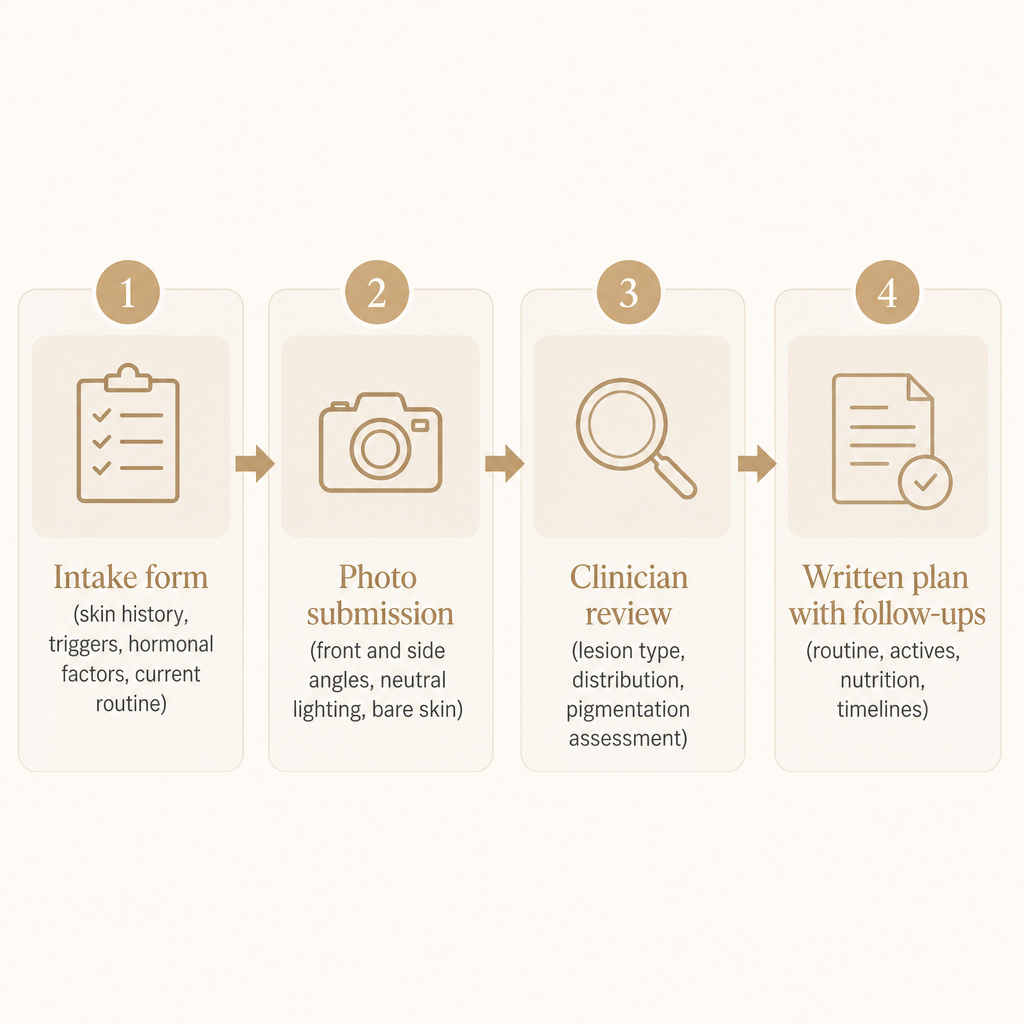
From your side the experience feels simple, but several distinct clinical steps happen in the background to make it safe and effective.
You first complete a structured intake form covering your skin history, triggers, hormonal factors, previous treatments, and current routine. This written intake replaces the questions a clinician would ask in a physical room and helps us understand whether your acne is likely hormonal, inflammatory, comedonal, or mixed, and whether rosacea, sensitivity, or pigmentation are also present.
You then upload high-quality photos of your skin: front and side angles, neutral lighting, bare skin, no makeup. Diagnostic accuracy in teledermatology depends heavily on image quality, and studies of acne workflows show that high-resolution photographs let clinicians grade severity and monitor treatment response over time with good reliability.
Once your form and images arrive, we review them together rather than in isolation. For acne, that means classifying lesion types such as blackheads, whiteheads, papules, and pustules, mapping distribution across the jawline, cheeks, forehead, or back, and noting associated features like post-acne discoloration or scarring. For rosacea, we assess vascular patterns and the triggers you report, such as heat, alcohol, or stress. For pigmentation and age spots, we look at color, borders, and distribution to distinguish sun damage from post-acne marks.
Depending on the case, the consultation itself may run in one of two ways. A synchronous visit is a real-time video call that approximates an in-person appointment, allowing live questioning and dynamic viewing of your skin. An asynchronous, store-and-forward consult means the clinician reviews your form and photos and responds with a detailed written plan and follow-up messaging, a format research shows is widely used for acne and other non-emergency skin conditions. Teledermatology literature describes synchronous, asynchronous, and hybrid formats as the standard models in remote dermatology, and our workflow fits this framework by combining guided photo submission, structured intake, and either live or message-based follow-up.
Finally, you receive a written, individualized plan. It usually covers morning and evening routines, product types and actives, guidance on nutrition and lifestyle triggers, and realistic timelines for when inflammation or pigment should start to improve. Clinical reviews of teledermatology for acne highlight that structured plans and clear expectations are central to keeping adherence high and achieving long-term results in virtual care.
How teledermatology for acne works clinically
Evidence from recent reviews and longitudinal studies shows teledermatology is particularly well-suited to chronic acne management. Clinicians use patient-submitted photos and video visits to grade severity, start treatment, and then adjust plans over repeated virtual follow-ups. High-resolution images uploaded before video visits improve evaluation of treatment results, allowing objective tracking of lesion counts and changes in pigmentation.
Remote visits also remove barriers like distance, work schedules, or the stigma some people feel about visiting a clinic, which matters most for adult and hormonal acne sufferers who need months of continuous care. Teledermatology is described as an effective and safe option for acne that improves adherence and quality of life when combined with structured follow-ups.
Clinical frameworks distinguish teledermatology use by treatment type. For topical and routine-based management, store-and-forward models with written plans and messaging are often sufficient. For systemic medications such as isotretinoin, protocols exist but typically incorporate real-time video, laboratory monitoring, and clear safety follow-up, reflecting the higher risk profile of those drugs. This is precisely why many remote-first services, including ours, concentrate on skincare, nutrition, and lifestyle-focused approaches for mild to moderate acne and related concerns.
Is an online skincare consultation right for you?
Both teledermatology evidence and everyday practice point to clear situations where remote care fits well.
- Persistent or hormonal acne that has not responded to over-the-counter products or occasional self-experiments. Remote care supports long-term management and monitoring, especially when photos are used to quantify response.
- Acne with post-inflammatory hyperpigmentation or mild scarring, where treatment must both calm active inflammation and gradually fade discoloration. Image-based assessment tracks pigment changes over time.
- Rosacea and sensitive, reactive skin, where triggers and product reactions matter as much as visible redness, and detailed history taking aligns naturally with remote intake.
- Early signs of aging and texture changes, which usually benefit more from preventive routines, well-chosen actives, and lifestyle coaching than from immediate procedures.
Still, teledermatology studies consistently frame online consultations as part of an integrated dermatology system, not a replacement for every in-person visit. A physical exam is usually needed for suspicious moles or lesions, painful nodulocystic acne that may require procedural intervention, and any skin change tied to systemic symptoms like fever or unexplained weight loss. In those cases, responsible remote clinicians advise a prompt in-person dermatology or medical evaluation rather than continuing purely online. For most chronic, non-emergency concerns, however, remote care offers an accessible, clinically backed alternative to recurring office visits.
What makes our online model distinct
We apply these teledermatology principles in a cosmetology-focused, remote-first setting led by Dr. Maria, a specialist experienced in acne, rosacea, pigmentation, sensitive skin, and early aging. Our workflow centers on a detailed intake form, guided photo submission, expert review, and a written plan rather than superficial product matching.
Unlike a one-time skin quiz, our model is built around ongoing follow-up. We stay involved as you implement the plan, using messaging and scheduled check-ins to adjust products, actives, and lifestyle recommendations based on how your skin actually responds. That mirrors the research showing repeated virtual visits and long-term tracking are key to sustained acne improvement.
For acne specifically, our signature ProAcne Program combines bi-weekly reviews over roughly three to four months with nutrition, topical skincare, and lifestyle changes, with a claimed 95% success rate and an emphasis on avoiding unnecessary medication where possible. It brings together the strengths of teledermatology, remote monitoring, photo-based tracking, and structured plans, into a premium yet accessible package. Because we support both English and Russian, the program suits international clients who want continuity of care across borders. Consultations start from $95.
Key risks and how they are managed
Every medical model has limitations, and teledermatology is no exception. Research and clinical guidelines highlight several risks and the ways reputable services reduce them.
- Image quality and misinterpretation. Poor or incomplete photos reduce diagnostic accuracy. Standardized photo taking, guided by clear instructions on angles, lighting, and focus, significantly improves reliability, and we include those instructions before your consultation.
- Over- or under-treatment. Without a physical exam there is a theoretical risk of missing subtle signs of severe disease. Teledermatology frameworks counter this with clear criteria for referring patients to in-person care and by reserving certain high-risk treatments for hybrid models.
- Privacy and data security. Remote care depends on transmitting medical information and photos, so platforms rely on secure messaging and storage, role-based access, and encrypted video tools to protect confidentiality.
- Adherence drop-off. Patients can disengage if they feel unsupported between visits. Structured programs with scheduled follow-ups and easy messaging improve adherence and satisfaction compared with one-off consults, which is exactly why our bi-weekly reviews exist.
Turning this into your own decision
If you are weighing whether to book, the core question is whether your concern is chronic, visually assessable, and suited to plan-based management rather than immediate procedures. Research indicates that acne, eczema, and other inflammatory conditions respond well to remote evaluation combined with structured treatment and monitoring.
For someone living with long-standing or hormonal acne, rosacea, pigmentation and age spots, or reactive skin, an online consultation offers three practical advantages: fast access to a specialist, a personalized plan that integrates skincare with lifestyle, and ongoing support without repeated travel. If you notice red-flag symptoms or rapidly changing lesions, an in-person dermatology appointment remains the safer first step.
Our remote-first model is designed for the chronic, frustrating skin concerns that do not require immediate physical procedures. If that describes your situation, the most useful next move is to share your skin history and photos so we can prepare a plan matched to your specific skin, goals, and language preference.
Frequently Asked Questions
Can an online skincare consultation actually diagnose and treat acne?
Yes. Multiple reviews show teledermatology can accurately evaluate acne severity using patient-submitted photos, start treatment, and adjust it over time, with outcomes comparable to in-person care when protocols are followed.
Are photos enough, or do I need a video call?
For many acne and pigmentation cases, high-quality photographs plus a detailed intake form provide enough information for a reliable assessment, especially in store-and-forward models. Video calls are added when live interaction or dynamic viewing is needed, forming a hybrid approach.
How often should I follow up after the first consultation?
Studies emphasize scheduled follow-ups, often every few weeks, to track response and adjust treatment, which improves adherence and outcomes compared with one-off visits. Our programs build regular review points into the treatment course.
Is online skincare consultation safe for long-term use?
When delivered by qualified clinicians using secure platforms and clear criteria for when in-person care is needed, teledermatology is considered a safe long-term option for managing chronic conditions like acne.
What if my case turns out to be too complex for online-only care?
Teledermatology frameworks explicitly include referring patients for in-person evaluation if concerning signs appear or physical procedures are required, so virtual care enhances rather than replaces traditional dermatology.