





Online Skincare Consultation How It Works: How Online Skincare Consultations Really Work
This article is educational and does not diagnose a condition or replace care from a qualified medical professional.
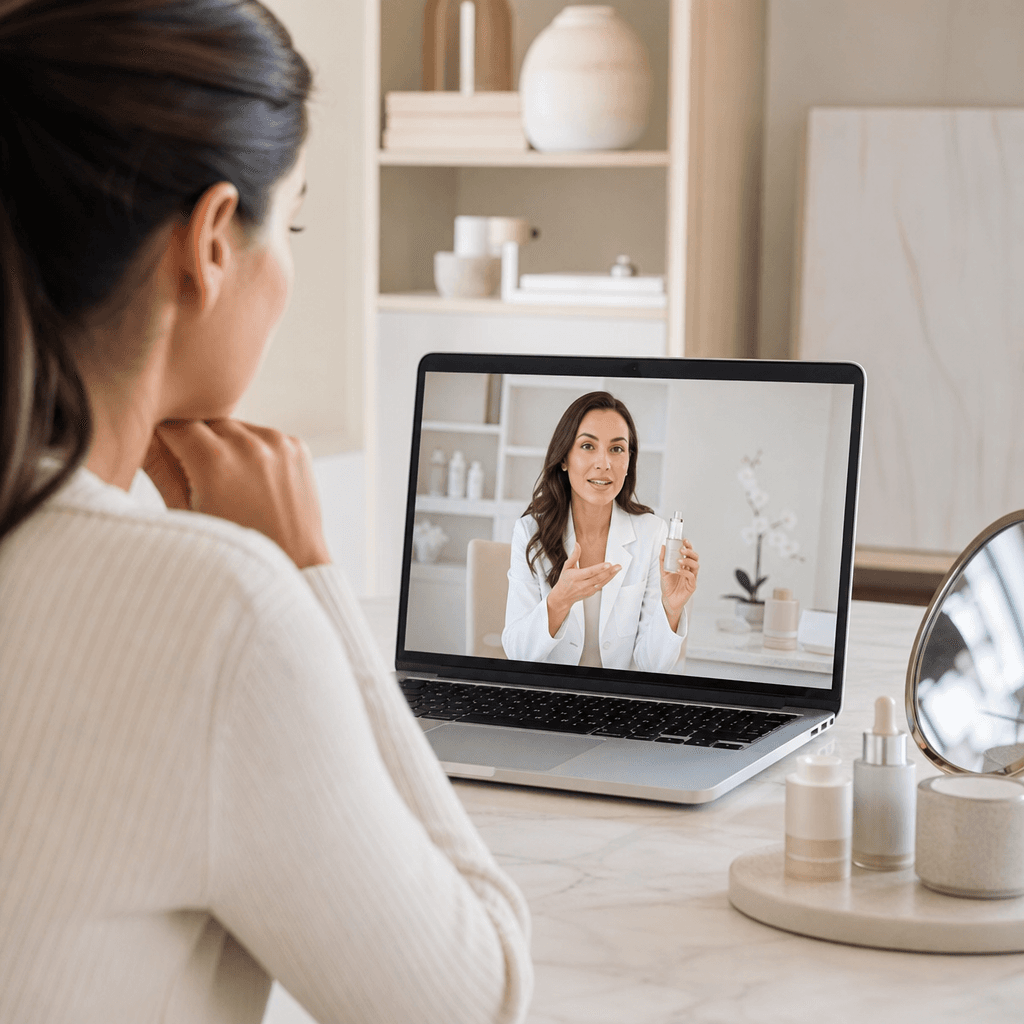
If you have ever wondered how a skin specialist can help without you ever sitting in a waiting room, the short answer is this: an online skincare consultation works by combining clear skin photos, a structured intake form, and expert review to produce a personalized treatment plan you can follow from home. That is the heart of online skincare consultation how it works, and it is exactly the model we use at Macherre Medical Center for acne, rosacea, pigmentation, sensitive skin, and early signs of aging. Instead of a single rushed appointment, remote care lets a specialist study your skin carefully, connect what they see to your history and habits, and adjust the plan over time as your skin responds.
This guide explains what these consultations actually are, how the process runs step by step, why the model works for chronic skin concerns, where it reaches its limits, and how to decide whether remote care fits your situation.
Table of contents
- What an online skincare consultation really is
- How the consultation process actually works
- How our consultations work at Macherre
- Why this model works, and where it does not
- Is an online skincare consultation right for you?
- Frequently asked questions
What an online skincare consultation really is
An online skincare consultation is a remote appointment where a skin specialist evaluates your condition using high-quality photographs and your health history, then provides a tailored plan for treatment and prevention. In dermatology and cosmetology, this sits within teledermatology, which lets licensed professionals deliver care through secure digital tools instead of an in-person visit.
The format usually blends secure intake forms, photo uploads, and either written or video consultations, so the specialist can review your symptoms, previous treatments, and the lifestyle factors that influence your skin. What you receive back is not a generic tip sheet but a structured recommendation: a topical routine, product changes, and guidance on diet, stress, and daily habits.
When people search for how this works, they are really asking one question: can a remote evaluation safely replace or complement a traditional face-to-face visit? For many chronic, non-urgent skin concerns, the answer is yes, provided the assessment is thorough and the follow-up is real.
How the consultation process actually works
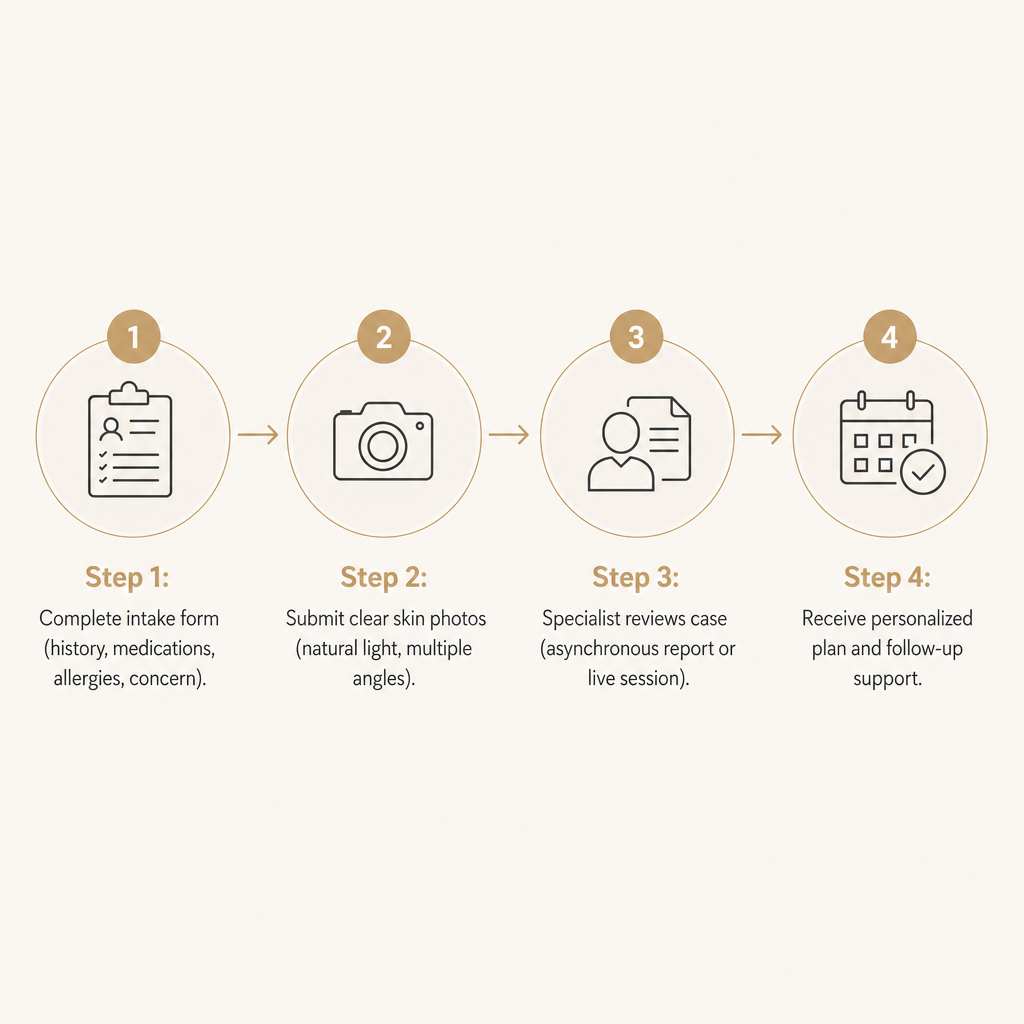
Across reputable teledermatology services, the process is remarkably consistent, even when the details differ between clinics. Four things need to happen, in order, for remote care to be safe and useful.
First, you complete a detailed intake form. This covers your medical history, medications, allergies, past skincare routines, and the specifics of your concern, whether that is hormonal acne, chronic redness, or persistent dark spots. The purpose is practical: it helps the specialist identify triggers, rule out red-flag symptoms, and avoid product or medication conflicts before anything is recommended.
Second, you submit photos of your skin. Clear, well-lit images are the core of remote evaluation because they reveal lesion type, distribution, color, and texture. Natural light, several angles, and both close-up and context shots matter, since poor images are the most common reason a specialist has to delay a decision or ask you to resubmit.
Third, the specialist reviews your case. This can be asynchronous, where the expert studies your photos and form and returns a written report, or synchronous, through a live video or chat session. In either format, the clinician combines what they see with your history to judge whether your case suits remote care, needs laboratory tests, or warrants an in-person referral.
Fourth, you receive a treatment plan and follow-up. The outcome is a structured plan that may include skincare routines, suggested product changes, and lifestyle adjustments, usually delivered through secure messaging or a patient portal. Good services schedule check-ins or keep a chat open so your response can be monitored and the plan adjusted over time.
How our consultations work at Macherre
Macherre Medical Center is an online skincare clinic led by Dr. Maria, a cosmetologist with five years of experience in acne, rosacea, pigmentation, sensitive skin, and early signs of aging. We use a remote-first, four-step model that begins with your form and skin photos, then moves into expert review and ongoing guidance.
In practice, the workflow looks like this:
- Fill out the form. You describe your skin problems, your goals, and any relevant medical history, including whether you deal with hormonal acne, chronic redness, post-acne discoloration, or sensitivity.
- Send photos. You upload images of your face or affected areas so lesion type, such as inflammatory papules, comedones, vascular redness, or pigment patches, and distribution can be assessed.
- Receive your consultation and plan. Dr. Maria analyzes your skin, factors in your history and lifestyle, and builds a tailored plan across topical skincare, nutrition, and daily habits.
- Follow the plan with support. We stay involved as you apply the plan, adjusting products or routines based on how your skin responds.
We position consultations from $95, framing the service as a premium yet accessible alternative to in-person dermatology, and we support both English- and Russian-speaking clients. We offer 24/7 online support and report a 95% success rate across our structured programs, which reflects how much consistent follow-up matters compared with one-time advice.
Our remote consultations are built around specific concerns: acne, including chronic and hormonal acne, where we look at triggers, diet, skincare, and lifestyle rather than only spot treatments; rosacea and persistent redness, where the focus is calming flare-ups, removing irritants, and protecting the skin barrier; and post-acne marks and discoloration, with individualized plans for fading pigment while keeping irritation low. We also work with sensitive and reactive skin, age spots and hyperpigmentation, and early signs of aging such as fine lines, texture changes, or dullness. These are precisely the chronic, non-urgent concerns that teledermatology is known to manage well over time.
The ProAcne Program
For persistent or hormonal acne, we offer the ProAcne Program, a structured course lasting roughly three to four months with bi-weekly follow-ups. It brings together three elements: a personalized topical routine calibrated to your skin type and acne severity, nutrition and lifestyle recommendations aimed at hormonal and inflammatory drivers, and regular progress checks that adjust the plan based on new photos and your feedback.
We report success in approximately 95% of ProAcne cases. That figure is less about any single product and more about accountability, education, and steady adjustments over several weeks, which tend to outperform one-off recommendations.
Why this model works, and where it does not
Online skincare works when three components are strong: visual assessment, contextual data, and iterative follow-up.
Visual assessment comes first. High-quality photos let a specialist distinguish comedonal from inflammatory acne, identify rosacea patterns, or read pigment distribution, which is what makes it possible to choose the right actives, such as retinoids, azelaic acid, or niacinamide, and to avoid ingredients that would irritate your particular skin.
Contextual data carries the assessment further. An intake form reveals timeline, hormonal patterns like flares around the menstrual cycle, past treatment failures, current medications, and coexisting conditions such as eczema or allergies. This context prevents common mistakes, including over-exfoliation, doubling up on actives, or ignoring triggers like stress and diet.
Iterative follow-up is where results are won or lost. Teledermatology increasingly leans on scheduled check-ins and reminders because adherence and timely adjustments are closely tied to outcomes. Our ProAcne Program mirrors this pattern with bi-weekly evaluation over three to four months rather than a single consultation.
Remote care also has honest limits. It cannot replace an in-person exam when a biopsy, dermatoscopic evaluation, or an immediate procedure is required. Suspicious moles, rapidly changing lesions, severe infections, or systemic symptoms need physical examination and sometimes urgent care. A responsible online service will tell you plainly when local medical help is the right call rather than stretching remote guidance past what it can safely do.
Is an online skincare consultation right for you?
The decision comes down to what your skin needs and how you prefer to be cared for.
You are likely a strong candidate if your concerns are chronic acne, hormonal breakouts, rosacea, post-acne marks, pigmentation, sensitive skin, or early aging signs rather than acute emergencies. Remote care also suits you if you can safely use cosmetic or dermocosmetic products and want a plan that leans on topical routines, nutrition, and lifestyle. Two practical habits matter too: being comfortable taking and sharing clear photos, and being willing to follow recommendations consistently over weeks to months, sending updates and asking questions along the way.
We are particularly well suited for adults with long-standing or hormonal acne who are tired of trying isolated over-the-counter products and want a structured, multi-factor program with regular feedback.
Online consultation is not the right primary option in some cases. If you have rapidly growing or changing moles, severe infections, extensive rashes, or systemic symptoms such as fever or weight loss alongside skin changes, you need in-person evaluation. The same is true if you suspect skin cancer, require a biopsy, or need procedures like injections, lasers, or surgical removal that simply cannot be done remotely. And if you are unable to share accurate photos and medical details, no clinician can assess your skin safely. In these situations, an in-person dermatologist or appropriate physician should be your primary provider, with online guidance used only as supplemental education, if at all.
Choosing Macherre means choosing a cosmetology-led, remote-first approach built on focused expertise from Dr. Maria, a simple four-step process, and personalized plans that integrate topical skincare, diet, and lifestyle instead of isolated product picks. It also means structured programs like ProAcne with bi-weekly follow-ups, bilingual support in English and Russian, and consultations starting from $95. For adults with chronic or hormonal acne, women managing rosacea or discoloration, and anyone frustrated with ineffective over-the-counter routines, that combination is a clear alternative to generic product shopping or brief, one-off visits. If you are unsure which concern fits your situation, share your main goal and a short description of your skin so we can point you to the right plan.
Frequently asked questions
Is the consultation live video or written?
We use a remote-first model where your form and photos are reviewed and then discussed with you as part of an individualized plan, with ongoing written support as you put the recommendations into practice.
Do you prescribe medication?
Our care is cosmetology-driven, emphasizing topical routines, nutrition, and lifestyle. This makes it especially suitable for clients seeking non-medication or topical-only approaches to their skin concerns.
How fast will I see results?
For chronic or hormonal acne, our ProAcne Program runs as a three to four month course with bi-weekly evaluations, reflecting how long it typically takes to see stable improvement when routines and lifestyle changes are followed consistently.
Is this available in Russian as well as English?
Yes. We serve both English- and Russian-speaking clients, with dual-language support across our online content and consultations.
How much does it cost to start?
Consultations start from $95, positioning our service as a premium yet accessible alternative to in-person dermatology visits.
What if my case is too complex for online care?
If your photos or history point to a condition that needs in-person examination or procedures, established telemedicine standards call for referral to local medical services, and online skincare guidance should be treated as secondary in those cases.