





Medical-Grade Skincare Explained: What Makes It Worth the Investment
This article is educational and does not diagnose a condition or replace care from a qualified medical professional.
You've cycled through drugstore serums, a "viral" TikTok cream, maybe a Korean essence a friend swore by — and your acne, pigmentation, or rosacea hasn't budged. Now you're holding a $90 bottle labeled medical grade skincare, or staring at its checkout page, asking the only question that matters: is this medicine or marketing? The frustration is specific. You keep paying for products that "work for everyone online" but not for your skin. Here is the honest starting point: the difference between a $15 cream and a $90 one is rarely the label on the front. It comes down to three things — active ingredient concentration, formulation stability, and whether anyone actually matched the product to your skin. This isn't a sales page that tells you to buy the expensive thing. It breaks down what "medical-grade" genuinely means, what it legally doesn't, when the spend pays off, and when a cheaper routine is the smarter call.
Table of Contents
- What "Medical-Grade" Actually Means — And What the Law Doesn't Recognize
- Drugstore vs. Medical-Grade vs. Prescription: Where Your Money Actually Goes
- The Ingredients That Justify the Price Tag
- When Medical-Grade Skincare Is Worth It — And When It's a Waste
- Why a Product Alone Won't Fix Chronic Skin: The Protocol Problem
- How to Access Medical-Grade Skincare Without an In-Person Dermatologist
- Your Medical-Grade Skincare Decision Checklist
- Common Questions About Medical-Grade Skincare
What "Medical-Grade" Actually Means — And What the Law Doesn't Recognize
Start with the fact that reframes the entire purchase: there is no FDA-regulated definition of medical grade skincare or "cosmeceutical." Neither term exists as an official category. Under US law, a product is legally classified only as a cosmetic, a drug, or both — there is nothing in between. According to the FDA, the word "cosmeceutical" carries no regulatory meaning at all. "Medical-grade" is the same: a marketing phrase, not a standard anyone is required to meet.
The legal line is drawn by language, and the wording matters more than most buyers realize. The FD&C Act defines cosmetics as articles applied to the body for "cleansing, beautifying, promoting attractiveness, or altering the appearance." It defines drugs as products intended to "diagnose, cure, mitigate, treat, or prevent disease or affect the structure or function of the body," per the FDA. That single distinction is why a cream legally cannot claim to "treat" your rosacea unless it is regulated as a drug. The moment a product makes a treatment claim, it stops being a cosmetic in the eyes of the law — which is exactly why most brands stay carefully vague.
Cosmetics also require no FDA premarket approval. They must only be safe for their intended use, properly labeled, and not adulterated or misbranded. No agency reviews a "medical-grade" serum before it reaches you and signs off on its potency or its promises. That responsibility sits entirely with the manufacturer.
So if the term is unregulated, what does it usually signal in practice? In the better cases, it points to higher active concentrations, pharmaceutical-grade raw ingredients, more stable delivery systems, and distribution through licensed professionals or clinics rather than mass-retail shelves. According to packaging and formulation reference Motif Skincare, a vendor source, medical-grade lines are typically formulated with higher concentrations of actives and sold through dermatology clinics and licensed pros instead of pharmacy aisles. That distribution model is part of what the price reflects.
But "usually" is doing heavy lifting in that sentence, and the experts are blunt about it. Cosmetic chemist and licensed esthetician Esther Olu told Prevention that "medical-grade skincare" is used to imply higher concentrations and therefore "better" formulas — while stressing it is a marketing term, and that medical-grade and non-medical-grade brands follow the exact same regulations. Dermatologist Dr. Chan, quoted in the same feature, cautions that brands are not required to run any clinical studies to call a product "medical-grade." The label alone guarantees nothing about evidence.
Board-certified dermatologist Dr. Leslie Baumann, MD sharpens the point further. According to skincare reference SkinTypeSolutions, a vendor source, Baumann notes that medical-grade products can still be FDA-classified as cosmetics and sold over the counter — "over the counter" being a regulatory designation, not a quality grade. Her position is the one worth holding onto: evidence-based ingredients, not labels, should drive what you buy.
There is one genuine baseline that has tightened recently. The Modernization of Cosmetics Regulation Act — MoCRA — now requires manufacturers to register their facilities with the FDA and list each product they sell, according to the FDA. That improves safety oversight and adverse-event tracking across every tier, from drugstore to clinic. It does not, however, verify that anything labeled "medical-grade" is more effective. It simply means someone is on record.
Medical-grade isn't a certification — it's a promise about formulation that only matters if the science behind it holds up.
Drugstore vs. Medical-Grade vs. Prescription: Where Your Money Actually Goes
Three tiers exist legally — cosmetic, cosmetic sold through clinics, and FDA-approved drug. The legal definitions are settled above. What separates them in practice and in cost is concentration, oversight, and where you can actually get them.
| Factor | Drugstore Cosmetics | "Medical-Grade" / Cosmeceutical | Prescription |
|---|---|---|---|
| Regulatory status | Cosmetic; no premarket approval | Usually cosmetic; no premarket approval | Drug; FDA-approved via NDA |
| Active concentration | Lower | Often higher | Highest / clinically dosed |
| Can claim to treat disease? | No | No (unless OTC monograph) | Yes (approved indications) |
| Typical access | Mass retail | Clinics, licensed pros | Under medical supervision |
| Best suited to | Occasional/mild concerns | Persistent concerns, OTC failures | Diagnosed conditions |
Read the table and the temptation is to slide your finger to the right-hand column and assume highest price equals best fit. It doesn't. The variable that actually drives results is concentration matched to your skin's tolerance — and that is not the same as concentration maximized. Prevention's experts warn that higher concentrations marketed as "superior" also raise the risk of irritation when they aren't matched to the individual. A 1% retinol that wrecks your barrier delivers worse outcomes than a 0.3% one you can actually use nightly.
The middle column carries a legal asterisk worth understanding. Most medical-grade products are cosmetics, so they cannot claim to treat acne or rosacea. The exception is the OTC drug monograph system: a product can make a claim like "acne treatment" only if it complies with the relevant FDA monograph, according to SkinTypeSolutions (vendor) and the FDA. That is why a benzoyl peroxide wash can say "treats acne" while a peptide serum cannot.
The prescription tier is a different category entirely. These are drugs, approved through new drug applications and dispensed under medical supervision. Dermatology reference work in StatPearls (NIH) describes cosmeceuticals as cosmetic products with pharmaceutical activity designed for minor skin disorders at a very low risk profile — useful, but not the same as a regulated drug with approved indications. When you compare medical grade vs prescription skincare, you are comparing a formulation choice against a clinical intervention. They solve different problems.
The Ingredients That Justify the Price Tag
Where medical grade skincare ingredients earn a higher cost, it comes down to two things the label rarely spells out: the molecule you're getting and whether it stays stable long enough to work. Here are the actives worth understanding.
Retinoids — potency is the whole game. The retinoid family runs on a potency ladder: OTC retinol sits at the bottom, retinaldehyde above it, and prescription retinoic acid (tretinoin) at the top — the most active form for collagen stimulation and acne. The percentage on the box isn't the full story. According to the Clinician's Guide to Topical Retinoids (NIH/PMC), most retinoids in cosmeceutical products are ineffective for photoaging unless the active is retinaldehyde. The molecule matters as much as the concentration. A poorly chosen "medical-grade" retinol can underperform a smarter formulation at a lower price.
Vitamin C (L-ascorbic acid) — stability is what you pay for. L-ascorbic acid is pH-dependent and oxidizes quickly in cheap or poorly packaged formulas. A vitamin C serum that has gone brown in the bottle is doing little for you. This is where formulation stability — the second pillar of what "medical-grade" should mean — genuinely shows up. The differentiator isn't the ingredient list; it's whether the product delivers the active intact to your skin over its shelf life.
Niacinamide — for pigmentation and post-acne discoloration. Niacinamide is the workhorse for evening skin tone and fading post-inflammatory marks, which makes it central to post-acne and discoloration treatment. It's well tolerated, which is part of why it pairs well alongside more aggressive actives without compounding irritation.
Azelaic acid — the rosacea and acne overlap ingredient. Few ingredients address two concerns at once the way azelaic acid does, working on both redness and breakouts. That dual relevance makes it a frequent component of acne treatment plans where inflammation and lesions appear together.
Peptides and ceramides — barrier repair for sensitive skin. These support the moisture barrier, and that support is what makes everything else possible. A reinforced barrier tolerates higher actives; a compromised one turns them into a source of stinging and flaking. For anyone managing reactive skin, this is the foundation that sensitive skin care is built on before potency is ever increased.
The standard that should sit behind all of these is the one most marketing skips. StatPearls (NIH) stresses that truly evidence-based formulations should be backed by adequately powered clinical studies conducted under Good Clinical Practices. Many "medical-grade" claims never clear that bar. The ingredient can be excellent; the proof behind a specific product can still be thin.

When Medical-Grade Skincare Is Worth It — And When It's a Waste
The honest answer to "is medical grade skincare worth it" depends entirely on what your skin is actually doing. Match the situation to the tier, and the reasoning becomes clear.
| Your skin situation | Recommended tier | Why |
|---|---|---|
| Occasional mild breakouts | Drugstore / OTC | Lower-cost routine usually sufficient |
| Chronic / hormonal acne | Medical-grade or prescription | Persistent cases benefit from higher actives + supervision |
| Stubborn pigmentation / post-acne marks | Medical-grade | Needs stable, higher-concentration actives |
| Reactive / sensitive / rosacea-prone | Medical-grade, slow introduction | Higher actives raise irritation risk if unmatched |
| Cosmetic maintenance only | Drugstore / OTC | No clinical problem to solve |
Here is the part most product pages won't tell you: for occasional, mild breakouts, a well-chosen $15 routine is often genuinely enough. Spending more doesn't buy a better outcome when there's no persistent problem to solve. And Prevention's experts are clear that higher concentrations raise irritation risk when they aren't matched to your tolerance — so the expensive option can actively make mild skin worse, not better.
Medical-grade earns its cost in a narrower set of cases: when the problem is persistent, hormonal, layered, or has already failed an honest OTC trial. Chronic and hormonal acne tends to need both higher actives and supervision, because the same breakout patterns keep returning regardless of how diligent the routine is. Stubborn discoloration is similar — age spots and hyperpigmentation treatment often requires stable, higher-concentration actives that drugstore formulas simply don't deliver reliably.
There's one more variable that masquerades as a product failure: time. Even OTC retinol needs about 3–6 months of consistent use to show visible improvement, according to vendor source SLMD Skincare. So "this isn't working yet" frequently means "I haven't given it long enough," not "I bought the wrong thing." Switching products every six weeks guarantees you never reach the point where any of them could have worked.
The most expensive product you can buy is the one that wasn't chosen for your skin.
Why a Product Alone Won't Fix Chronic Skin: The Protocol Problem
Here is the gap between buying medical-grade actives and getting results from them: a medical grade skincare routine is only as effective as the protocol around it. Sequencing, introduction pace, tolerance-building, and the pairing with nutrition and lifestyle determine whether a strong active heals your skin or wrecks it. The product is the easy part. The protocol is where outcomes are decided.
Consider what goes wrong when people self-prescribe. The most common failure is barrier damage from layering too many actives at once — retinoid plus acid plus vitamin C, all introduced the same week, in pursuit of faster results. The barrier breaks down, and the very ingredients meant to help start stinging, flaking, and triggering reactions. Anyone already prone to reactivity is set back further; this is precisely the scenario sensitive skin care exists to prevent, by establishing tolerance before potency.
The second failure is retinoid "purging" mistaken for failure. Early in retinoid use, skin can break out or flake as cell turnover accelerates — a phase that often precedes improvement. People quit at exactly this point, convinced the product is wrong, when they are days from the turn. This matters most for those using retinoids for early signs of aging prevention, where the long game is everything and abandoning the active mid-adjustment forfeits months of progress.
The third is mixing incompatible actives in aggressive combinations that compound irritation rather than benefit. More isn't more. More is often a rash.
Compare that to how clinical protocols actually run. Guidance from the Clinician's Guide to Topical Retinoids (NIH/PMC) describes prescription-retinoid protocols that start with lower strengths, a pea-sized amount, and a gradual increase in frequency — a few nights a week, building up as the skin adapts. Vendor source Skinology Center frames the practical version: retinol suits beginners, tretinoin suits more severe acne or pronounced aging, and a schedule of 2–3 nights per week mirrors proper tolerance-building. Vendor source SLMD Skincare adds the timeline that keeps people from quitting too soon — results arrive over months, not days.
That entire body of judgment — what to start with, how fast to escalate, what to pair, what to hold back — is the expertise a remote consultation is built to provide. Someone reviews your skin history and your submitted photos, builds a plan matched to your skin rather than a population average, and adjusts it as your skin responds. At Macherre Medical Center, that structure takes the form of bi-weekly follow-ups over a 3–4 month course, because skin genuinely responds over that window, not over a weekend. The follow-up cadence isn't an upsell — it's the mechanism that catches purging before you quit, dials back actives before the barrier breaks, and changes course when something isn't working.

Results aren't bought at checkout — they're built over months with the right actives applied the right way.
How to Access Medical-Grade Skincare Without an In-Person Dermatologist
You don't need a waiting room to get a structured, professional plan. An online medical grade skincare consultation follows a clear sequence — here's how to do it without wasting money on guesswork.
1. Identify your primary concern honestly. Decide what you're actually solving: acne, pigmentation, rosacea, sensitivity, or early aging. A routine that targets everything at once usually fixes nothing. If your issue is congestion specifically, blackheads and whiteheads are a different problem than inflammatory acne; if it's roughness and unevenness, skin texture improvement calls for a different active strategy. Naming the real concern narrows everything that follows.
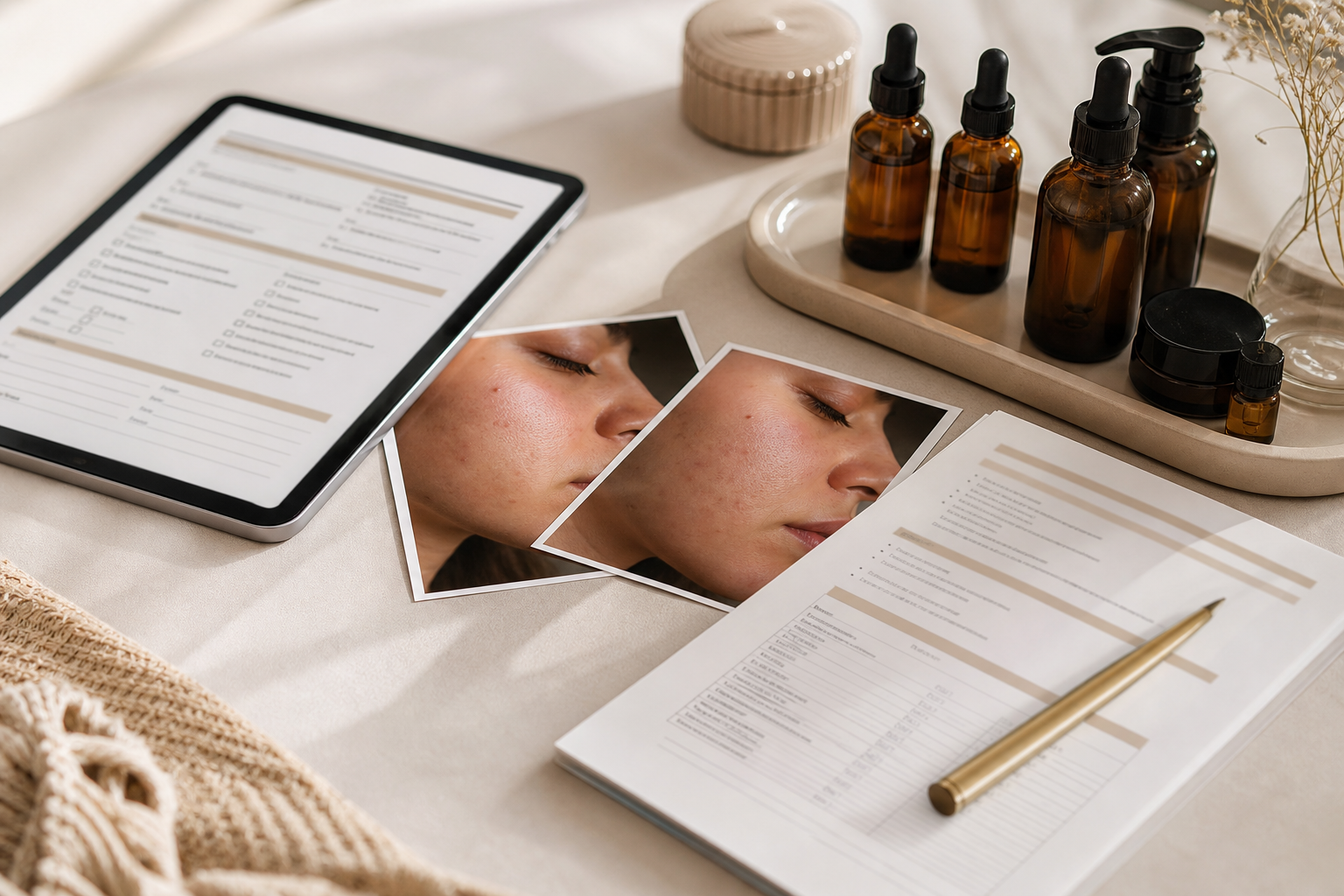
2. Gather your skin history, current products, and clear photos. Document what you've used, what reacted, and what you're on now. Take photos in natural light with no filters. This is exactly the input a remote clinician evaluates, and the quality of the plan depends on the quality of what you submit.
3. Choose a personalized consultation, not a one-size-fits-all box. This is the dividing line between a real plan and a subscription that mails the same formula to everyone. A personalized consultation matches concentration to your tolerance and folds in nutrition and lifestyle — not just a product, but a protocol around it. That distinction is the difference between a generic kit and a plan built for the way your skin actually behaves.
4. Expect a tolerance-building introduction schedule. Actives should be introduced gradually — the 2–3-nights-a-week, pea-sized approach — rather than all at once. If a plan has you layering everything from day one, it isn't built to protect your barrier.
5. Commit to a follow-up cadence. Skin responds over 3–4 months. Macherre's bi-weekly follow-ups over a 3–4 month ProAcne course exist for exactly this reason — to adjust the plan as your skin changes rather than leaving you to interpret the signals alone. Consultations start from $115 | €99, run bilingually in English and Russian, and are built entirely remotely, which is what makes structured care accessible to international readers far from a dermatology clinic.
Your Medical-Grade Skincare Decision Checklist
Run this self-audit before you buy anything or book anything. Each item ties back to something covered above — check honestly.
- Have I given OTC products a genuine 8–12 week trial? Even OTC retinol needs 3–6 months to show results, so quitting early reads as failure when it's really impatience.
- Is my concern chronic, hormonal, or recurring — not occasional? Medical-grade earns its cost on persistent problems, not on the rare breakout.
- Do I know my skin type and current barrier condition? Higher actives applied to a compromised barrier backfire, turning strong ingredients into irritants.
- Am I matching products to my skin, or copying someone else's routine? Mismatched concentration is the main driver of irritation, not the active itself.
- Do I have professional guidance for sequencing actives? Sequencing and pace are where most self-treatment quietly fails, long before the product is the problem.
- Am I prepared for a 3–4 month commitment, not an overnight fix? Skin responds over months; planning for days sets you up to abandon a plan that was about to work.
If three or more of these boxes are unchecked, a personalized consultation will almost certainly save you money against months of trial-and-error — and a structured acne treatment plan built remotely and bilingually from $115 | €99 is a far cheaper path to results than another shelf of half-used medical grade skincare you bought on a guess.
Common Questions About Medical-Grade Skincare
Is medical-grade skincare the same as prescription skincare?
No. Prescription products are FDA-approved drugs, dispensed under medical supervision, with approved indications and defined risk profiles. Most "medical-grade" products are legally cosmetics sold over the counter, according to the FDA. When you weigh medical grade vs prescription skincare, you're comparing a formulation choice against a regulated medical intervention.
Can I buy medical-grade skincare without a consultation?
Usually yes, because most of these products are cosmetics. But buying without guidance means no one is matching the concentration to your tolerance — and that matching is the main driver of results and the main source of irritation, as Prevention's experts and the FDA framework both make clear. The product is available; the judgment isn't included.
How long before I see results from medical-grade products?
It depends on the active. OTC retinol typically takes about 3–6 months, while prescription tretinoin can show changes in roughly 6–12 weeks, per SLMD Skincare (vendor) and the Clinician's Guide to Topical Retinoids. Plan in months, not days, and don't switch products before you've given one a fair window.
Is medical-grade skincare safe for sensitive or rosacea-prone skin?
It can be, but higher actives raise irritation risk when introduced too quickly. Slow, supervised introduction matters most for reactive skin — the gradual, tolerance-building approach the NIH/PMC retinoid guidance describes. Medical grade skincare for acne or rosacea works on sensitive skin only when the pace is right.
Does more expensive always mean more effective?
No. A brand isn't required to run clinical trials to call a product "medical-grade," and StatPearls (NIH) stresses that genuine efficacy should rest on adequately powered studies many products never conduct. As SkinTypeSolutions (vendor) frames it, evidence-based ingredients matched to your skin matter far more than the price on the box.