





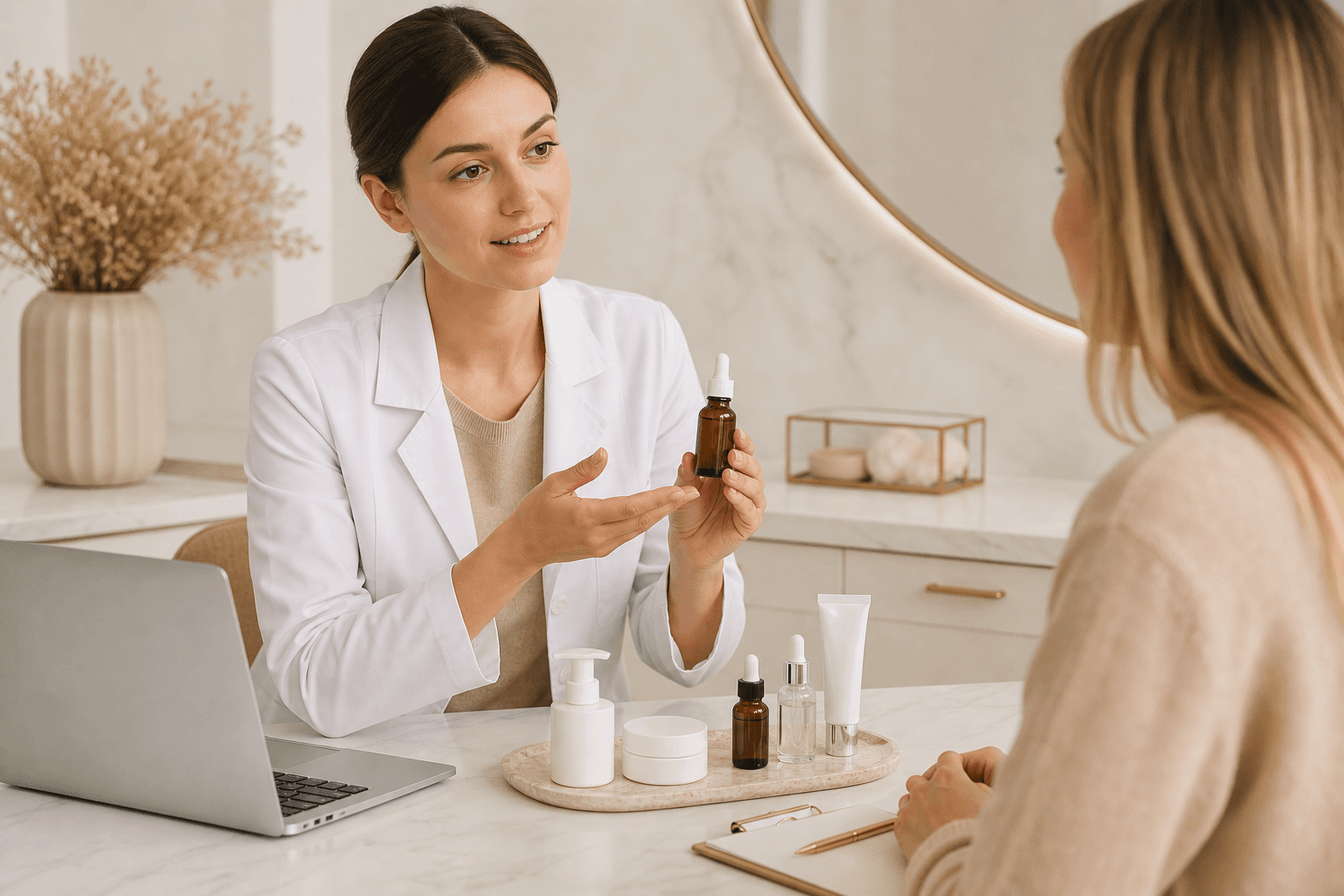
What Is Medical-Grade Skincare? A Cosmetologist Explains the Difference
This article is educational and does not diagnose a condition or replace care from a qualified medical professional.
You have spent months trying products that promised more than they delivered. The label said "dermatologist-recommended." The price felt premium. The packaging looked clinical, almost pharmaceutical — and your acne, your pigmentation, or the flush across your cheeks still hasn't shifted. Now you keep seeing the phrase medical grade skincare and wondering whether it's real, or whether it's another sticker designed to justify a higher price tag. It's a fair question, and you're not naive for asking it. The category is genuinely confusing, partly by design. What follows is a plain-language breakdown from a cosmetologist's chair: what the term legitimately means, when it earns your money, and when you're paying premium prices for something the drugstore aisle could have matched.
Table of Contents
- What 'Medical-Grade' Actually Means — and What It Legally Doesn't
- Drugstore vs. Cosmeceutical vs. Prescription: Where the Line Actually Sits
- The Ingredients That Justify the Label — and the Dosages That Matter
- When Medical-Grade Is Worth It — and When You're Overpaying
- Why the Product Alone Won't Fix Your Skin
- How to Start Safely: A Cosmetologist's Step-by-Step Framework
- Quick Answers Before You Buy
What 'Medical-Grade' Actually Means — and What It Legally Doesn't
Here is the honest core of it: medical grade skincare is not a legally defined or FDA-regulated category. Neither is its close cousin, "cosmeceutical." Both are marketing terms. Any brand can print "medical-grade" on a box without meeting a single specific threshold for potency, ingredient stability, or clinical testing. The dermatologist-run educational resource SkinTypeSolutions makes this point bluntly, and Zensa Skincare's educational content echoes it: because the term is not standardized, a company can apply it freely, which means the label alone guarantees you nothing.
That sounds damning, and it should make you skeptical. But don't throw out the whole category, because the term does signal something real when it's used responsibly. Three things, specifically.
First, higher active-ingredient concentrations than you typically find on a drugstore shelf. A well-made medical-grade line often carries actives at strengths that produce faster, more measurable change.
Second, formulation quality and ingredient stability — the correct pH, protected actives, and better delivery systems. This is the difference between a vitamin C serum that brightens pigmentation and one that oxidizes into a useless, faintly irritating orange liquid before you finish the bottle. Same molecule, opposite outcome.
Third, professional oversight. Genuine medical-grade lines are usually dispensed through clinics or professionals, and they're frequently formulated or vetted by board-certified dermatologists. Orange Coast Dermatology, a US clinic, notes that the medical-grade products they carry have been formulated or approved by board-certified dermatologists and lab-tested — while still being classified as topical cosmetics, not prescription drugs.
That regulatory distinction matters, so let's ground it. In the United States, cosmetics — including virtually everything marketed as "skincare" — are regulated under the Federal Food, Drug, and Cosmetic Act. More recently, the Modernization of Cosmetic Regulations Act (MoCRA), signed in 2022, added real teeth: mandatory registration of cosmetic facilities and products, serious adverse-event reporting, and FDA authority to recall products that harm human health. That's a meaningful step up in accountability.
But here is the part that reframes every "medical-grade" claim you'll ever read. Apart from color additives, cosmetic products and ingredients generally do not require FDA approval before they go on sale. According to the U.S. Food and Drug Administration, cosmetics reach the market without pre-market FDA validation of their efficacy or safety. So labels like "clinical," "professional," or "medical-grade" do not indicate that the FDA has reviewed, tested, or endorsed anything about the product.
MoCRA raised the baseline — good manufacturing practices, more transparency, post-market surveillance. That's genuine progress. But it's still a relatively modest standard. The Campaign for Safe Cosmetics points out that MoCRA does not require the FDA to systematically verify ingredient safety or mandate pre-market safety reviews, which means even a premium, "medical-grade" cosmetic still leans heavily on manufacturer self-policing.
The takeaway for you as a buyer is clean and slightly liberating: the label certifies nothing. The evidence behind the formula and the professional standing behind it are what actually carry weight.
Medical-grade isn't a legal certification — it's a promise about potency and oversight that only means something when a real professional stands behind it.

Drugstore vs. Cosmeceutical vs. Prescription: Where the Line Actually Sits
The cleanest way to hold all of this in your head is a three-tier model. On one end, over-the-counter products you buy off a shelf. On the other, prescription drugs a physician oversees. Medical-grade cosmeceuticals sit in the middle — and that middle is exactly where a lot of confusion lives.
| Attribute | OTC / Drugstore | Medical-Grade (Cosmeceutical) | Prescription |
|---|---|---|---|
| Active concentration | Lower, gradual-acting | Higher than retail, below drug level | Highest; active retinoic acid, etc. |
| Formulation & stability | Variable | Emphasis on stability, delivery, pH | Drug-level purity standards |
| Where you get it | Mass retail, drugstores | Clinics / professionals, no written Rx | Requires a prescription |
| Professional oversight | None required | Recommended / dispensed by pros | Physician oversight required |
| Regulation | Cosmetic (FD&C Act, MoCRA) | Cosmetic (same rules; not a separate class) | Regulated as a drug |
| Typical retinoid result timeline | ~3–6 months (OTC retinol) | Between OTC and Rx | ~6–12 weeks (tretinoin/adapalene) |
Why does the middle tier even exist? Because there's a wide gap between the weak, slow options in the drugstore aisle and the medication-dependent prescription route — and plenty of skin problems live in that gap.
Retinol is the clearest illustration. OTC retinol uses lower concentrations and converts slowly into retinoic acid, the form your skin actually uses. That makes it gentle but patient work: expect visible change in roughly 3–6 months, according to the dermatology education content from SLMD Skincare. Medical-grade retinol is stronger, yet still formulated to convert gradually so irritation stays controlled. Plastic surgeon Dr. Randy Rudderman, cited by Boston Center for Plastic Surgery, describes these serums as aiming for prescription-like results with a more controlled irritation profile. Prescription tretinoin and adapalene skip the conversion entirely — they are retinoic acid. They penetrate deeper, act faster (often noticeable in roughly 6–12 weeks), and require physician oversight because that speed comes with real irritation potential. Alamo Heights Dermatology stresses that these higher-strength, higher-purity products need medical supervision to balance efficacy against safety.
If you're one of the many readers who wants a non-medication, topical-only approach, the cosmeceutical tier is often where you belong: more potent than the drugstore, without committing to prescription drugs. For persistent acne, the right tier depends on your specific case, which is exactly why concern-first matching matters more than grabbing the strongest thing on the shelf. And the recurring theme holds here too — the tier label is a starting point, not a guarantee. Formulation and guidance decide the outcome.
The Ingredients That Justify the Label — and the Dosages That Matter
The single most useful idea in this entire piece is this: the same ingredient can be transformative or worthless depending on its concentration, its stability, and its pH. That's the real value proposition of a well-made medical-grade formulation — not the word on the box, but the chemistry inside it. Cosmetic chemist content like Lab Muffin Beauty Science has long hammered this point: "grade" labels matter far less than formulation and clinical data. Here are the six actives worth understanding.
Retinoids (retinol → retinaldehyde → retinoic acid). These treat acne, rough texture, and early aging. Everything hinges on potency and the conversion pathway — how many steps the molecule takes to become the retinoic acid your skin uses. Medical-grade retinol sits between OTC retinol and prescription tretinoin in strength, which is why it's such a common bridge for people who've outgrown the drugstore but aren't ready for a drug.
Vitamin C (L-ascorbic acid). This brightens, targets pigmentation, and acts as an antioxidant. It's also notoriously unstable. The pH and the packaging determine whether it stays active or oxidizes into an ineffective, sometimes irritating product. There is no clearer case of formulation beating label — two serums with the identical percentage of vitamin C can perform nothing alike.
Niacinamide. This calms redness, supports the skin barrier, and helps with texture and post-acne marks. It's well-tolerated across a wide range of concentrations, so the value lives less in raw strength and more in thoughtful pairing and stable formulation.
Azelaic acid. One of the best multitaskers for rosacea, acne, and post-inflammatory pigmentation. Effective concentration genuinely matters here, but it stays notably non-irritating — which makes it a quiet hero for sensitive skin that reacts to almost everything else.
Alpha and beta hydroxy acids (glycolic, lactic, salicylic). These exfoliate for smoother texture, clearer pores, and less dullness. Concentration and pH together determine both how well they work and how much they irritate — the textbook example that stronger is not automatically better. If blackheads and whiteheads are your main concern, salicylic acid at the right strength and pH matters far more than chasing the highest percentage you can find.
Growth factors and peptides. These support repair and early-aging concerns. Whether they penetrate meaningfully depends almost entirely on the delivery system and formulation stability — an area where careful medical-grade formulation can genuinely earn its price.
The thread running through all six: potency without formulation knowledge is a gamble, and it's your skin and your money on the table.

When Medical-Grade Is Worth It — and When You're Overpaying
Not everyone needs medical-grade skincare. Saying that out loud is the most honest thing a cosmetologist can do, because the truth builds more trust than a blanket recommendation ever could. Use the situation below to locate yourself before you locate a product.
| Skin situation | OTC often sufficient? | Medical-grade often worth it? | Professional guidance essential? |
|---|---|---|---|
| Mild, occasional breakouts | Yes | Rarely needed | No |
| Chronic or hormonal acne | Usually not | Often yes | Yes |
| Stubborn pigmentation / post-acne marks | Sometimes | Often yes | Yes |
| Rosacea & reactive skin | Depends | Case-by-case | Yes |
| Early aging concerns | Sometimes | Can help | Recommended |
| "I've tried everything" | No | Likely yes | Yes |
If your skin throws the occasional breakout or looks a little dull, well-chosen OTC products and genuine consistency are usually enough. Spending on high-potency actives at that point is overpaying — you're buying strength your skin doesn't need and might not tolerate.
The calculus changes with chronic or hormonal acne, stubborn pigmentation, and reactive or rosacea-prone skin. These are precisely the situations where self-selecting high-potency actives without a plan goes wrong. This is where I see barrier damage: someone reads that stronger is faster, stacks three actives, and ends up more inflamed than when they started. Post-acne marks and discoloration are especially unforgiving, because the wrong aggressive routine can deepen the very pigmentation you're trying to fade.
Remember that "medical-grade" isn't standardized. SkinTypeSolutions makes the point that because there's no threshold to meet, buying "stronger" blindly can mean paying premium prices for something no better than a drugstore product — or something too aggressive for your particular skin. And because even MoCRA doesn't verify efficacy, price and label are poor proxies for suitability. A high price tag tells you what a brand charges, not what your skin needs.
So decide concern-first, not product-first. Name the problem accurately, then match the tier and the actives to it. That order of operations is what separates people who see results from people who accumulate half-used bottles.
Buying stronger products without a plan is how sensitive skin gets worse, not better — potency without strategy is just faster damage.
Why the Product Alone Won't Fix Your Skin
Here's the shift that changes everything about how you spend: a medical-grade product is a tool, not a treatment plan. Buying the right serum and following a supervised protocol are two very different things, and the gap between them is where most disappointing results are born.
A real plan accounts for variables a product on a shelf simply cannot.
It starts with your skin type and barrier status. Before any potent active goes on your face, someone should assess whether your barrier can handle it. Introduce a strong retinoid to a compromised barrier and you don't get faster results — you get weeks of setback.
It considers layering order and compatibility. Stacking retinoids with high-strength acids without thought is a reliable way to over-exfoliate. Which active goes where, and with what, is a decision, not a guess.
It includes ramp-up scheduling. Introducing one active at low frequency and building tolerance over weeks is the difference between adaptation and reaction. Potent actives reward patience and punish impatience.
And it depends on response-based adjustment — changing course based on how your skin actually behaves over weeks, not on what the box promised. Skin talks back. Someone needs to be listening.
This is where the regulatory reality lands with full force. Because cosmetics — medical-grade lines included — rely heavily on manufacturer self-policing with no mandatory pre-market efficacy review, the professional interpreting your skin's response matters more than any marketing claim on the label. The Campaign for Safe Cosmetics has been clear that MoCRA does not require systematic verification of ingredient safety or pre-market safety reviews, which means the burden of judgment shifts to you — or to the professional guiding you. Clinicians at Orange Coast Dermatology and Alamo Heights Dermatology make the same practical case: higher concentrations of actives call for professional guidance, not solo experimentation.
There's a bigger frame here too. Skin is systemic. It reflects what you eat, how you sleep, your stress, your hormones — not just what you apply at night. A serious plan looks at nutrition, daily habits, and topical care together, because a single serum can't outwork the rest of your life. Sensitive and reactive skin especially needs this wider lens; monitoring barrier response over time tells you more than any ingredient list can.
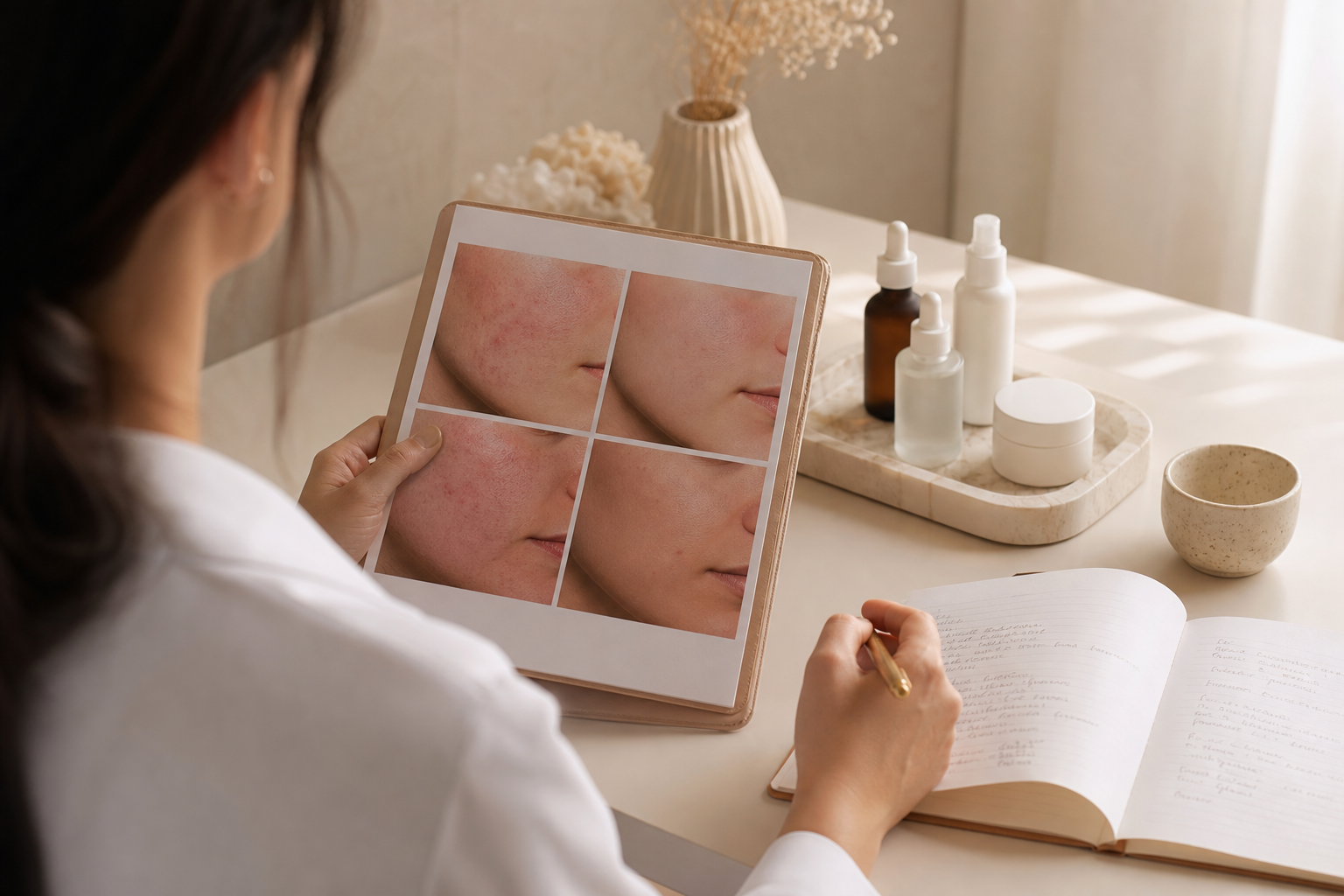
Consider the difference between two models. In one, a formula ships to your door and you're left to hope it works. In the other, a professional reviews your skin through photos, adjusts your protocol based on what they see, and reassesses at intervals over a multi-month course. The first is a transaction. The second is guidance. Given that retinoids and most actives take months rather than days to show their real effect — the same timelines we mapped earlier — monitoring across a 3–4 month window isn't padding. It's the minimum time frame in which meaningful change actually reveals itself, which is exactly why early signs of aging are treated over months, never weekends.
The right molecule at the right strength still fails if no one is watching how your skin actually responds over time.
How to Start Safely: A Cosmetologist's Step-by-Step Framework
If you've read this far and feel ready to move toward stronger, better-formulated products, here's a roadmap that protects both your skin and your budget. Follow it in order.
1. Identify your primary concern honestly. Acne, pigmentation, sensitivity, and aging drive very different choices, and chasing several at once is one of the most common mistakes I see. If age spots and hyperpigmentation are your real priority, name that clearly — a routine built for acne won't serve you, and trying to solve everything simultaneously usually solves nothing.
2. Audit your current routine. Write down what's working and what's irritating, how often you use each product, and how your skin reacts. Note whether dry, dehydrated skin or texture issues are complicating the picture. You cannot fix what you haven't mapped, and this audit alone often reveals the culprit behind ongoing irritation.
3. Get a professional skin assessment before buying high-potency actives. Because "medical-grade" isn't standardized and stronger isn't automatically better, matching actives to your specific barrier prevents both wasted money and real damage. This step is where the guesswork ends.
4. Introduce one active at a time on a ramp-up schedule. Start at low frequency and build gradually. Don't stack multiple potent actives from day one — that's how tolerance-building turns into a reaction that sets you back weeks.
5. Document with photos every two weeks. Consistent photos in the same lighting reveal slow progress the mirror hides, and they flag early irritation before it becomes a problem. Your memory is unreliable; your camera isn't.
6. Reassess and adjust — don't stack blindly. Real results come from iteration over a 3–4 month window, not from adding more products every time you feel impatient. The skill is in adjusting one variable at a time and reading the response.
None of this requires a leap of faith or a big upfront spend on potent products you're not sure you need. A personalized remote assessment — a form, your photos, and a professional's read on your medical grade skincare options — is the low-risk first step that saves you from the far more expensive path of trial and error. Start with understanding your skin. The right products follow from there.
Quick Answers Before You Buy
Is medical-grade skincare the same as prescription skincare?
No. Prescription products such as tretinoin and adapalene contain drug-level active retinoic acid, require a prescription and physician oversight, and are regulated as drugs. Medical-grade products are still classified as cosmetics — stronger than typical retail, often dispensed through professionals without a written prescription, but not held to drug-level FDA standards. Alamo Heights Dermatology and Orange Coast Dermatology both draw this line clearly: the difference is one of strength, purity, and regulatory class, not just marketing.
Can I get medical-grade products without an in-person dermatologist visit?
Often, yes. These lines are dispensed through professionals rather than mass retail, and remote consultation models let a qualified professional assess your skin from photos and a detailed intake form, then guide product selection and monitor your response over time. What matters is professional oversight — not whether you're sitting in a physical waiting room. Location is logistics; guidance is the substance.
Are medical-grade products safe for sensitive or rosacea-prone skin?
They can be, with the right choices. Azelaic acid and niacinamide, for instance, are well-tolerated multitaskers that often suit reactive skin well. But higher potency raises irritation risk across the board, so sensitive and rosacea-prone skin especially benefits from professional guidance and a slow ramp-up rather than self-selection. The goal is calm, steady progress — not the fastest possible result.
How long before I see results with medical-grade skincare?
Set realistic expectations. OTC retinol typically shows visible change in about 3–6 months, according to SLMD Skincare and telehealth medical content from Felix; medical-grade sits between OTC and prescription; prescription retinoids can act in roughly 6–12 weeks. A supervised 3–4 month course is a realistic window for meaningful results across most concerns. Anyone promising overnight transformation is selling the label, not the outcome.