





How to Fade Post-Acne Marks Safely
This article is educational and does not diagnose a condition or replace care from a qualified medical professional.
Fading the brown and red spots acne leaves behind is realistic for most people, but it follows a slower clock than many product ads suggest. With a consistent routine built around daily sun protection and a small number of proven brightening ingredients, most post-acne discoloration lightens meaningfully over roughly 12 to 16 weeks, and often keeps improving across three to four months. That is the honest answer to how to fade post acne marks safely: not a single miracle serum, but a sequenced routine that calms inflammation first, protects the barrier, and only then works on pigment. On the budget side, an at-home approach centered on sunscreen, moisturiser, and one or two active serums sits well below the cost of in-clinic peels or lasers. When you want that framework built around your exact skin, our online post-acne and discoloration consultations at Macherre Medical Center start from around $115 | €99.
Table of contents
Know what you are actually treating
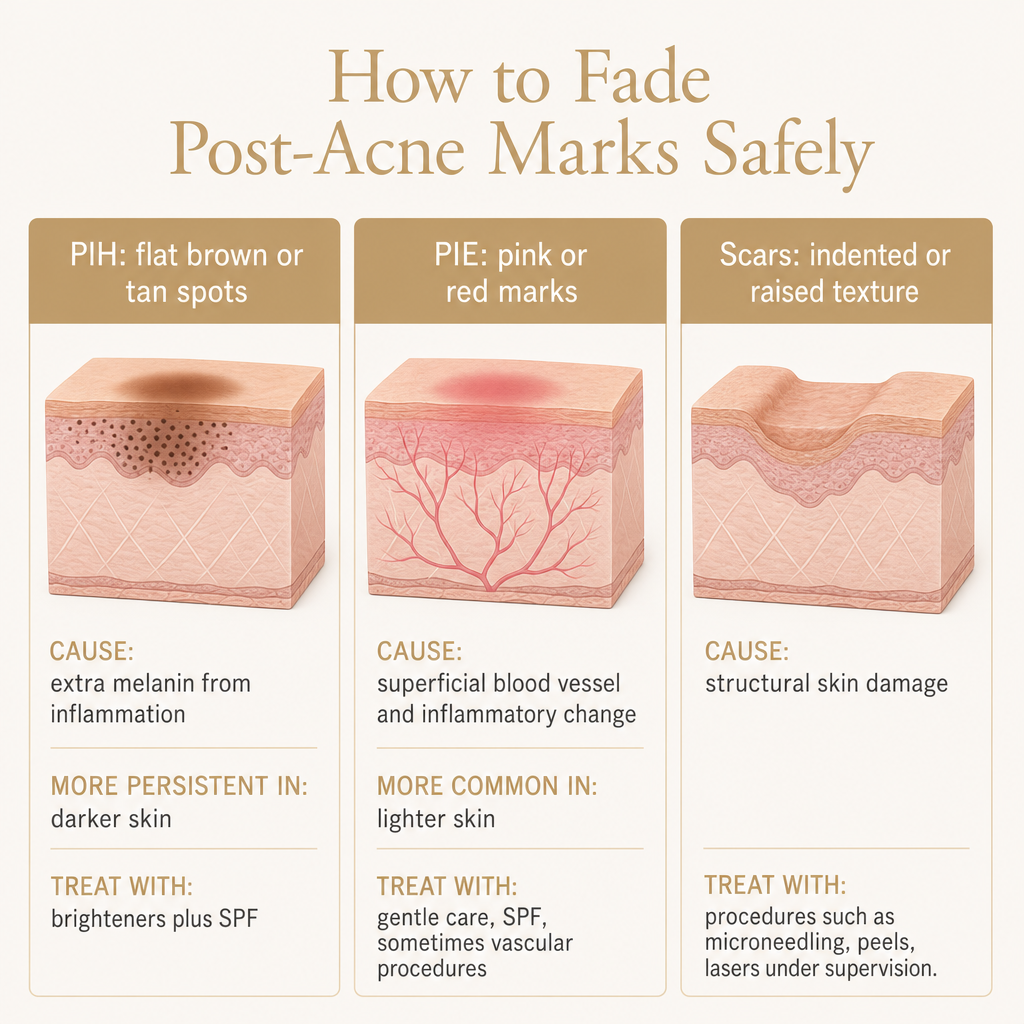
The biggest early error is treating every leftover spot the same way. Post-acne marks fall into three distinct groups, and each responds to a different strategy.
Post-inflammatory hyperpigmentation (PIH) shows up as flat brown or tan spots where a pimple used to be. Inflammation triggers extra melanin production, and this type is more common and more stubborn in darker skin tones. Pigment-focused brighteners plus strict sun protection are the right lever here.
Post-inflammatory erythema (PIE) is the pink or red mark, more typical in lighter skin. It relates to superficial blood vessels and inflammation rather than pigment, so it often improves with gentle care, sun protection, and time, and sometimes with vascular-targeted procedures. Classic pigment lighteners do less for it.
True scars are textural: indented "ice-pick" or "boxcar" depressions, or raised areas where skin structure was damaged. These do not respond much to fading serums and usually need procedures such as microneedling, peels, or lasers under professional supervision.
Getting this classification right saves months. Our Post-Acne and Discoloration Treatment stream deliberately separates discoloration from textural scarring, then tailors the plan to whether you are dealing with pigment, texture, or a mix of both.
Before you start: a readiness checklist
An intensive fading routine works only when the groundwork is in place. Run through this list before layering on actives.
- Your acne is at least partly controlled. You should not be forming new inflamed cysts every week; otherwise you keep generating fresh marks faster than you can fade old ones.
- You can commit to daily broad-spectrum SPF 30+. Ultraviolet and visible light darken PIH and prolong healing. Every clinical guideline treats sunscreen as non-negotiable, not optional.
- Your skin barrier is reasonably intact. Widespread stinging, peeling, or open lesions make acids and retinoids risky rather than helpful.
- You can tell PIH from PIE from scars. Brown or tan points to pigment and brighteners; red or pink points to erythema and gentle care; indented or raised points to a procedural conversation.
- You know roughly your skin type and sensitivity history. Your skin tone and past reactions influence which actives, such as retinoids, azelaic acid, or hydroquinone, can be used safely.
- You are not planning to self-treat with strong peels or lasers. Chemical peels and energy-based devices for pigmentation belong under professional supervision, particularly in skin of colour.
If you cannot tick most of these, starting conservatively is the safer path. Our post-acne and discoloration consultation is built for exactly this stage, so you avoid self-experimenting your way into more pigment. Because so many marks trace back to unresolved breakouts, it is also worth reading our companion guide on hormonal acne treatment for adults if new lesions keep appearing.
The four-phase routine, step by step
We usually structure post-acne fading in four phases: control inflammation, repair the barrier, fade pigment, then maintain. The sequence matters more than any single product, because pushing brighteners onto irritated skin often creates new pigment.
Phase 1 — Calm inflammation and active acne
- Cleanse gently, morning and night. Use a mild, pH-balanced cleanser with fingertips only. Skip scrubs and brushes; over-cleansing and friction raise inflammation and PIH risk.
- Treat the acne with low-irritation actives. Depending on your skin, options include benzoyl peroxide, topical retinoids such as adapalene or tretinoin, and azelaic acid. Azelaic acid is especially useful because it addresses both acne and PIH with a lower irritation profile, including in skin of colour.
- Stop picking and squeezing. Manipulating lesions reliably increases inflammation, redness, and scarring risk. It is one of the highest-impact habits to break.
Phase 2 — Repair and protect the barrier
- Moisturise daily to match your skin type. A hydrating, non-comedogenic moisturiser reduces irritation from actives and supports barrier recovery. A calm barrier tolerates brighteners far better and lowers the chance of rebound pigmentation.
- Apply broad-spectrum SPF 30+ every morning. Sunscreen is the backbone of PIH management, since UV darkens spots and slows their resolution. Tinted or mineral formulas add visible-light protection, which is increasingly recognised as a driver of hyperpigmentation.
Our pigmentation protocols always pair brightening actives with a tailored sunscreen recommendation and practical lifestyle adjustments, from seeking shade to timing outdoor activity.
Phase 3 — Fade pigment, introduced slowly
Once basic acne care and daily SPF are comfortable, layer in brighteners one at a time. For most of our remote patients the core stack draws from azelaic acid, retinoids, niacinamide, and vitamin C, adjusted to sensitivity.
- Azelaic acid, usually PM, two to five nights a week to start. It competitively inhibits tyrosinase, a key enzyme in melanin synthesis, and selectively targets overactive melanocytes. Clinical data show strong improvement in acne-induced PIH over 12 to 24 weeks, with efficacy comparable to hydroquinone in some studies but better tolerance. It suits mixed acne plus PIH, sensitive or rosacea-prone skin, and darker tones needing gentle pigment control.
- Topical retinoid on alternate evenings, if tolerated. It speeds epidermal turnover, pushing pigmented cells out faster while treating comedonal acne. Start low and build slowly, because retinoid dermatitis can itself worsen PIH if it becomes severe.
- Niacinamide, often in the morning. It reduces pigment transfer from melanocytes to surrounding cells rather than blocking melanin production directly. Azelaic-acid-plus-niacinamide regimens have shown large improvements in acne and PIH with good tolerability over 12 to 16 weeks.
- Vitamin C, a few mornings per week. An antioxidant that helps reduce oxidative stress and can lighten pigment. Many clinicians start around 10 to 15% and increase frequency gradually to avoid irritation.
A practical rule we apply: choose one main evening active, either a retinoid or azelaic acid, plus one simple brightening step in the morning, rather than stacking several strong acids at once.
Phase 4 — Maintain and progress
- Simplify once marks fade. Most guidance favours continuing sunscreen plus a low-intensity brightener such as azelaic acid or niacinamide, instead of cycling stronger peels indefinitely.
- Escalate only when needed. If PIH stays bothersome after several months of consistent care, or if scars are indented or raised, dermatology practices may add superficial peels, microneedling, or selected laser and light treatments under specialist supervision. When a remote plan plateaus, we often coordinate local in-person procedures while continuing to manage the topical and lifestyle side.
Common mistakes and how to troubleshoot them
Most stalled results trace back to a short list of avoidable errors.
- Treating marks while ignoring new acne. Chasing pigment while fresh breakouts continue guarantees a fresh crop of PIH and hides your progress.
- Treating sunscreen as a sunny-day product. Inconsistent SPF is one of the most common reasons hyperpigmentation refuses to improve.
- Over-exfoliating or stacking too many actives. Daily high-strength AHAs, BHAs, retinoids, and vitamin C together often irritate the skin, and irritation itself triggers new pigment.
- Reaching for strong peels or devices without guidance. Unsupervised peels, microdermabrasion, and lasers carry a real risk of worsening PIH, especially in darker or reactive skin.
When something goes wrong, work through it in order:
Persistent stinging, burning, or redness. Pause all exfoliating acids and retinoids. Run moisturiser and SPF only until symptoms settle, then reintroduce a single active at lower frequency and concentration.
Marks darken or spread despite treatment. Check sun exposure and SPF habits first, then rule out an irritant reaction to a new product. If it continues, a remote assessment can confirm whether you are truly dealing with PIH, PIE, melasma, or a different pattern that needs a different plan.
No improvement after roughly three to four months. A genuine lack of response after several months of appropriate care is a signal to re-evaluate, not to add more products. This is the point where structured follow-ups, like the bi-weekly reviews in our post-acne and discoloration program, tend to outperform further solo adjustments.
DIY or professional: where the line sits
Staying at home is usually reasonable when your acne is mild to moderate and improving, your marks are mainly flat brown PIH rather than deep scars, you tolerate azelaic acid, niacinamide, and a low-strength retinoid without significant irritation, and you can hold a strict daily SPF and a simple, consistent routine.
Lean toward a structured consultation, online or in person, in these situations:
- Mixed PIH and PIE, or suspected rosacea and very sensitive skin. These overlaps need careful ingredient selection and sometimes procedural options best planned by a specialist. Our rosacea management stream exists for this redness-plus-reactivity picture.
- Deep, indented, or raised scars. Textural damage rarely responds to serums alone and typically needs microneedling, peels, or laser under dermatologic guidance.
- Darker skin tones with a history of product or procedure burns. Here, cautious use of peels and lasers matters, and pigment-modulating topicals overseen by a specialist are generally favoured.
- Little to no improvement after three to six months of compliant care. This is a standard trigger for a professional evaluation to reset expectations and options.
When you consult us, you pick the stream that matches your main concern, complete an online form, and upload clear photos. Dr. Maria assesses your acne type, pigment pattern, sensitivity, and lifestyle, then builds a personalised plan spanning cleanser, targeted actives, moisturiser, sunscreen, and nutrition and habit guidance. For post-acne and discoloration, follow-ups every two weeks across three to four months let us titrate actives safely and adjust quickly if irritation or a plateau appears. It is a remote-first path for people who want evidence-based supervision without a medication-heavy or clinic-bound routine, rather than pure trial and error.
Frequently asked questions
How long do post-acne brown marks usually take to fade?
Most PIH improves noticeably over 12 to 16 weeks with consistent brightening actives and daily SPF. Complete clearance can take several months longer, and the deepest, oldest marks may not disappear entirely.
Can I fade marks without treating the acne itself?
No. Controlling active acne is the first step in every PIH approach, because new inflammation keeps producing new marks faster than you can fade the old ones.
Is hydroquinone necessary, and is it safe?
Hydroquinone is a long-standing depigmenting agent used short-term for stubborn PIH, but it is usually reserved for supervised use because of irritation and rebound risks. Many people do well with azelaic acid, retinoids, niacinamide, and vitamin C alone.
Can I combine azelaic acid with retinoids and niacinamide?
Evidence supports pairings such as azelaic acid with tretinoin and azelaic acid with niacinamide for PIH, with meaningful improvement and acceptable tolerance when introduced gradually rather than all at once.
Do I really need sunscreen if I mostly stay indoors?
Yes. Broad-spectrum SPF 30+ is recommended daily, because UVA penetrates windows and both UV and visible light can darken hyperpigmentation.
When should I consider a structured online program?
If you have combined acne and pigmentation, several failed routines, or moderate to severe marks that have not improved after a few months, a personalised, follow-up-based program tends to deliver safer, more realistic progress than continued DIY changes.