





How to Describe Skin Concerns to a Cosmetologist
This article is educational and does not diagnose a condition or replace care from a qualified medical professional.
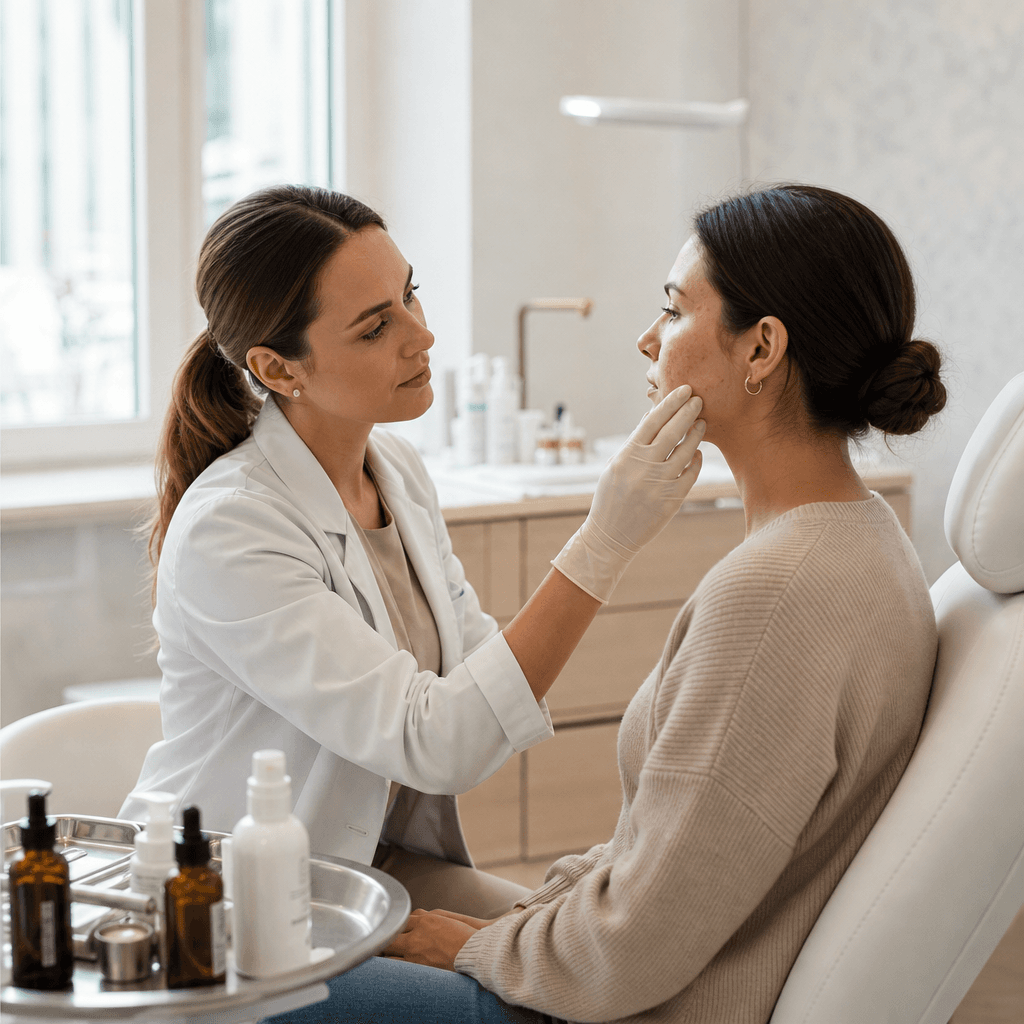
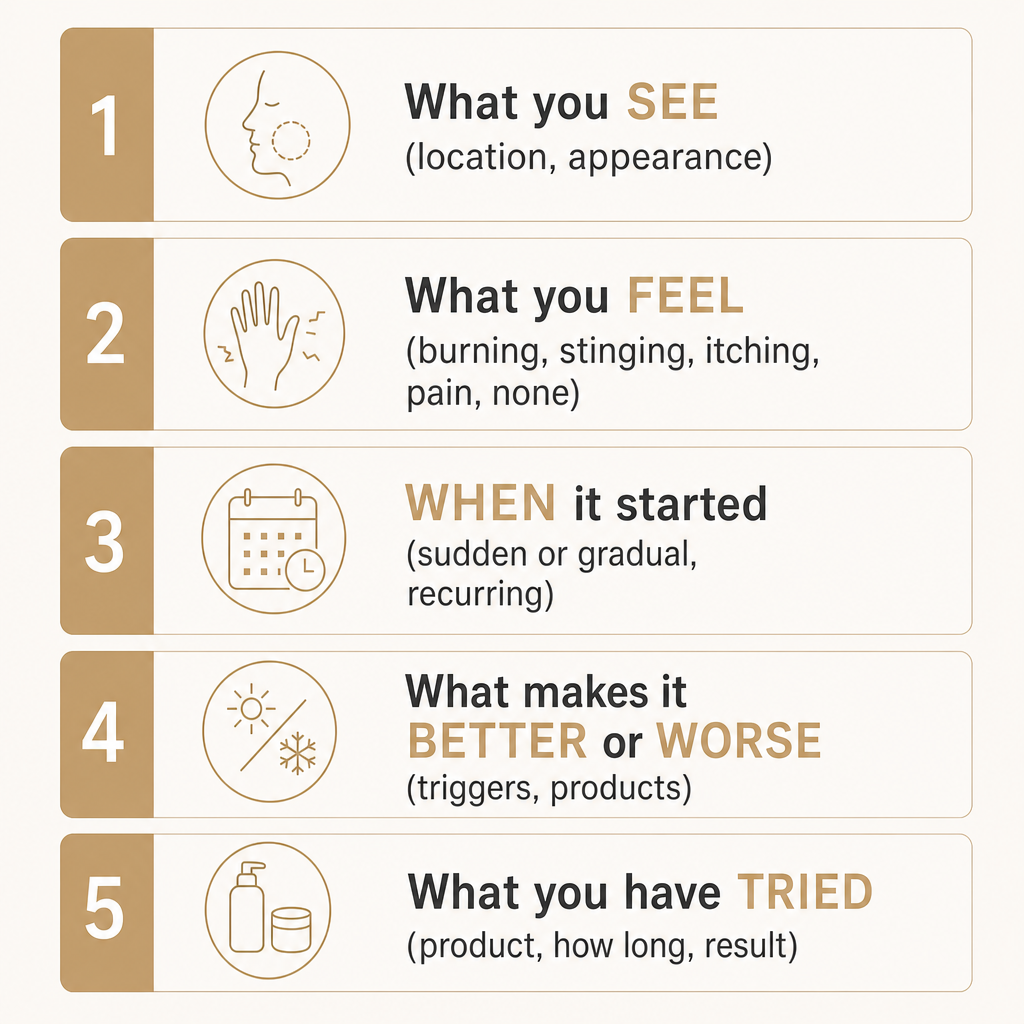
If you are unsure how to describe skin concerns to a cosmetologist, start with five anchors: what you see, what you feel, when it started, what makes it better or worse, and what you have already tried. Those details let us understand your priorities, judge whether cosmetic guidance is appropriate, and recognise when you should first see a dermatologist or another medical professional. This is general education, not a diagnosis. No one can confirm every skin condition from a single conversation or photograph, and some symptoms need a medical assessment before any routine is built.
The quiet truth of a good consultation is that precision beats medical vocabulary. You do not need to arrive with the right diagnosis. You need an honest, specific account of your skin so the plan matches your real concern rather than a label you guessed at.
Table of contents
What we actually need to know about your skin
Instead of saying "I think I have hormonal acne" or "this is definitely rosacea," describe the observable pattern. A label can quietly steer the conversation toward the wrong plan; a clear description keeps it open.
Six details carry most of the useful information:
- Location: forehead, cheeks, jawline, chest, back, around the mouth, or elsewhere.
- Appearance: bumps, blackheads, whiteheads, redness, flakes, dark marks, uneven texture, swelling, or visible vessels.
- Sensation: itching, burning, tenderness, tightness, pain, or nothing at all.
- Timing: when it began, whether it is constant or recurring, and whether it follows a pattern.
- Severity: occasional, frequent, widespread, deep, painful, or interfering with daily life.
- Changes: whether the concern is improving, worsening, spreading, or leaving marks.
Compare "my skin is bad" with this:
For about eight months I have had tender bumps mainly along my jawline. They become more frequent before my period and sometimes leave brown marks. I use a cleanser, moisturiser, and sunscreen, but I stopped exfoliating acids because they stung.
The second version tells us location, timing, a possible cyclical pattern, a secondary concern (marks), and a product that caused irritation. That is enough to begin reasoning about your skin instead of guessing.
It also helps to state the outcome you want, because priorities shape advice. "My main concern is recurring inflamed spots, not occasional blemishes" leads somewhere different from "the acne has improved, but the brown marks remain" or "I want a simple routine rather than several new products." Someone focused on active breakouts needs a different discussion from someone whose main worry is discoloration or stinging.
Separate the active problem from the leftover marks
People often use "acne" to describe several different things at once, and merging them hides what you most want fixed. Pulling them apart is one of the most useful things you can do before a consultation.
- Active lesions: new spots, pus-filled bumps, blackheads, whiteheads, or deeper painful lumps.
- Post-inflammatory hyperpigmentation: brown or grey marks left after inflammation settles.
- Post-inflammatory erythema: pink or red marks where a spot has healed.
- Texture changes: dents, raised scars, roughness, or pores that look enlarged.
- Irritation: burning, scaling, redness, or tightness caused or worsened by products.
A sentence like "I get two or three inflamed spots each week, but the bigger issue is that each one leaves a dark mark that lasts for months" tells us to address both the breakouts and the marks they leave, which are managed differently.
If blackheads or whiteheads are your main concern, our blackheads and whiteheads removal consultation focuses there. For lingering dark marks or uneven colour, our post-acne and discoloration treatment is the better fit, while our skin texture improvement consultation covers roughness and uneven surface. One caution worth repeating: do not assume every dark spot is a post-acne mark. A new or changing pigmented area may need medical evaluation rather than a cosmetic plan.
Put your concern on a timeline
Time course gives a concern its context. Where possible, include the approximate month or year it began, whether it appeared suddenly or gradually, whether it has happened before, whether it is becoming more frequent, and whether it runs in cycles. Note too if it started after an illness, a medication, pregnancy, a contraception change, a move, or another significant life change.
I had occasional spots as a teenager, but the deeper breakouts began in my late twenties. They are mostly on my chin and jaw, and they have become more frequent over the last six months.
The American Academy of Dermatology recommends preparing this kind of history, along with a list of medications, vitamins, and supplements, before an acne appointment (American Academy of Dermatology). When you describe timing, keep cause and observation separate. "I notice a pattern around my period" is more accurate and more useful than "my hormones are definitely unbalanced." The pattern is something we can work with; the conclusion is something a consultation may or may not support.
Describe sensation, not just appearance
"Sensitive" means very different things to different people, so the specific feeling matters as much as the look. Visible redness with burning points toward a different conversation than redness with no discomfort at all.
| What you notice | How to describe it |
|---|---|
| Burning | It burns immediately after applying some products. |
| Stinging | Water or moisturiser stings on my cheeks. |
| Tightness | My skin feels tight after cleansing. |
| Itching | The area is itchy, especially at night. |
| Tenderness | The bumps hurt when touched. |
| Flushing | My cheeks become hot and red after heat or exercise. |
| No sensation | The marks are visible but do not itch or hurt. |
If you flush frequently, stay persistently red, or react to many products, that belongs in your description. Our rosacea management consultation and sensitive skin care consultation are built around exactly these reactive patterns, and the sensation you report helps us choose between them.
List everything currently touching your skin
A complete product and medication history prevents the two most common surprises in a consultation: a hidden irritant and an interaction. Include products you use only occasionally.
- Cleanser, toner, moisturiser, sunscreen, and makeup.
- Acne products, exfoliating acids, and spot treatments.
- Retinoids or other active ingredients.
- Haircare products that touch the face, neck, or back.
- Prescription and non-prescription medicines.
- Vitamins and supplements.
- Recent professional treatments: peels, waxing, laser, injections, or extractions.
For each item, say how often you use it, when you started, whether it helped, and whether it caused burning, dryness, itching, or new breakouts. The AAD specifically advises patients to list medications, vitamins, supplements, and non-prescription acne products, because any of these can contribute to a concern or interact with treatment (American Academy of Dermatology).
If you can, photograph the products or write down the ingredient names. "A blue bottle from the pharmacy" rarely identifies a formula. One more practical note: avoid restarting several abandoned products in the days before a consultation. We may need to see your skin in its usual state, and a sudden change makes the history harder to read.
Patterns, triggers, and relevant health details
Triggers are not always causes, but patterns are worth naming. Mention whether symptoms shift with menstruation or other hormonal changes, pregnancy or contraception, stress or poor sleep, heat, sun, or cold, exercise and sweating, masks or tight clothing, shaving, new makeup or detergent, travel, or a consistent dietary pattern you have genuinely noticed.
Keep the wording neutral. "I notice more flushing after hot showers" is more useful than "hot showers caused my skin condition," because the first invites discussion and the second closes it.
Some health information also changes what is safe to recommend. Share known allergies; a history of eczema, asthma, hay fever, or contact reactions; previous diagnoses of acne, rosacea, dermatitis, or psoriasis; pregnancy, breastfeeding, or plans to conceive; current medicines including hormonal ones; relevant recent blood tests; a personal or family history of skin cancer; and any treatment that caused a significant reaction. You do not need to share unrelated private details, but do not leave out a health fact simply because it seems unconnected to your skin. If you are unsure whether something matters, mention it and ask.
Photographs are supporting evidence, not a verdict
For an online consultation, consistent photographs show distribution and change over time. Take them in natural or even light, without beauty filters, from the front and both sides, at a steady distance, on clean skin when requested, and include both close-ups of the main area and wider shots that show how far it spreads.
Photographs still have limits. They may not reliably capture texture, warmth, tenderness, or how quickly redness appears. Describe those features in writing so the image and your words complete each other rather than leaving gaps.
When a cosmetologist is not your first contact
Some changes call for medical assessment before any cosmetic plan. Treat the following as reasons to seek a clinician rather than a routine:
- A new or changing mole, or a mole changing in size, shape, or colour.
- An irregular mark, or a mark with several colours.
- A lesion that bleeds, crusts, becomes inflamed, painful, or itchy.
- A new or unusual mark that does not fade after a few weeks.
- A dark area beneath a nail with no injury to explain it.
The NHS advises arranging a GP assessment for these changes, including unusual marks on the palms, soles, or beneath a nail (NHS). The AAD similarly advises mentioning an itching, bleeding, or changing mole when scheduling care (American Academy of Dermatology). Prompt medical advice also fits rapidly worsening symptoms, severe pain, widespread blistering, facial swelling, breathing difficulty, or signs of infection such as spreading warmth, pus, or fever. A cosmetology consultation should never delay assessment of a possible skin cancer, serious infection, or severe reaction.
How this maps onto a Macherre online consultation
Everything above feeds directly into how we work. Our current Virtual ProAcne program opens with an extended acne and rosacea consultation that reviews your skin history, current routine, lifestyle, and any blood-test results you provide. From there you receive a starting plan with a morning and evening routine, product options, and a gradual introduction schedule, then a progress review every two weeks using fresh photos and either a video call or a structured chat review, with direct-message support between check-ins.
The program page describes a length of 4–6 months, with the exact duration depending on your starting point, how your skin responds, and your consistency with the plan. Because pricing and the way products are included can differ between options, confirm the current terms on the live Virtual ProAcne program page before booking rather than relying on a figure quoted elsewhere.
A clear intake message pulls the anchors together. Something like this gives us enough to begin:
My main concern is recurring acne and dark marks on my cheeks and jaw. It began about a year ago and became more frequent over the last four months. I get small inflamed spots two or three times a week, with occasional deeper tender bumps. The marks are brown and do not itch. I currently use a gentle cleanser, moisturiser, and SPF 30. I stopped a retinoid because of peeling. I take a combined contraceptive pill and have no known allergies. I would like a simple routine and advice on preventing irritation.
These are program terms, not a promise of a cure or a fixed result. A personalised plan may be adjusted, paused, or referred to medical care if your symptoms suggest something outside routine cosmetology support. If your main concern is not acne, the same descriptive habits apply to our acne treatment consultation and to the other focused consultations linked throughout this guide.
Frequently asked questions
How detailed should my description actually be?
Detailed enough to cover location, appearance, sensation, timing, and what you have tried. You do not need medical terms. A few specific sentences about what you see and feel are more useful than a suspected diagnosis.
Should I stop all my skincare before a consultation?
No, unless you have been told to. Keep your usual routine, prepare a complete list of what you use, and flag anything that caused irritation. We may suggest simplifying the routine only after reviewing your history.
What if I do not know whether it is acne, rosacea, or irritation?
That is completely fine. Describe the appearance, sensations, location, timing, and triggers, and leave the labelling to the consultation. Sorting out which support is appropriate—and whether medical assessment is needed—is part of the process.
How long does the Virtual ProAcne program last?
The current program page lists 4–6 months, with the exact duration set individually according to your starting point, your skin's response, and your consistency with the plan. Confirm current details on the live program page.
What should I do about a changing mole or unusual dark mark?
Arrange a medical assessment rather than treating it as a cosmetic concern. The NHS recommends seeing a GP for a mole that changes size, shape, or colour, or for a new or unusual mark that persists.