





Hormonal Acne Treatment for Adults Explained
This article is educational and does not diagnose a condition or replace care from a qualified medical professional.
If your breakouts cluster along the jawline, chin, and lower face, worsen before your period, and keep coming back despite drugstore products, you are likely dealing with hormonal acne. Effective hormonal acne treatment for adults means calming the androgen-driven oil production and inflammation behind those deep, tender bumps rather than chasing individual spots. At Macherre Medical Center, we build that around a personalized, remote-first plan that layers medical-grade topical care, nutrition, and lifestyle change, so the treatment fits your skin type and health rather than a generic routine.
This guide explains what makes adult acne hormonal, why it behaves the way it does, the evidence-based options available, and how to decide which tier of care is right for you.
Table of contents
What hormonal acne actually is in adults
Hormonal acne is acne where fluctuations or excess of androgens, the male-type hormones that both men and women produce, drive oil overproduction, clogged pores, and inflammation. In adults, and particularly in women, this often appears as deep, tender bumps or cysts along the jawline, chin, and neck, with flares before menstruation or during stress, pregnancy, or perimenopause.
One detail matters more than most people realize: hormonal acne can occur with completely normal lab results. Some women experience what researchers call cutaneous hyperandrogenism, where the skin behaves as if hormone levels are high even when blood tests come back normal. That is why treatment decisions rest on the clinical pattern of your breakouts, not only on numbers.
Guidelines on adult female acne note that hormone-directed therapy becomes most relevant when there is severe oiliness, clear premenstrual worsening, endocrine changes, or persistent inflammatory acne that has resisted standard treatment. For men, true hormone-blocking therapy is used far less often, but androgens still fuel excess sebum and can contribute to late-onset, resistant acne that needs more advanced non-hormonal approaches.
Why hormones keep adult breakouts going
Adult acne follows the same core mechanism as teenage acne. The difference is that hormones and lifestyle keep the process active for longer, which is why breakouts persist into your late twenties, thirties, and beyond.
The chain works like this. Androgens such as testosterone and DHEAS bind to receptors in the sebaceous glands and increase sebum production. That oily, sticky sebum mixes with dead skin cells and plugs the follicle, forming microcomedones and the visible blackheads and whiteheads that follow. Inside those clogged pores, the bacterium Cutibacterium acnes metabolizes sebum and triggers inflammation, producing red papules, pustules, and cysts. Hormonal fluctuations amplify every step, which is why late-onset acne, cyclical flares around menstruation, and stubbornly oily adult skin are classic signals that hormones are in the driver's seat.
Understanding this chain explains how the medical options work. Hormonal treatments intervene either by lowering androgen production, as combined oral contraceptives do, or by blocking androgen action in the skin, as spironolactone and topical anti-androgens do. Everything else in a good plan supports that same goal of reducing oil, unclogging follicles, and quieting inflammation. If comedonal congestion is a big part of your picture, our work on blackhead and whitehead removal targets that plugging stage directly.
Evidence-based treatment options for adults
Modern guidelines treat hormonal acne inside a broader adult acne plan: topical therapy is the foundation, and systemic or hormonal options are added based on severity and response. Rushing to pills before optimizing the basics is a common mistake.
Foundational topical and non-hormonal care
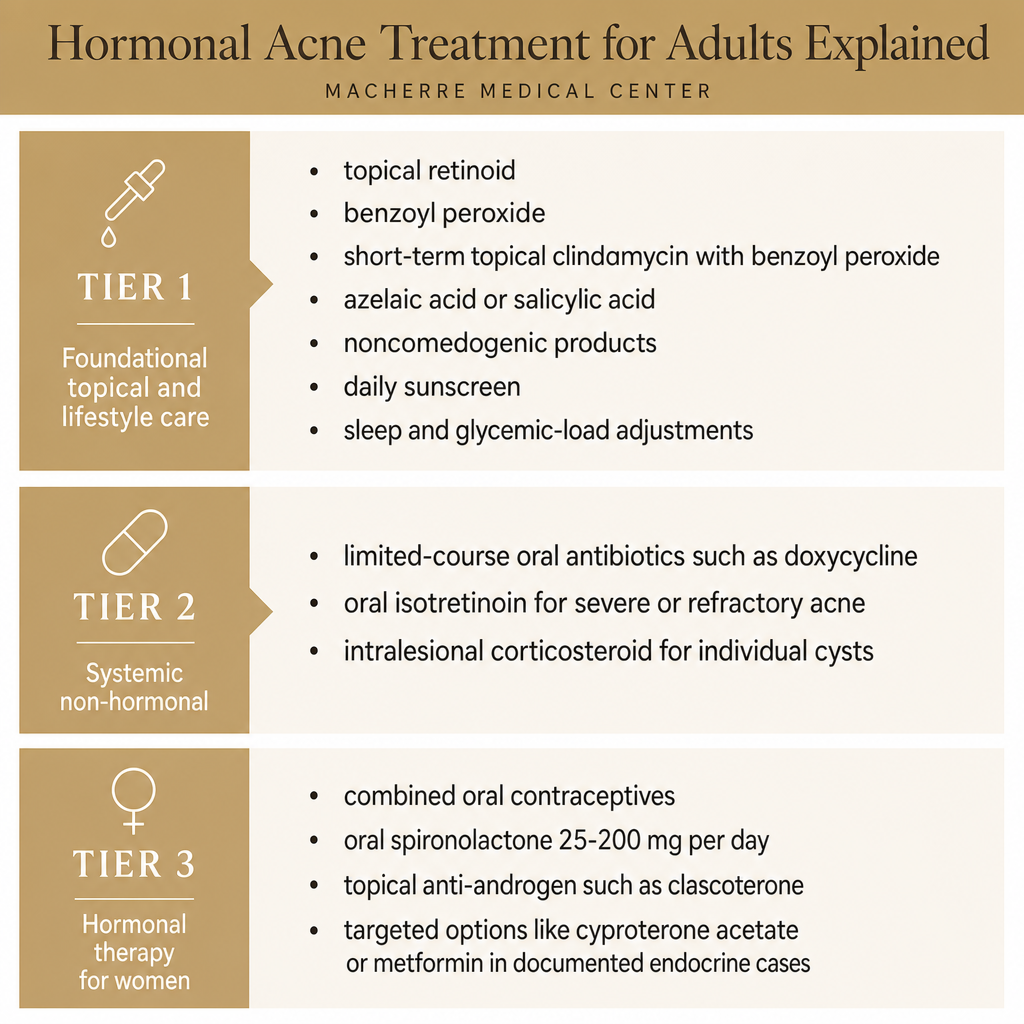
Acne guidelines recommend starting with topical combinations rather than jumping straight to systemic drugs, even in adults. The core building blocks are topical retinoids such as adapalene or tretinoin to normalize cell turnover and prevent comedones, benzoyl peroxide to reduce Cutibacterium acnes and limit antibiotic resistance, and short-term topical clindamycin combined with benzoyl peroxide for inflammatory lesions. Azelaic acid and salicylic acid serve as useful adjuncts, especially for comedones, post-inflammatory pigmentation, and sensitive skin.
Routine and lifestyle carry real weight in mild to moderate hormonal acne. That means noncomedogenic, oil-free products, washing the face twice daily, applying only pea-sized amounts of active creams, avoiding harsh exfoliants, and wearing daily sunscreen. Dietary patterns that limit high glycemic load and excess alcohol, paired with stress management and adequate sleep, may reduce hormonal flares for some adults.
This is the layer where our remote consultations concentrate: building a sustainable regimen that respects sensitive, rosacea-prone, or pigment-prone skin while still targeting the acne itself. Because many adults with hormonal breakouts also carry post-acne discoloration, we tailor the plan across those overlapping concerns rather than treating acne in isolation.
Hormonal therapies for women
Hormone-directed treatment for adult women uses therapies that either suppress androgen production or block its effect at the skin. These are usually reserved for moderate to severe, persistent, or relapsing acne, or for clear menstrual and endocrine-associated flares.
Combined oral contraceptive pills that contain estrogen and progestin can suppress ovarian androgen production and raise sex hormone-binding globulin, which lowers free testosterone. Major European and American guidance treat them as a second-line or adjunct option for moderate to severe acne in women, particularly when contraception is also desired, and they are often paired with topical retinoids and benzoyl peroxide. Not every guideline promotes them as primary acne therapy; NICE guidance, for example, suggests combined oral contraceptives mainly when contraception is needed, given variable evidence for acne-specific benefit. They also carry familiar risks such as venous thromboembolism, migraines, and blood pressure changes, and are contraindicated in some women, so they require medical evaluation.
Oral spironolactone is an anti-androgen that blocks androgen receptors and reduces sebum, which makes it particularly effective for jawline, lower-face, and cystic hormonal acne in adult women. Recent systematic reviews and meta-analyses show it significantly improves moderate to severe acne compared with placebo or doxycycline, often with a 50 to 100 percent reduction in lesions. A few practical points define how it is used:
- It is prescribed off-label but is increasingly recognized as a standard-of-care option for persistent adult female acne.
- Doses commonly range from 25 to 200 mg per day, with many women responding at 50 to 100 mg per day.
- Initial improvement often appears around three months, with maximal benefit by five to six months.
- It suits long-term use in healthy women because bacterial resistance is not a concern and efficacy is durable.
Common side effects include menstrual irregularities, breast tenderness, fatigue, and a dose-dependent risk of elevated potassium, though serious electrolyte problems are rare in healthy women without kidney disease. Spironolactone is not used in pregnancy and requires reliable contraception and medical supervision.
Beyond these, certain situations call for more specialized hormone-modulating options: cyproterone acetate and other anti-androgenic progestins for women with proven hyperandrogenism, glucocorticoids for select adrenal hyperandrogenism, and metformin in polycystic ovary syndrome to improve insulin resistance and indirectly reduce acne-promoting signals. These are targeted choices managed alongside endocrinologists. For adults who want hormonal targeting without systemic changes, newer topical anti-androgen creams such as clascoterone act locally on sebaceous-gland receptors to reduce sebum and inflammatory lesions.
Systemic non-hormonal therapies
Many adults with hormonal acne still need a systemic non-hormonal medication at some point. Oral antibiotics such as doxycycline are used in limited courses alongside topical benzoyl peroxide and retinoids for moderate to severe inflammatory acne. Oral isotretinoin remains the strongest option for severe nodulocystic or refractory disease, but it carries strict pregnancy-prevention requirements because of teratogenicity. Individual large cysts can be settled with intralesional corticosteroid injections. Across all of these, guidelines stress limiting antibiotic duration and turning to hormonal or isotretinoin alternatives when long-term control is needed.
When acne is truly hormonal and who needs testing
Not every adult with acne needs a full hormonal workup. Most people improve with conventional topical and systemic treatment and have no significant endocrine disease. Testing is worth pursuing when specific red flags appear.
Expert reviews suggest hormonal evaluation for women who have late-onset acne appearing after roughly age 25 to 35, sudden severe or therapy-resistant acne, rapid relapse after isotretinoin or oral contraceptives, or signs of androgen excess such as irregular periods, hirsutism, or androgenic hair thinning. Where testing is indicated, the AE-PCOS task force recommends measuring total and free testosterone along with DHEAS to detect hyperandrogenism and guide treatment. In everyday practice, many dermatology guidelines still treat adult female acne with hormonal therapy when the clinical pattern looks hormonal and first-line care has failed, even if androgen levels read normal.
Our starting point is a careful clinical profile: the timing of flares, associated symptoms, and your full treatment history, then a topical and lifestyle strategy matched to your skin type and overall health. If red flags for an endocrine disorder show up, we advise arranging lab testing and endocrine or gynecologic evaluation locally while your skin-focused, non-hormonal care continues without interruption.
How to decide which tier of care fits you
Adults generally move through three decision tiers, and knowing where you sit prevents both undertreatment and overtreatment.
Start by optimizing topical and lifestyle care. If your acne is mild to moderate without clear menstrual or endocrine features, guidelines support a strong regimen of a topical retinoid plus benzoyl peroxide, appropriate cleansers and moisturizers, and lifestyle adjustments before anything systemic. Escalate to systemic non-hormonal therapy when the disease is moderate to severe: oral antibiotics or isotretinoin become appropriate when lesions are numerous, painful, or scarring, or when topicals alone fall short.
Consider hormone-directed treatment when the pattern and severity justify it. That case is strongest for an adult woman with clear menstrual flares or late-onset jawline and chin acne, persistent inflammatory acne after standard courses of topicals, antibiotics, and even isotretinoin, or coexisting signs of androgen excess or PCOS. In these situations combined oral contraceptives and spironolactone are recommended as second-line or adjunct therapies. For women who prefer to avoid systemic medication, topical anti-androgens and light-based treatments are emerging alternatives, though evidence and availability vary.
Our ProAcne Program is built for adults who either want to avoid systemic medication or need structured support around prescribed treatment. Bi-weekly follow-ups across three to four months let us adjust skincare, lifestyle, and nutrition as the skin evolves. If you do proceed with hormonal medication through your local doctor, that framework helps support long-term remission and reduces side effects such as irritation, redness, or pigment changes. When rosacea overlaps with your acne, our dedicated rosacea management stream keeps redness from being aggravated by active acne treatment.
How we approach hormonal acne at Macherre
We are an online skincare consultation clinic led by Dr. Maria, a cosmetologist with five years of experience in acne, rosacea, pigmentation, sensitive skin, and early signs of aging. Our remote-first model suits adults with hormonal acne who need ongoing guidance more than a single prescription.
Care begins with a comprehensive intake and photo analysis. You complete a detailed form and upload skin photos, which lets us assess acne type, whether comedonal, inflammatory, or cystic, its distribution across the jawline or T-zone, and associated issues such as discoloration, rosacea, or sensitivity. From there you receive a personalized, non-stepwise plan that coordinates topical care chosen to respect sensitive and pigment-prone skin, lifestyle guidance aimed at stabilizing hormonal and inflammatory triggers, and nutrition suggestions compatible with your skin and health. This is especially useful if you prefer minimal or no systemic medication, or have already tried standard products without success.
Because hormonal acne rarely travels alone, we integrate it with your other skin concerns. Adults dealing with breakouts frequently also carry melasma, age spots and hyperpigmentation, rough texture, or dryness from earlier treatments, and our separate consultation streams let us tailor the plan across several diagnoses at once. Through the ProAcne Program, bi-weekly follow-ups over three to four months give you time to work through purging phases, adjust products, and stabilize your routine, which matters because hormonal acne responds over months, not days. English and Russian-speaking clients access the same level of care remotely, which suits international adults without easy access to in-person dermatology. Consultations start from $115 | €99.
Frequently asked questions
How do I know if my acne is hormonal or just regular adult acne?
Typical hormonal patterns include jawline and chin breakouts, deep tender nodules, clear premenstrual flares, and skin that stays oily well after adolescence. If you see these patterns and your acne relapses despite consistent topical care, hormonal involvement is likely.
Do all adults with acne need blood tests and hormonal medications?
No. Most adults respond to optimized topical therapy and, when needed, short courses of oral antibiotics or isotretinoin, without any endocrine abnormality. Hormonal testing and treatment are reserved for therapy-resistant, late-onset, or clearly hyperandrogenic cases.
How long does hormonal acne treatment like spironolactone or the pill take to work?
These therapies are slow but steady. Improvement commonly appears after about three months, with maximal benefit around five to six months, and they can be continued long-term when tolerated.
What are the main risks of hormonal therapies for acne?
Combined oral contraceptives carry contraceptive-related risks including blood clots, migraines, and blood pressure changes, and are unsuitable for some women. Spironolactone can cause menstrual irregularities, breast tenderness, fatigue, and rare electrolyte issues; it is avoided in pregnancy and requires medical supervision.
Can I treat hormonal acne without systemic medication?
For many adults, a consistent topical regimen of a retinoid plus benzoyl peroxide or azelaic acid, combined with lifestyle changes and professional non-drug options such as chemical peels or topical anti-androgens, can meaningfully reduce hormonal acne over several months. Our ProAcne framework is designed for clients who want to prioritize topical-focused care while following evidence-based principles.
How does an online clinic handle international and Russian-speaking clients?
We use detailed intake forms, photo-based assessment, and bilingual communication in English and Russian to deliver customized plans remotely, so international clients can pursue structured hormonal acne treatment for adults without geographical barriers.