





5 Proven Treatments for Tightening Loose Facial Skin Without Surgery
This article is educational and does not diagnose a condition or replace care from a qualified medical professional.
5 Proven Treatments for Tightening Loose Facial Skin Without Surgery
Collagen production declines roughly 1% per year starting in your late 20s, and the decline accelerates after menopause and with cumulative UV exposure. The dermis thins, elastin fibers fragment, and the SMAS layer — the deep fascial sheet surgeons reposition during a facelift — loses its grip on the soft tissue above it. The visible result reads on your face: jowls forming along the jawline, midface descent flattening your cheekbones, a softening jaw angle, crepey neck skin that creases when you turn your head.
If you have spent $200 on a serum hoping to reverse this, you already know the frustration. Most drugstore and even prescription topicals stop at the epidermis. They cannot reach the dermal and sub-dermal layers where laxity actually originates. That is a depth problem, not a formulation problem — and no amount of layering hyaluronic acid will solve it.
Between a $150 retinol bottle and a $25,000 facelift sits a meaningful middle ground: five clinic-grade options for non-surgical skin tightening that measurably remodel collagen, contract dermal tissue, or mechanically reposition fallen structures. According to the American Academy of Dermatology, laser resurfacing is "the most effective procedure for tightening loose skin," but it is not the only effective treatment for loose skin on face worth considering. The right choice depends on severity, downtime tolerance, and budget. This guide gives you the framework to match the treatment to the need.

Table of Contents
- Why Topical Creams Stall at the Surface
- Radiofrequency Microneedling
- HIFU (Ultherapy)
- Chemical Peels by Depth
- Thread Lifts
- Matching Treatment to Severity, Budget, and Downtime
Why Topical Creams Stall at the Surface — And What Treatment Depth Actually Tightens Skin
Most over-the-counter moisturizers and serums act on the stratum corneum and the upper epidermis. That is roughly the top 0.1mm of your skin — a layer that responds to hydration, light exfoliation, and antioxidants, but that has almost nothing to do with how tightly your face holds its shape. Even strong actives like retinoids, which do reach somewhat deeper than passive moisturizers, primarily address fine lines, pigmentation, and texture. They do not contract the dermis. They do not reposition the SMAS. They do not pull a sliding jowl back into place.
This is why a reader can spend $300 on serums monthly and see no measurable change in jaw definition. The serum works — on what it can reach. It just cannot reach the layer where laxity actually lives. Hydrated skin looks plumper and smoother for a day. That visual benefit is real, but it is cosmetic, not structural. Rebuilding the architecture of your dermis requires a different category of intervention entirely.
Four mechanisms can actually tighten facial skin at clinical strength. Understanding them will let you read any treatment menu and immediately know what it does and does not do.
Collagen remodeling via controlled thermal injury. When the dermis is heated to roughly 60–70°C, existing collagen fibers denature, and fibroblasts respond by laying down new Type I and Type III collagen over 8–12 weeks. This is the workhorse mechanism behind RF microneedling, HIFU, and laser resurfacing. The treatment itself is brief; the result builds slowly, peaking at three to six months as the new collagen matrix matures.
Immediate dermal contraction. At specific thermal thresholds, collagen fibers also contract instantly during the procedure, producing a visible "pre-tightening" before remodeling completes. HIFU and Thermage produce this most clearly. You leave the clinic looking subtly tighter, then continue improving for months.
Controlled chemical injury. Acids — TCA at medium depth, phenol at deep — destroy a measured depth of tissue. The healing process produces denser, tighter dermis along with new collagen. The depth of the acid determines the magnitude of the tightening. This is the mechanism behind medium and deep chemical peels, and it does double duty by also resurfacing texture and pigmentation in ways energy devices do not.
Mechanical suspension plus biostimulation. Absorbable sutures inserted into subcutaneous tissue physically reposition fallen tissue upward while also stimulating localized collagen along each thread tract. Thread lifts are the only treatment in this category that produces an immediately visible mechanical lift, rather than gradual remodeling.
Hydration makes skin look plumper for a day. Collagen remodeling changes its architecture for a year.
The five treatments covered next use these mechanisms at clinical strength. Each operates at a different depth, addresses a different severity range, and demands a different commitment of time and money. According to the American Board of Cosmetic Surgery, this entire category is best matched to "mild-to-moderate loose skin … with little-to-no downtime" — which is also the practical ceiling. If your laxity has crossed into severe territory (skin that hangs below the jawline, deep neck cords, significant excess tissue), no non-surgical option will fully replace what a surgical facelift accomplishes. What follows is the framework for everyone else.
The treatments are not ranked best to worst. They are explained by mechanism and depth so you can match one to your specific situation. Topicals you already use — for early signs of aging prevention or uneven skin texture — remain useful as the daily floor. The treatments below build above that floor.
Radiofrequency Microneedling: Controlled-Heat Collagen Remodeling for Moderate Laxity
RF microneedling is the most accessible entry point into clinical-grade tightening, and it does two things at once.
- Mechanism. Insulated micro-needles, with depths typically adjustable between 0.5mm and 4mm, penetrate the dermis. Once seated at the chosen depth, the needle tips deliver radiofrequency energy that heats the surrounding dermis to approximately 65–72°C while sparing the epidermis above. Two effects follow: immediate collagen contraction at the heat zones, plus a months-long healing cascade that lays down new collagen. Common device platforms include Morpheus8, Genius RF, and Legend Pro — according to SkinCare Physicians, these are among the most clinically deployed RF microneedling systems in U.S. practices.
- Realistic timeline. First visible tightening appears at four to six weeks. Peak result lands at three to six months after the final session, as new collagen continues maturing. A typical series runs three to four sessions, spaced four weeks apart, according to procedural data from FaceFitWell.
- Cost reality. Expect roughly $300–$600 per session in most U.S. metro markets, putting a full series in the range of about $1,200–$2,400. These are typical market ranges from clinic-published rates rather than fixed prices, and they vary meaningfully by city, device, and provider experience.
- Downtime. 24–48 hours of redness resembling a moderate sunburn. Pinpoint scabbing is possible for two to three days at the needle insertion sites. Most patients return to work within 24 hours wearing tinted SPF. There is no incision and no anesthesia beyond topical numbing cream.
- Best candidate profile. Moderate laxity in the cheeks, jawline, and upper neck. Particularly effective for patients in their 40s and 50s with intact skin elasticity and visible early jowling. RF microneedling also addresses acne scarring and enlarged pores in the same session, which is part of why it has become the default starting point for most laxity-curious patients in this age range.
- Where it underperforms. Severe jowling that has crossed below the jawline. Very thin skin where the dermal target is shallow and the energy has nowhere productive to land. Patients seeking immediate, dramatic results — RF microneedling builds gradually, and anyone expecting a same-day visible lift will be disappointed.
- Combination protocol note. RF microneedling is often paired with HIFU four to six weeks earlier — deep layer first, mid-dermal layer second — for synergistic depth coverage. Clinics that offer both devices will often build a layered protocol rather than selling either treatment in isolation.
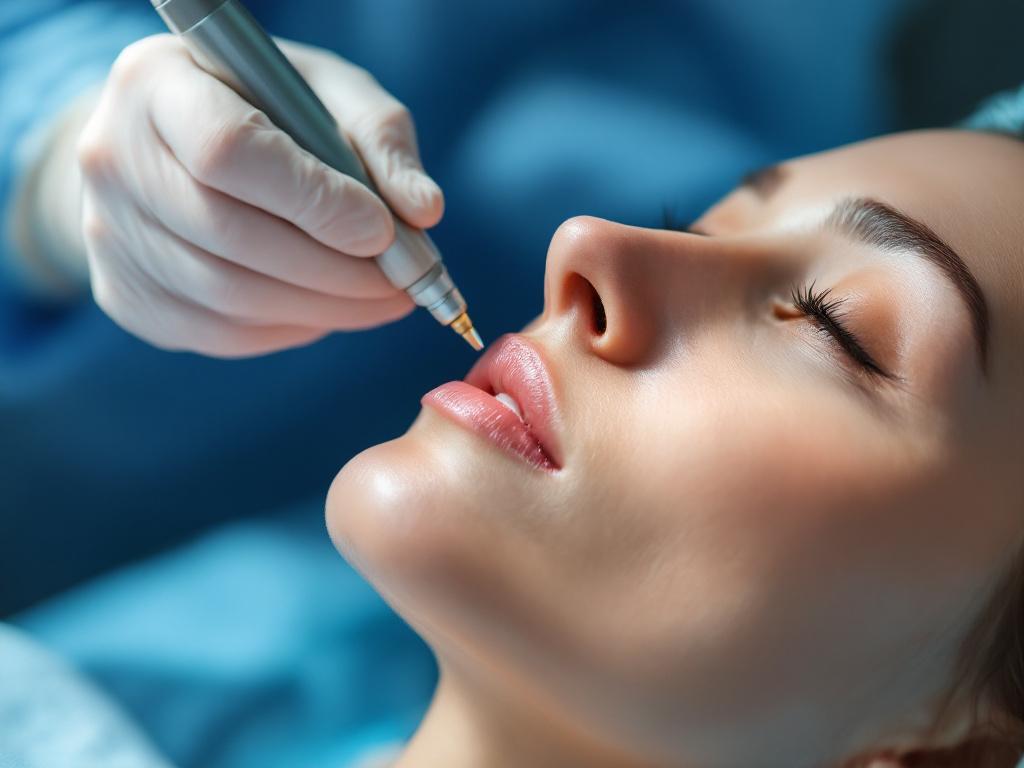
If you have moderate laxity, can commit to three to four visits over four months, and want minimal downtime, RF microneedling is the most accessible entry point in this category. It will not reverse severe sagging, but for the early-jowling patient who has watched their jawline blur over the past five years, it produces a measurable, photographable change at a price point that does not require financing.
HIFU (Ultherapy): Focused Ultrasound to the SMAS — The Closest Thing to a Non-Surgical Lift
High-Intensity Focused Ultrasound delivers acoustic energy that converges at precise depths below the skin surface — typically 1.5mm, 3.0mm, and 4.5mm. The 4.5mm depth is the one that matters most for lifting. That is the SMAS — the same fibromuscular layer that surgeons surgically reposition during a facelift. The energy passes through the epidermis without damaging it, then converts to heat at the focal point at approximately 65–70°C, creating discrete thermal coagulation points that contract immediately and stimulate sustained collagen production over the following months. Speaking to Women's Health Magazine UK, aesthetic doctor Dr Galyna Selezneva described Thermage — the parallel non-invasive RF option — as supported by "decades of clinical data … to support its safety and efficacy," a useful frame for understanding the scientific maturity of this whole category.
HIFU is the only non-surgical treatment that reaches the SMAS — the same layer a surgeon repositions in a facelift. The lift is gradual, not dramatic, but it is real.
Most patients require only one or two sessions. Initial tightening becomes visible at two to three weeks, with peak lift at around three months as new collagen matures, according to procedural data from Vital Skin Derm. The sensation during treatment is best described as brief stinging or heat pulses at each transducer pass; a full-face protocol takes 60–90 minutes. There are no needles, no incisions, no anesthesia beyond optional oral analgesics for sensation tolerance. You walk out, you go to dinner, you return to work the same day if your schedule requires it.
A single session typically runs $1,500–$3,500 in U.S. markets — the highest per-session cost in this guide, but also the lowest session count. When you compare HIFU's one-or-two-session protocol against a four-session RF microneedling series, the annual cost equivalent often runs lower with HIFU. The math depends on your specific quote, but readers who fixate on the per-session sticker shock often miss this. You are buying fewer visits and a deeper depth, not just a more expensive afternoon.
The reader best suited to HIFU is the one with moderate-to-significant jowling, neck laxity, midface descent, or a softening brow position. If you find yourself looking at photos from five years ago and noticing the jaw angle has blurred, the cheekbone contour has flattened, and your face reads more tired than your actual energy level — that reader is HIFU's center of target. The treatment lifts. It does not resurface, it does not restore lost volume, and it does not change your skin tone. It tightens the structural envelope.
Where HIFU underperforms: very thin or very thick skin types, where the focal point energy either over-penetrates or fails to deliver enough thermal effect. Patients with significant volume loss — HIFU lifts what is there; it does not restore fullness, which requires biostimulators or filler as a parallel protocol. Patients with active acne in the treatment field, open wounds, or implanted electronic devices in the head and neck region. And patients seeking a dramatic same-day result will be disappointed, because the lift is gradual and largely arrives in month two and three rather than week one.
One more practical note: HIFU is highly device-and-operator dependent. Ultherapy (the FDA-cleared brand) is referenced by the American Board of Cosmetic Surgery as a recognized non-surgical tightening option, but the broader HIFU market includes machines of widely varying quality. A bargain-priced HIFU session at $400 likely is not running on the same hardware or transducer protocol as a $2,500 Ultherapy session. Confirm the device name, ask how many lines of energy will be delivered to your specific treatment areas, and verify the operator has logged at least a hundred procedures on that platform before you commit.
Chemical Peels by Depth: Matching TCA and Phenol Strength to Severity
Chemical peels use acids to create controlled, depth-specific injury. The healing response — re-epithelialization plus dermal collagen remodeling — produces both surface refinement and underlying tightening. The depth of the peel determines how much of each you get. A superficial peel is essentially an exfoliation; a deep peel is a multi-week medical procedure with sedation. The three categories are not interchangeable, and choosing wrong is one of the more common ways patients waste money in this space.
| Peel Depth | Active Agent & Concentration | Typical Downtime | Tightening Effect | Best Used For |
|---|---|---|---|---|
| Superficial | Glycolic / Salicylic 15–30% | 3–5 days mild flaking | Minimal | Texture, fine lines, dullness |
| Medium | TCA 35–50% | 7–10 days visible peeling | Moderate | Mild-to-moderate laxity, photoaging |
| Deep | Phenol 88% | 14–21 days, crusting and erythema | Strong | Severe laxity, deep perioral wrinkles |
The depth-injury relationship is straightforward: deeper peels reach deeper dermis, where more collagen is remodeled, producing stronger tightening — but also more downtime and meaningfully higher complication risk. Post-inflammatory hyperpigmentation, prolonged erythema, infection if aftercare fails, and in rare cases scarring. These are not theoretical risks. They are the reason deep peels are performed by board-certified dermatologists or plastic surgeons, often with sedation and cardiac monitoring, rather than by aestheticians.

The practical reality matters as much as the clinical one. A deep phenol peel is essentially a three-week social retreat. The crust phase — roughly days five through ten — is not presentable in any professional context, and the erythema lingers well after the crusting resolves. Medium TCA peels are realistic for someone who can take a long weekend plus a week of careful concealer use; the peeling phase is manageable but visible. Superficial peels are genuine "lunchtime" procedures with minimal disruption.
Cost ranges to plan around: superficial peels run roughly $150–$400 per session; medium TCA peels typically $500–$1,500; deep phenol peels $2,000–$6,000, often performed under sedation with monitoring that increases the total cost further. A single deep peel can produce results lasting three to five years, which changes the value calculation significantly compared to repeating a treatment series annually.
Who should not pursue medium or deep peels without specialist consultation: Fitzpatrick IV–VI skin types, where post-inflammatory hyperpigmentation risk is markedly higher and protocols must be modified; patients with active rosacea flares, whose inflamed skin will react unpredictably to acid; recent isotretinoin use within the past six months, which compromises healing and increases scarring risk; and reactive/sensitive skin types with an already-compromised barrier.
Chemical peels are the right answer when laxity is paired with significant texture or pigmentation damage. Peels do double duty in a way that energy devices do not — they remodel collagen and resurface the visible skin envelope. If your concerns are purely structural (jowling without sun damage), an energy device is more efficient. If your face shows a decade of accumulated UV exposure alongside laxity, a medium TCA peel addresses both at once and often produces a more comprehensive visual result than a tightening-only protocol would.
Thread Lifts: Immediate Mechanical Lift With Modest Collagen Stimulation
Thread lifts use absorbable sutures inserted via cannula into subcutaneous tissue. Two materials dominate: PDO (polydioxanone), which dissolves in roughly six to eight months, and PLLA (poly-L-lactic acid), which lasts 18–24 months. Two effects work in parallel. The threads have tiny barbs or cones along their length that catch on tissue, which lets the practitioner physically reposition sagging soft tissue upward at the moment of insertion. Then, over the following four to eight weeks, the body's foreign-body response around each thread stimulates localized collagen along the thread tract. The result is a combination of immediate mechanical lift and slow biostimulation along discrete vectors.
Not all threads do both jobs. Smooth threads stimulate collagen but provide no mechanical lift — they are a biostimulation tool, not a lifting tool, and a clinic that sells you "a thread lift" using only smooth threads has misrepresented the procedure. Barbed (cog) threads provide the actual lift. Within barbed threads, PDO is the entry-level option: lower cost, shorter duration, useful for testing whether you like the result before committing to something longer-lasting. PLLA threads — Silhouette InstaLift is the most widely cited example — are stronger, longer-lasting, and better suited to patients with moderate jowling who want something more durable than PDO without committing to surgery.
The mechanical lift is visible immediately on the table. This is unique among the five treatments in this guide, and it is the reason thread lifts get booked in advance of weddings, reunions, and on-camera professional events where an immediately presentable result matters. The collagen stimulation contribution emerges over the following four to eight weeks, and the combined effect peaks at roughly eight weeks. From there it gradually softens over 12–18 months as the threads fully dissolve. Speaking to Women's Health Magazine UK, aesthetic doctor Dr Nina Bal compared energy-based alternatives like Endolift to threads and surgical options, noting that the laser-fiber approach "lifts and sculpts the face in a way no injectable can" — a useful frame for understanding what threads can match (mechanical repositioning) and what they cannot (the sustained dermal remodeling produced by deeper energy treatments).
Threads are the only treatment that lifts the face the day of the procedure. They are also the most dependent on who is holding the cannula.
Thread lifts run $800–$2,500 per treatment in U.S. markets, depending on thread count, thread type, and treatment area. Downtime is genuinely minimal — possible bruising and tenderness for five to seven days, occasional puckering at insertion points that resolves within two weeks. Most patients return to work the next day with concealer over any visible bruising. This is the most "lunchtime-procedure adjacent" of the structural treatments in this guide, but the bruising potential means scheduling around any high-visibility events for the first week is wise.
The hard caveat with threads is practitioner skill. Vector placement, tension calibration, and anchor point selection determine whether the result looks natural or whether the threads are visible, palpable through the skin, or migrate over time. A poorly placed thread produces a worse aesthetic outcome than no treatment at all. This is the most operator-dependent procedure in the guide, and discount pricing on thread lifts almost always correlates with reduced practitioner experience. Verify board certification, ask to see before-and-after photos from the specific practitioner (not the clinic at large), and confirm thread brand and count before you book.
Threads also do not address skin quality. They reposition tissue, but they do not resurface or tighten the skin envelope itself. A patient with significant texture damage and jowling will benefit more from a combination protocol — peels or RF microneedling for the surface, threads or HIFU for the structure — than from threads alone. Threads are best for mild-to-moderate jowling, brow descent, and marionette lines in patients with reasonable skin quality. They are not effective for severe laxity (the threads cannot generate enough tension), very heavy faces where the tissue weight will pull threads back down within months, or patients seeking permanent results.
Matching Treatment to Severity, Budget, and Downtime: Your Decision Framework
You now know what each treatment does. The remaining question is which one fits your face, your timeline, and what you are willing to spend — both in dollars and in days. The matrix below consolidates the parameters into a single decision view. Use it as a starting filter, then validate the specifics against any quote you receive in consultation.
| Treatment | Cost / Session (USD) | Sessions | Downtime | Time to Peak | Strongest Fit |
|---|---|---|---|---|---|
| RF Microneedling | $300–$600 | 3–4 | 24–48 hrs redness | 3–6 months | Moderate laxity + texture |
| HIFU (Ultherapy) | $1,500–$3,500 | 1–2 | Minimal tenderness | 3 months | Moderate-to-significant jowling, SMAS laxity |
| Medium TCA Peel | $500–$1,500 | 1–2 | 7–10 days peeling | 4–8 weeks | Laxity + texture/pigmentation |
| Deep Phenol Peel | $2,000–$6,000 | 1 | 14–21 days | 8–12 weeks | Severe laxity, deep wrinkles |
| Thread Lift (PLLA) | $800–$2,500 | 1 | 5–7 days bruising | Immediate + 8 wks | Mild-to-moderate jowling, immediate visible lift |
Cost ranges and protocol figures synthesized from clinic-published rates and category guidance from professional bodies including the American Board of Cosmetic Surgery and American Academy of Dermatology cited earlier in this guide.
Severity matching, in plain terms. The framework below maps the most common patient archetypes to the treatment combinations that actually fit each profile.
If you have mild laxity — slight jawline softening, early under-eye crepeyness, no visible jowling yet — start with a 3–4 session RF microneedling series. Lower cost, lowest risk, addresses texture concurrently, and serves as both a corrective and preventive measure. Most readers in their late 30s to early 40s belong here, and over-treating at this stage wastes money you will need later.
If you have moderate laxity — visible jowling, jawline blurring, midface descent, the "I look more tired than I feel" frustration — HIFU is the primary treatment, with optional RF microneedling four to six weeks later for surface refinement. This combination is the highest-value protocol for most readers in this category and represents the sweet spot of the entire non-surgical category. Speaking to Women's Health Magazine UK, aesthetic doctor Dr Priya Verma described combination protocols this way: "I often layer Endolift with Julaine, an injectable that works using small micro-spheres of poly-L-lactic acid that activate your skin's own fibroblast cells to rebuild lost collagen. Together, they supercharge dermal remodelling. The laser reshapes and contracts tissue, while PLLA restores structure and strength to the skin's matrix." The principle generalizes: layered protocols outperform single-modality treatments at this severity level.
If you have significant laxity paired with strong texture or pigmentation damage — a decade or more of cumulative sun exposure has compounded the structural decline — a medium TCA peel followed by HIFU eight to twelve weeks later addresses both layers efficiently. Readers willing to accept three weeks of recovery can compress this into a single deep phenol peel that handles texture, pigmentation, and structural tightening in one procedure with multi-year durability.
If you have mild jowling but want a visible lift quickly — an event timeline, a wedding, a reunion, a high-stakes professional moment — a PLLA thread lift is the only treatment in this guide that delivers a same-day visible result. Accept the trade-off that the result is shorter-term than HIFU, plan to repeat or convert to HIFU within 18 months, and budget accordingly.
A consultation checklist before you book.
- Book with a board-certified dermatologist or plastic surgeon, not a med-spa technician. The same device in different hands produces dramatically different results — particularly for HIFU and thread lifts, where operator skill is the largest single variable in the outcome. Verify board certification through state medical board records, not just the clinic's website. Marketing claims of "expertly trained" do not equate to credentialing.
- Request before-and-after photos of patients who match your skin tone, age range, and laxity severity. Generic images from device manufacturer brochures do not predict your outcome. Ask specifically: "Can I see three patients you have personally treated who looked similar to me?" A practitioner who cannot produce three relevant cases on request has not done enough volume to deliver a confident result.
- Ask about combination protocols. A clinic that offers only one device will tell you that device is the answer. A clinic that offers RF, HIFU, peels, and threads can match the protocol to your face rather than to their inventory. The breadth of options on offer is itself a quality signal.
- Get the realistic downtime in writing. "Minimal downtime" is marketing language and means nothing actionable. Ask: "On day three, what will my face look like? Day seven? Day fourteen?" A practitioner who has personally performed the procedure dozens of times will answer specifically. A practitioner who answers in vague reassurance has either not done enough cases or is hedging on a known issue.
- Confirm maintenance expectations upfront. Every treatment in this guide requires periodic touch-ups. RF microneedling annually, HIFU every 12–24 months, threads every 12–18 months, medium peels every 6–12 months. Treat them as ongoing skin maintenance rather than one-time corrections, and budget annually rather than per-visit. Underlying skin health matters too — treatments work best when paired with corrected baseline skin barrier function, since dehydrated and dry skin produces inflammation that compromises remodeling results.
- Allow three months before judging the result. Collagen remodeling is a months-long biological process, not a same-day cosmetic event. The day-one and week-one appearance is not the final outcome — and judging too early is the most common reason patients incorrectly conclude a treatment "did not work." Photograph yourself in identical lighting and angle at week one, week six, and month three to track honestly. The phone-camera comparison at month three is the only fair assessment of what the treatment actually produced.