





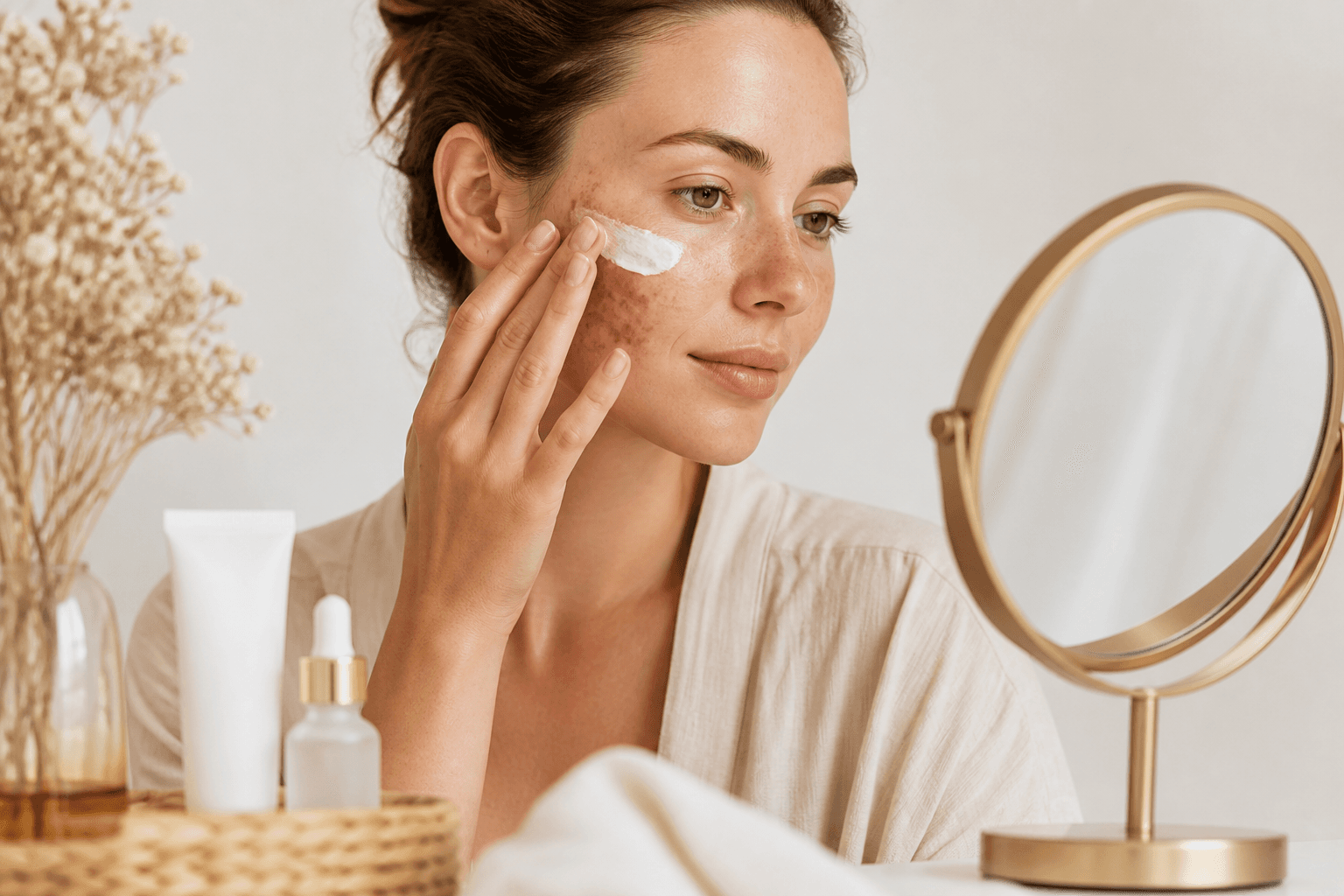
The Best Sunscreen Strategy for Melasma: What to Use and Why
This article is educational and does not diagnose a condition or replace care from a qualified medical professional.
Why One Sunny Afternoon Undoes Three Months of Melasma Treatment
You are twelve weeks into a hydroquinone or azelaic acid regimen. The cheekbone patches have softened. The mirror finally cooperates. Then a friend hosts an outdoor lunch on a Saturday — three hours under a patio umbrella that doesn't quite cover your face — and by Monday morning the patches are darker than they were in Week 4. This is the scenario that brings most patients back to a consultation, and it is almost never bad luck. It is the predictable result of using a sunscreen for melasma that was actually designed for general consumers — a label that says "broad spectrum SPF 30" and stops there.
The SPF number on the bottle is close to irrelevant for melasma control. What matters is UVA-PF (PPD), visible-light blocking, and reapplication discipline. As Dr. Dina Strachan frames it, melanocytes in melasma patients carry a kind of "memory" — a single afternoon of unprotected exposure, or even ambient heat from a hot car, can erase months of treatment progress (Dina Strachan MD).
What follows is the working framework: the three specifications that actually matter, how to read formulation labels without falling for marketing language, the layering and reapplication protocol that protects active treatment, and the timeline for when to upgrade or switch your sunscreen for melasma as your skin moves through treatment phases.
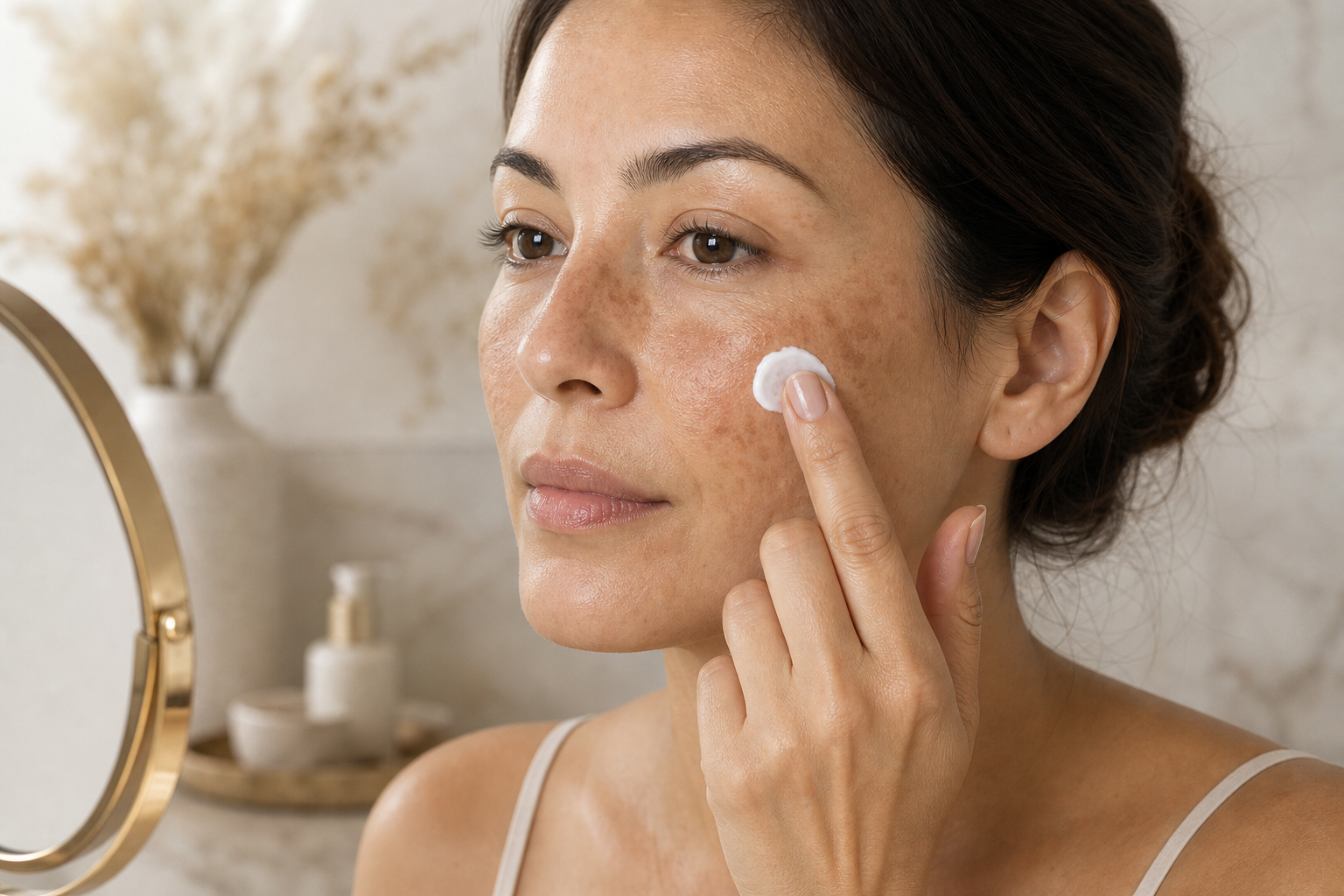
Table of Contents
- Why Standard Broad-Spectrum SPF 30 Quietly Fails Melasma Skin
- The Three Specifications That Actually Determine Whether a Sunscreen Controls Melasma
- Formulation Showdown — Mineral, Hybrid, Tinted, and Powder Sunscreens for Melasma
- The Application and Reapplication Protocol That Most Melasma Patients Get Wrong
- Matching Sunscreen Strategy to Treatment Phase
- Sunscreens Pigment-Focused Dermatologists Recommend — and How Macherre Integrates Sunscreen Into the Treatment Plan
- Your Melasma Sunscreen Audit and Upgrade Plan (This Week)
Why Standard Broad-Spectrum SPF 30 Quietly Fails Melasma Skin
Melasma is a hyperpigmentation disorder driven by three overlapping triggers: UV radiation (especially long-wavelength UVA1, 340–400 nm), visible light (especially HEV/blue light, 400–500 nm), and heat. Each one destabilizes melanocytes that are already hyperactive from hormonal and genetic factors. Hormones and genes set the stage. Light and heat pull the trigger.
A review of nine clinical studies published in the Journal of Clinical and Aesthetic Dermatology concluded that broad protection against UVA, UVB, and visible light is essential for stabilizing melasma and post-inflammatory hyperpigmentation, particularly in skin of color (JCAD review). That phrase — broad protection — is doing a lot of work, because the generic "broad-spectrum SPF 30" stamped on most drugstore bottles is technically compliant but functionally inadequate for post-inflammatory hyperpigmentation and other pigment disorders.
Four specific failures explain why.
SPF measures UVB, not UVA. SPF 30 blocks roughly 97% of UVB; SPF 50 blocks about 98%. That marginal UVB difference is not the relevant axis for melasma. Dermatologists advise SPF 50+ for melasma not because the UVB math demands it, but because real-world application is consistently 25–50% of the lab-tested 2 mg/cm² thickness used in SPF certification under ISO 24444 (Dina Strachan MD). Labeled SPF 50 delivers something closer to SPF 15–25 on the face you actually wear into the world.
The US "Broad Spectrum" label is a low bar. Under the FDA Final Rule on sunscreen labeling, a product needs only to pass a critical wavelength test at ≥370 nm — a pass/fail measurement that doesn't quantify how much UVA is blocked. A US sunscreen can legally carry "broad spectrum" while providing weak long-wavelength UVA1 coverage exactly where melasma-driving wavelengths sit.
The EU and Asian markets are stricter. EU sunscreens that carry the circled UVA logo must deliver UVA-PF equal to at least one-third of the labeled SPF. The Japanese and Korean PA system maps measured PPD (Persistent Pigment Darkening) to consumer labels, where PA++++ corresponds to PPD ≥16 — the threshold pigment-focused dermatologists recommend for melasma patients (JCAD review).
Visible light is invisible to SPF testing entirely. No SPF number, no PA rating, captures how a sunscreen performs against the 400–500 nm wavelengths that drive melasma flares in medium-to-deep skin tones. The only commonly available formulation feature that addresses visible light is iron oxide tint.
One misconception worth dismantling here: this is not a mineral-versus-chemical debate. Dr. Strachan explicitly notes that well-formulated chemical sunscreens, layered with iron-oxide-containing makeup, can work for melasma (Dina Strachan MD). The real axis is UVA-PF + visible light defense + reapplication, not the filter family. The same logic applies whether you are managing classic hormonal melasma or age spots and sun-driven pigmentation, which share many of the same triggering wavelengths.
UVA also penetrates window glass. Indoor work near a window, the morning commute, the drive home — these are clinically relevant exposure events for melasma patients, not edge cases (Rejuva Dermatology).

Melasma does not care about the SPF number on the bottle. It cares whether you are blocking the specific wavelengths of UVA and visible light that triggered it in the first place.
The Three Specifications That Actually Determine Whether a Sunscreen Controls Melasma
Forget marketing language. Melasma patients should read sunscreen labels for exactly three data points.
Specification 1: Quantified UVA Protection — PPD ≥16 (PA++++) or EU UVA-PF ≥ 1/3 of SPF.
The PPD score is the measurable UVA equivalent of SPF. The PA system translates PPD into consumer labels: PA++ ≈ PPD 4–8, PA+++ ≈ PPD 8–16, PA++++ ≈ PPD ≥16. Pigment-focused dermatologists recommend PPD ≥16 as a minimum, and often ≥20–30 for active melasma (JCAD review; Dr. Davin Lim). Most US sunscreens display neither PPD nor PA — which is itself a red flag. Korean, Japanese, and European formulations often outperform US drugstore brands on this specification for exactly this reason.
Specification 2: SPF 50+ With Mineral Filter at Clinically Meaningful Concentration.
SPF 50 is the practical floor because users typically apply 25–50% of the lab-tested 2 mg/cm² thickness, meaning labeled SPF 50 delivers real-world protection closer to SPF 15–25 (ISO 24444; Dina Strachan MD). For mineral options, zinc oxide ≥10% — sometimes combined with titanium dioxide — is the practitioner heuristic for reliable UVA1 coverage. This is a consistent recommendation across pigment-focused dermatology guides rather than a formal regulation. A clinical finding worth holding onto: in patients with skin of color and dyschromia, daily use of SPF 60 produced greater reduction in hyperpigmented macules than SPF 30 (JCAD review). For patients with reactive or sensitive skin, high-zinc formulations are often better tolerated than chemical filters during the destabilized barrier phase of active depigmenting treatment.
Specification 3: Iron Oxides (Tint) for Visible-Light Defense.
This is the specification most generic articles omit. Iron oxides — the same pigments used in cosmetic foundations — are the only commonly available filter that blocks the 400–500 nm visible light spectrum implicated in melasma. The head-to-head evidence is unambiguous: a UV+visible-light sunscreen produced a 75% reduction in MASI score versus 60% with a UV-only sunscreen, a statistically significant clinical advantage (JCAD review). The practical implementation is either a tinted mineral sunscreen, or an untinted sunscreen layered under an iron-oxide foundation.
If a sunscreen meets all three specifications — quantified high UVA, SPF 50+ with mineral or hybrid filters at meaningful concentration, and iron-oxide tint — it is engineered for melasma. If it meets only one or two, it is a compromise that must be augmented through layered foundation, more aggressive reapplication, or shade-seeking behavior to compensate. There is no fourth specification that rescues a sunscreen failing on the first three.
UVA Rating Systems Decoded
| Label/System | Region | What It Measures | Melasma Threshold |
|---|---|---|---|
| SPF | US, global | UVB blocking only | SPF 50+ recommended |
| "Broad Spectrum" | US (FDA) | Critical wavelength ≥370 nm (pass/fail) | Insufficient on its own |
| UVA circle logo | EU | UVA-PF ≥ 1/3 of labeled SPF | Meets minimum |
| PPD number | Global research | UVA dose to induce pigmentation | ≥16 minimum; ≥20–30 ideal |
| PA+ to PA++++ | Japan, Korea | Consumer label mapped to PPD | PA++++ (PPD ≥16) |
Compiled from FDA, EU Cosmetics Regulation, Japanese Cosmetic Industry Association, and the Journal of Clinical and Aesthetic Dermatology review.
Formulation Showdown — Mineral, Hybrid, Tinted, and Powder Sunscreens for Melasma
No single formulation wins every melasma scenario. The right choice depends on treatment phase, skin texture preference, climate, and — most underestimated of all — your realistic ceiling for reapplication. The table below maps the four formulation categories melasma patients actually encounter against the specifications that matter.
Formulation Comparison for Melasma
| Formulation | UVA1 Defense | Visible Light Defense | Heat Generation | Best Used For |
|---|---|---|---|---|
| Untinted mineral cream (ZnO ≥10%) | High | Minimal | Negligible | Active treatment phase, morning base layer |
| Tinted mineral (ZnO + iron oxides) | High | Strong | Negligible | Active and maintenance phase, medium-deep tones |
| Hybrid (chemical + mineral) | Variable (check PPD/PA) | Minimal unless tinted | Slight | Mid-to-late treatment, mineral texture intolerance |
| Powder mineral compact | Low–moderate | Minimal (unless tinted) | None | Midday reapplication over base sunscreen only |
Synthesized from the JCAD review, Dina Strachan MD, and Rejuva Dermatology.
Why untinted mineral is the active-treatment workhorse. Zinc oxide at ≥10% provides reliable long-wavelength UVA1 coverage and generates negligible heat. That second point matters more than most patients realize — heat itself is a melasma trigger (Dina Strachan MD). Untinted mineral also avoids the irritation risk of some chemical filters during a phase when the barrier is already destabilized by depigmenting actives. The trade-off is the white cast and the absence of visible-light defense, which has to be added through makeup.
Why hybrid formulations have a real role. The "chemical sunscreens cause melasma" headline is an oversimplification. Well-formulated hybrid sunscreens, used correctly and paired with iron-oxide makeup, are not contraindicated. For a patient who refuses to wear mineral sunscreen daily because of texture, a high-UVA hybrid they will actually apply is materially better than a perfect mineral they skip. This is also where products designed to address early signs of photoaging that often accompany melasma often live, since elegant hybrid textures support consistent daily use.
Why tinted mineral is the strategic upgrade. The 75% versus 60% MASI score finding is the single strongest piece of evidence in this field. For medium-to-deep skin tones — where visible light contribution to melasma is highest — tinted formulations should be considered first-line, not optional. The tint is not cosmetic; it is a functional filter.
Why powder is reinforcement, not foundation. Powder mineral sunscreens lack the surface film density needed as primary protection. They are useful for the midday touch-up problem when removing makeup is impractical, but a powder applied over bare skin is a placebo. Treat it as a reinforcement layer over an existing cream or lotion base.
The formulation that wins is the one matched to your current treatment phase — which is what the next two sections work through.
The Application and Reapplication Protocol That Most Melasma Patients Get Wrong
The right sunscreen applied wrong protects no one. Five steps separate the protocol that works from the one that fails quietly under your foundation.
Step 1 — Sequence the morning routine correctly (the 10-minute rule).
The order is non-negotiable in active treatment phase: cleanse → treatment actives (vitamin C, hydroquinone, azelaic acid, niacinamide) → wait 5–10 minutes for absorption → moisturizer → wait 2–3 minutes → sunscreen → wait 5–10 minutes before makeup. Applying sunscreen directly on top of wet actives can dilute the sunscreen film, disrupt the uniform layer that SPF and PPD testing assumes, and reduce real-world coverage. For dehydrated or moisture-deficient skin, the moisturizer step is what allows the mineral film to spread evenly instead of pilling — skipping it sabotages both hydration and SPF.
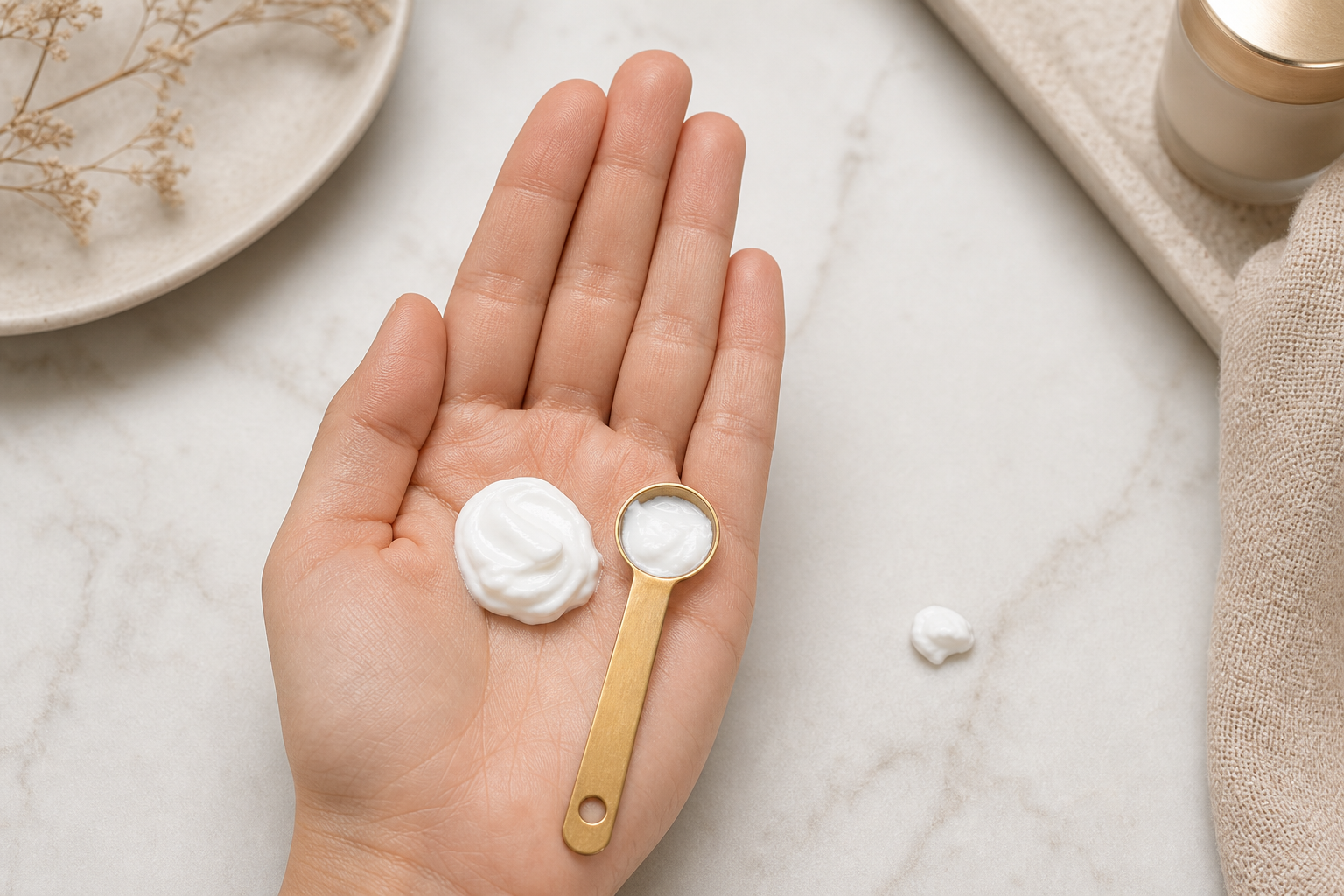
Step 2 — Apply the correct quantity: ½ teaspoon for face + neck.
Laboratory SPF and PPD testing uses 2 mg/cm², which translates to approximately ½ teaspoon for face and neck combined (Dina Strachan MD; Revival Dermatology; ISO 24444). Real-world users typically apply 25–50% of that. The practical breakdown is ¼ teaspoon for face alone, ¼ teaspoon for neck, or the "two-finger length" method where you stripe sunscreen along the length of your index and middle fingers and combine before applying.
The zones melasma patients consistently miss: ears, temples, the hairline edge, sides of neck, and upper chest. Melasma can creep into these zones — and for patients managing skin texture and finish concerns alongside pigmentation, the visible white cast on these missed zones is also where the cosmetic complaint shows up first.
Step 3 — Reapply every 2 hours outdoors; every 3–4 hours indoors near windows.
Dermatology guidance is consistent: reapply at least every 2 hours in direct sun, and every 2–3 hours during prolonged outdoor exposure even on cloudy days (Dina Strachan MD; Revival Dermatology). For indoor lifestyles with significant window exposure, morning application plus one midday reapplication is the realistic floor — not the optimal protocol, the floor. If you commute in bright sun or sit near a south-facing window, treat your indoor day as a moderate outdoor day.
Step 4 — Choose a reapplication vehicle that actually delivers product to skin.
Powder alone delivers too little active to count as a true reapplication; it is a reinforcement layer over existing sunscreen, not a substitute. Sprays often deliver inconsistent coverage. The most reliable midday tools are: a sunscreen stick (drag across cheeks, nose bridge, forehead, and ear edges), a cushion compact with mineral SPF (Korean and Japanese brands frequently carry PA++++), or — if you have the time — washing off makeup and reapplying lotion. Tinted powder over existing sunscreen adds visible-light defense without disturbing makeup, which is its real role.
Step 5 — Coordinate with treatment actives.
Niacinamide and azelaic acid generally layer well under mineral sunscreens. Hydroquinone is applied at night in most protocols; if used in the morning, allow full absorption before sunscreen contact. Low-pH vitamin C formulations should be fully absorbed first, because applying mineral sunscreen onto a still-wet acidic layer can cause pilling and disrupt the film. Avoid hydrating mists between sunscreen reapplications — the moisture can disrupt the mineral layer you are trying to reinforce.
Most melasma recurrence is not because the treatment failed. It is because reapplication stopped the moment makeup went on, and the sun kept working underneath.
Matching Sunscreen Strategy to Treatment Phase — Early Active, Mid-Treatment, Stabilized
A patient in Week 2 of a hydroquinone regimen needs a different sunscreen approach than a patient in Month 6 of maintenance. The barrier is compromised differently, the relapse risk is different, and the realistic compliance ceiling is different. The matrix below identifies your phase and the protocol that fits it.
Sunscreen Strategy by Treatment Phase
| Treatment Phase | Typical Timing | UVA Priority | Formulation Focus | Reapplication Cadence |
|---|---|---|---|---|
| Early Active | Weeks 1–4 of treatment | Maximum (PPD ≥20, PA++++) | Untinted or tinted mineral, ZnO ≥10–12%, SPF 50+ | Every 2 hours outdoors; every 3 hours indoors |
| Mid-Treatment | Weeks 5–12 | High (PPD ≥16, PA++++) | Tinted mineral or stable hybrid with confirmed PPD | Every 2–3 hours outdoors; midday touch-up indoors |
| Stabilized / Maintenance | Week 12+ and ongoing | Sustained (PPD ≥16) | Lifestyle-fit tinted mineral, cushion, or hybrid | Morning + one midday reapplication baseline |
Treatment phase framework synthesized from the JCAD review, Dr. Davin Lim, and Dina Strachan MD. Visible light defense — tinted formulation or iron-oxide foundation layer — is recommended across all three phases for medium-to-deep skin tones.
Why the early active phase demands the strictest protocol. During the first month of hydroquinone, azelaic acid, or tretinoin-based depigmenting therapy, the barrier is thinning and melanocyte response is heightened. A single high-UVA-exposure event can trigger rebound pigmentation that erases weeks of work. The "melanocyte memory" framing applies most acutely here — patients in Week 3 of treatment are functionally more vulnerable to a Saturday lunch outdoors than they were before treatment started. This is the phase where untinted high-zinc formulations earn their position as the base layer, with tint or iron-oxide foundation always added on top.
Why mid-treatment is when patients quit and relapse. By Week 5–8, visible improvement creates false confidence. Patients downgrade to easier sunscreens, skip reapplication during work, or stop layering iron-oxide makeup because the patches look fainter. This is the highest-risk window for relapse — not because the science changed, but because compliance does. Be honest with yourself about this. If you are noticing improvement in Week 6, that is exactly when the protocol must stay strict, not loosen.
Why "stabilized" is not "finished." Sunscreen alone can prevent melasma development and improve existing melasma, but combination therapy — sunscreen plus depigmenting actives — remains more effective than sunscreen monotherapy (JCAD review). Even in maintenance, daily sunscreen is the holding pattern that lets active treatments stay paused. The day you stop sunscreen is the day the maintenance phase quietly converts back into early active phase, often without warning.
Adjunctive measures across all phases. Wide-brimmed hats with brims of at least 3–4 inches, shade-seeking during peak sun hours, avoidance of tanning beds, and minimizing heat exposure from hot cars or prolonged cooking near open flame are standard recommendations across the dermatology literature (Dina Strachan MD; Revival Dermatology). For patients with concurrent rosacea-driven flushing and heat sensitivity, the heat-avoidance piece does double duty — reducing both melasma triggers and rosacea flares from the same behavioral change.
This phase-matching logic is exactly the kind of decision that benefits from a structured pigmentation-focused treatment plan rather than self-directed product trial. Most patients downgrade their sunscreen one phase too early.
The sunscreen that works for stabilizing melasma is not the same one that works for living with melasma long-term. Knowing when to switch is half the battle.
Sunscreens Pigment-Focused Dermatologists Recommend for Melasma — and How Macherre Integrates Sunscreen Into the Treatment Plan
The products listed below appear consistently in pigment-focused dermatology recommendations. Each is presented with its measurable specifications, not marketing claims. The goal is to give you a vocabulary for evaluating any sunscreen — not just these — against the three specifications established earlier.
Category A: Untinted Mineral Sunscreens — Active Treatment Phase Workhorses
- EltaMD UV Clear SPF 46. Zinc oxide 9.0% with niacinamide 5%. Frequently recommended in US dermatology practices for melasma-prone and acne-prone skin because of low comedogenic risk and gentle finish. Limitation: lacks iron oxide tint. Pair with iron-oxide foundation for visible-light defense (NYC Dermatologist guide; Dr. Davin Lim). The same brand is often recommended for patients managing active acne alongside pigmentation because the non-comedogenic formulation does not aggravate breakouts.
- La Roche-Posay Anthelios family. Multiple formulations across markets; the European versions typically carry stronger UVA-PF compliance (≥1/3 of SPF per EU regulation) than US versions. Dr. Davin Lim specifically recommends Anthelios for melasma patients who prioritize cosmetic texture and daily adherence (Dr. Davin Lim).
- Invisible Zinc and similar high-zinc Australian formulations. Cited as cosmetically acceptable high-UVA options for melasma protocols, especially useful where climate intensity makes the UVA priority non-negotiable (Dr. Davin Lim).
Category B: Tinted Mineral Sunscreens — Active Treatment Through Maintenance
- Tinted mineral formulations containing iron oxides at cosmetic pigment levels. This is the gold-standard category per the 75% versus 60% MASI score evidence. Examples cited in pigment-focused dermatology practices include Melan 130 (Dr. Lim recommendation), Colorescience tinted SPF, and EltaMD UV Elements. Dr. Strachan frames mineral-based, broad-spectrum SPF 50+ sunscreens with iron oxides as the "gold standard" for preventing melasma recurrence (Dina Strachan MD).
- What to look for on the ingredient list. Iron oxides (CI 77491, 77492, 77499) listed alongside zinc oxide and/or titanium dioxide. If iron oxides are present and zinc oxide is ≥9–10%, the product meets the structural criteria for melasma defense regardless of which brand it is. Train yourself to read ingredient lists; brand loyalty is not a protocol.
Category C: Maintenance and Reapplication Tools
- Mineral cushion compacts (Korean and Japanese brands typically carry PA++++). These outperform US-market powder compacts for midday touch-up because they deliver true mineral sunscreen film, not just pigment dust. The cushion is the closest thing to "reapplying lotion without disturbing makeup" that currently exists.
- Tinted sunscreen sticks. Practical for hairline, ears, neck, and on-the-go reapplication. The stick format is also the most travel-tolerant — it survives bags, cars, and pockets without leaking.
- Iron-oxide foundations as visible-light layering. For patients whose preferred sunscreen is untinted, a foundation containing iron oxides applied over it approximates the visible-light defense of a tinted sunscreen (Dina Strachan MD; Rejuva Dermatology). This is a real protocol, not a workaround — it is how many patients in the maintenance phase prefer to operate.
How Macherre Integrates Sunscreen Into the Treatment Plan
At Macherre Medical Center, Dr. Maria treats sunscreen selection as a clinical decision inside the personalized treatment plan, not as a generic recommendation handed to patients at the end of a consultation. When a patient submits photos and intake for melasma concerns, the sunscreen recommendation is matched to their treatment phase, skin tone (especially for visible-light considerations in medium-to-deep skin), climate, and daily exposure pattern. This phase-aware integration is part of why structured online consultation produces more consistent outcomes than self-directed product trial. Bi-weekly follow-ups during a pigmentation-focused treatment plan make it possible to upgrade or downgrade sunscreen as the patient progresses through phases, rather than locking them into one product that fits the early active phase but not the maintenance phase — or vice versa. For patients whose pigmentation includes age-related pigmentation concerns, the same phase logic applies with adjusted UVA priorities.
As Revival Dermatology notes, the best sunscreen is the one the patient will actually use consistently (Revival Dermatology) — and the consultation process exists to find that specific match between specification and real-life routine.
Your Melasma Sunscreen Audit and Upgrade Plan (This Week)
Use this checklist to audit your current sunscreen against the three specifications, identify your treatment phase, and lock in a reapplication rhythm. Work through it in order — each step builds on the previous one.
- Read your current sunscreen label for UVA quantification. If it lists PA++++, PPD ≥16, or carries the EU UVA circle logo, it meets the melasma minimum. If it only says "broad spectrum" with no number behind it, it likely does not. Replace within two weeks.
- Confirm SPF 50 or higher. SPF 30 is the absolute floor cited in some sources, but it underperforms in real-world application where users apply 25–50% of the tested thickness. SPF 50+ compensates for the under-application gap that is universal among daily users.
- Check the ingredient list for iron oxides (CI 77491, 77492, 77499). If absent, either switch to a tinted mineral sunscreen or layer an iron-oxide foundation on top. This step is non-optional for medium-to-deep skin tones, where visible-light contribution to melasma is highest.
- Identify your treatment phase. Mark one: Early Active (Weeks 1–4) / Mid-Treatment (Weeks 5–12) / Stabilized (Week 12+). Match your reapplication cadence and formulation focus to the phase matrix in Section 5. If you are not currently in active treatment, default to the Stabilized protocol.
- Measure ½ teaspoon for your next application. Use an actual measuring spoon once to calibrate what the correct amount looks like in your palm. Apply this quantity for face and neck combined. Once you have seen the volume, you can eyeball it — but you have to see it first.
- Set two phone alarms. One at the 2-hour mark from morning application; one at the 4-hour mark. Reapply each time using a stick, cushion, or full re-lotion — not powder alone. Alarms work because compliance does not survive on willpower alone past Week 6.
- Photograph your melasma today in natural daylight. Frontal and three-quarter angles. Re-photograph in 4 weeks at the same time of day, same location, same lighting. This is the only objective measure of whether your sunscreen and treatment combination is working. Memory is a poor judge of pigment.
- If you are mid-treatment with a provider, confirm your sunscreen choice. Incompatible actives, vehicle ingredients, or pH conflicts can reduce both sunscreen and treatment efficacy. A sunscreen that works perfectly in isolation can underperform when layered over the wrong morning routine.
Briefing Template — Copy and Fill
MY MELASMA SUNSCREEN PROFILE

Current sunscreen brand and SPF: _______________
UVA rating listed (PA / PPD / EU UVA logo): _______________
Iron oxides present (yes/no): _______________
Zinc oxide % (if mineral): _______________

My treatment phase: [ ] Early Active  [ ] Mid-Treatment  [ ] Stabilized
Concurrent treatment actives: _______________

Reapplication plan:
  Morning application time: _______________
  Midday reapplication: _______________
  Outdoor reapplication trigger: _______________

Adjunctive measures: [ ] Wide-brim hat  [ ] Shade-seeking  [ ] Iron-oxide makeup layer

Photo log dates: _______________   Next review: _______________
If you want your full sunscreen-and-treatment protocol reviewed against your photos, your skin history, and your real daily exposure pattern, a structured pigmentation-focused treatment plan is built around exactly that audit. Plans typically arrive within 48 hours of intake submission, with sunscreen recommendations matched to your phase rather than handed to you as a single product to use forever.