





Sunscreen for Aging Skin: The Anti-Aging Step Most People Skip
This article is educational and does not diagnose a condition or replace care from a qualified medical professional.
Sunscreen for Aging Skin: The Anti-Aging Step Most People Skip
You're using retinol three nights a week. You're layering vitamin C every morning. You've spent $200+ on serums this year chasing firmer, brighter, smoother skin. But if your sunscreen for aging skin is inconsistent — or worse, missing — you're undoing months of progress in a single unprotected afternoon at a sunny café window.
Here's the evidence that should stop you mid-routine: in a landmark Australian randomized trial published in the Annals of Internal Medicine, 900 adults were followed for 4.5 years. The daily sunscreen group showed no detectable increase in skin aging. The discretionary-use group showed significant photoaging progression. Same skin, same age range, same climate — different outcome, driven entirely by one habit.
Daily sunscreen is the only over-the-counter product with randomized-trial evidence that it stops visible aging in its tracks. Retinol repairs. Sunscreen prevents. You need both.
Up to 90% of visible signs of aging — wrinkles, sagging, discoloration, rough texture — are caused by UV exposure, not chronological aging, according to dermatologist Dr. Henry W. Lim writing in the Journal of the American Academy of Dermatology. Chronology gives you about 10%. The sun does the rest.
By the end of this guide, you'll know exactly which formula your aging skin needs, where sunscreen fits in your routine without sabotaging your actives, and which silent mistakes are aging you despite daily application.
Table of Contents
- Why Aging Skin Reacts Differently to UV — The Biology Behind the Damage
- Mineral vs. Chemical Sunscreen for Aging Skin — Head-to-Head
- The Anti-Aging Sunscreen Formula Checklist — 8 Non-Negotiables
- Where Sunscreen Fits in Your Anti-Aging Routine (Without Sabotaging Your Actives)
- Six Sunscreen Mistakes That Silently Age You
- Building a Lifetime Anti-Aging Sun Strategy — Beyond the Bottle
- Sunscreen for Aging Skin — Practitioner Answers to the Questions Clients Actually Ask
Why Aging Skin Reacts Differently to UV — The Biology Behind the Damage
The sunscreen that worked at 25 is not the sunscreen your skin needs at 45. This isn't a marketing claim — it's a biological fact rooted in four specific changes that happen between those decades.
Your stratum corneum is thinning. The outermost barrier of your skin — the layer that does the first round of UV scattering before photons even reach your living cells — thins progressively after age 35. Dr. Barbara A. Gilchrest, former Chair of Dermatology at Boston University School of Medicine, put it plainly in the New England Journal of Medicine: "The stratum corneum thins with age, making mature skin more vulnerable to UV damage. The standard SPF 15 that might have sufficed in youth becomes inadequate after 40 without proper reapplication." Translation: the same UV dose causes more cellular damage than it did ten years ago, because less of it is being scattered before it gets through.
Your antioxidant reserves are depleted. Healthy younger skin produces and stores its own arsenal of UV-combating antioxidants — vitamin E (tocopherol), coenzyme Q10, glutathione. These molecules neutralize the free radicals that UV photons generate inside your skin cells. By your 40s, these levels have dropped significantly. The implication is direct: the free radicals that UV creates today do more damage per photon than they did in your 20s, because your skin's internal defense team is smaller. This is why aging skin benefits disproportionately from antioxidant-fortified sunscreen — you're not just blocking UV, you're replacing depleted defenses.

Photoaging compounds non-linearly. A peer-reviewed review hosted by the National Institutes of Health lays out the mechanism: UVA penetrates the dermis and degrades collagen and elastin progressively, with damage that accumulates across decades. By the time you're 40, you're seeing the cumulative result of UV exposure from your 20s and 30s — every unprotected beach day, every dashboard commute, every patio lunch — surfacing as fine lines and uneven tone. The damage was always there. It's just becoming visible now.
The UVA blind spot is what's actually aging you. Here's the distinction that most labels don't make obvious: UVB causes burns (B is for burn). UVA causes aging (A is for aging) — and it penetrates clouds, car windows, and office glass. The SPF number on your bottle measures only UVB protection. That's why "broad spectrum" labeling and UVA ratings (UVA-PF in Europe, PA+++ in Asia) matter more than chasing higher SPF numbers after 40. The global standard for measuring UVA protection is ISO 24443:2021 — if your sunscreen's brand can't tell you how it scores against this benchmark, that's information in itself.
SPF measures sunburn protection. It does not measure wrinkle protection. After 40, the UVA rating on the label matters more than the number on the front.
Your actives are making you more photosensitive. If you're addressing early signs of aging with retinoids, AHAs, or vitamin C, your skin is more UV-vulnerable than it would be without them. Retinoids accelerate cell turnover, which exposes newer, less-mature keratinocytes to UV before they've developed their natural protective pigmentation and structure. Without sunscreen the next morning, the very products meant to reverse aging are accelerating it. The cell turnover that gives you smoother texture also gives UV a fresher target.
This is the reframe that changes everything: sunscreen for aging skin isn't the same product category as sunscreen for a beach day. It's a daily anti-aging treatment whose formula needs to match the biology of skin that's both more vulnerable and more chemically active than it used to be.
Mineral vs. Chemical Sunscreen for Aging Skin — Head-to-Head
Most articles tell you mineral is "gentler" and chemical is "lighter." That's marketing shorthand, not analysis. For aging skin specifically, the answer hinges on three variables: barrier integrity, active ingredient compatibility, and reapplication realism.
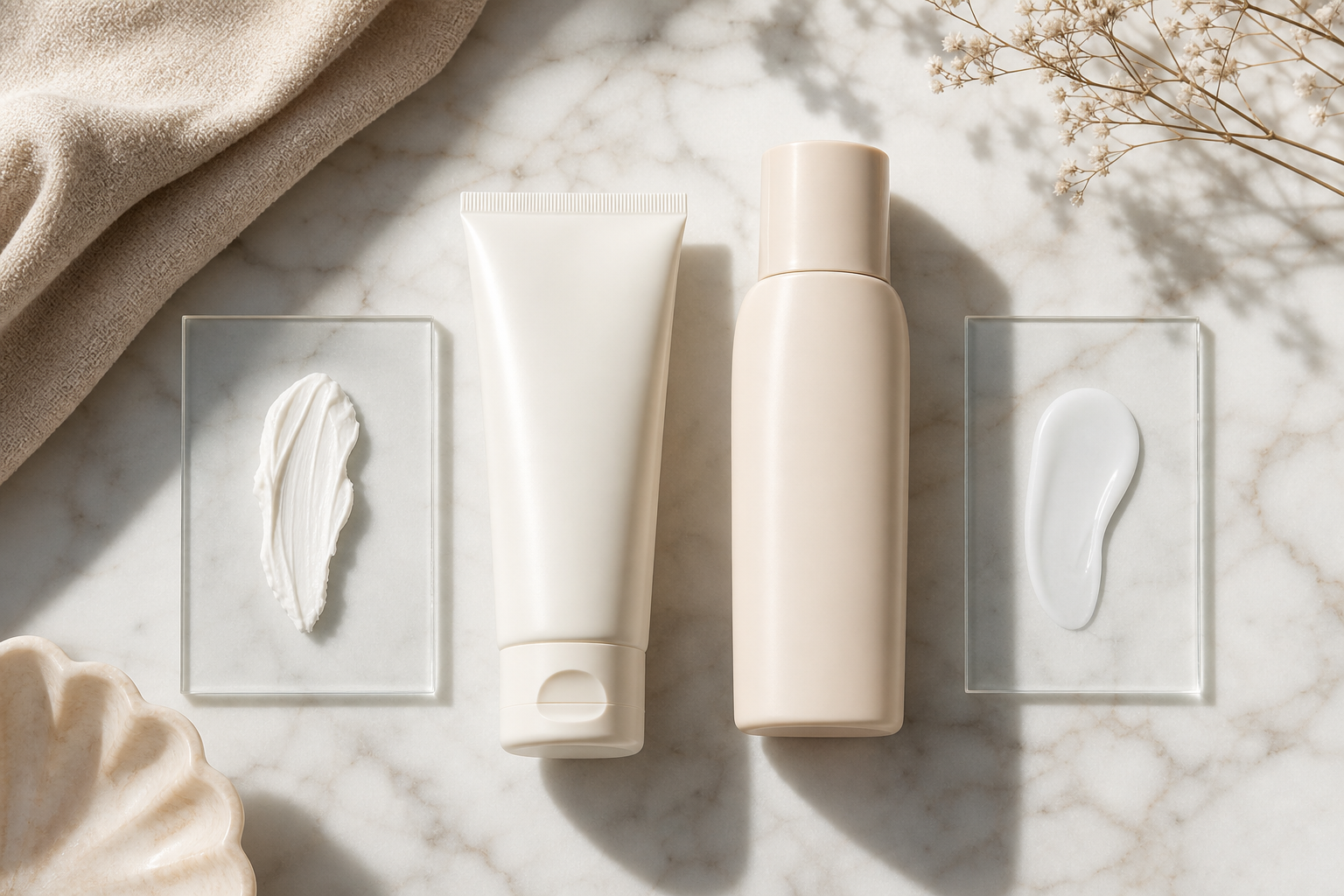
| Criterion | Mineral (Zinc / Titanium) | Chemical (Avobenzone, Octocrylene, Tinosorb) |
|---|---|---|
| UV coverage | Zinc up to 380nm; titanium up to 360nm | Varies by filter; broad-spectrum needs combinations |
| Time to activate | Immediate on application | 15–30 minutes absorption needed |
| Irritation risk on aging skin | Low; well-tolerated on compromised barriers | Higher with oxybenzone/avobenzone alone |
| Compatibility with retinoids & vitamin C | Sits on surface; no absorption competition | May compete with actives for penetration |
| Cosmetic finish | Possible white cast; modern formulas improved | Lightweight, invisible finish |
| Reef-safe profile | Generally yes (non-nano zinc) | Oxybenzone & octinoxate banned in some regions |
| Reapplication friction | Higher (visible texture) | Lower (invisible re-layering) |
Why mineral often wins for aging skin. Zinc oxide provides broad-spectrum protection up to 380nm; titanium dioxide covers up to 360nm, according to data published in the Cosmetics Journal. More important for daily wearers: mineral filters work the instant they hit your skin. There's no 15-to-30-minute absorption window where you're walking around thinking you're protected but technically aren't, a point reinforced by the NIH peer-reviewed review on photoaging and sunscreen mechanisms. For aging skin that's already running retinoids and acid actives, mineral filters also sit on the skin's surface rather than absorbing — meaning they don't compete with your serums for dermal real estate.
Why chemical isn't disqualified. Modern stabilized filters — Tinosorb S, Mexoryl SX, octocrylene paired with avobenzone — deliver broad-spectrum performance without the white cast that breaks daily compliance for many skin tones. And compliance is the entire game. The best sunscreen is the one you'll actually wear every day, on every exposed surface, for the rest of your life. A mineral formula that you skip three mornings a week because you hate the finish is worse than a chemical formula you reach for without thinking.
The oxybenzone caveat. The Environmental Working Group has flagged oxybenzone for skin irritation potential and possible endocrine disruption — concerns that matter more for compromised aging-skin barriers, where penetration is already higher than in younger skin. Octinoxate raises similar flags. If you're going chemical, screen for stabilized broad-spectrum systems that exclude both.
For sensitive skin and rosacea-prone aging skin, mineral is almost always the safer starting point — the lower irritation profile matters when your barrier is already reactive. But the goal isn't formula purity. The goal is lifetime daily compliance. Match the formula to the routine you'll actually keep.
The Anti-Aging Sunscreen Formula Checklist — 8 Non-Negotiables
Decoding a sunscreen label takes 60 seconds once you know what to look for. Run any product you're considering against these eight criteria. If it fails three or more, it's not anti-aging sunscreen — it's just sunscreen.
1. Broad-spectrum, SPF 30 minimum. SPF 30 blocks 97% of UVB. SPF 50 blocks 98%. According to the American Academy of Dermatology, the jump from 30 to 50 is marginal in real terms. What's not marginal: consistent reapplication of SPF 30 outperforms sporadic SPF 50 every time.
2. Zinc oxide 8–15% (if mineral). Below 8%, broad-spectrum claims start to weaken at the UVA end of the spectrum, where aging happens. Above 15%, the white cast becomes unmanageable for daily wear, and you'll quietly stop applying it. The Cosmetics Journal data on zinc concentration and broad-spectrum performance puts the sweet spot in this range for most aging-skin users.
3. Built-in antioxidants. Vitamin E (tocopherol), ferulic acid, green tea polyphenols, or resveratrol on the ingredient list. These neutralize the UV-induced free radicals that even the best filters can't block 100% of — and they replace the antioxidant reserves your aging skin no longer produces in sufficient quantity.
4. Stabilized UVA filter (if chemical). Avobenzone alone degrades in sunlight within about 30 minutes. To stay effective for a full day, it must be paired with a stabilizer — octocrylene, Tinosorb S, or Mexoryl SX. The NIH review on filter stability makes this non-negotiable for chemical formulas marketed for daily wear.
5. Hydrating base. For aging skin, the sunscreen often replaces your morning moisturizer. Look for hyaluronic acid, glycerin, squalane, or ceramides in the inactive ingredient list. A drying sunscreen on aging skin exaggerates every fine line by lunchtime — a particular concern if you're already managing dehydrated or dry skin.
6. Iron oxides (3–5%) for visible light protection. Research published in the Journal of Investigative Dermatology shows that visible light — including HEV/blue light from screens and indoor lighting — contributes meaningfully to hyperpigmentation in mature skin. Iron oxides (the pigments in tinted sunscreens) block this wavelength. For deeper skin tones, where dyschromia is often the dominant aging concern, iron oxides may matter more than the SPF number.
7. No oxybenzone, no octinoxate. Both are flagged by the Environmental Working Group for irritation potential and environmental toxicity. For an aging-skin barrier that's already more permeable, these are an unforced error.
8. A texture you'll actually reapply. A bottle of SPF 50 that lives unused in your drawer is worse than an SPF 30 you reach for daily. Swatch it on your jawline before committing. Watch how it interacts with your foundation. Reapply it once over makeup. The texture test is non-negotiable because compliance is the variable that actually determines outcomes — formulas don't work if they sit on your shelf.
Where Sunscreen Fits in Your Anti-Aging Routine (Without Sabotaging Your Actives)
The textbook answer is "sunscreen goes last in the morning." For aging skin running multiple actives, the real answer is more nuanced — the order depends on whether your sunscreen is mineral or chemical, and what's underneath it.
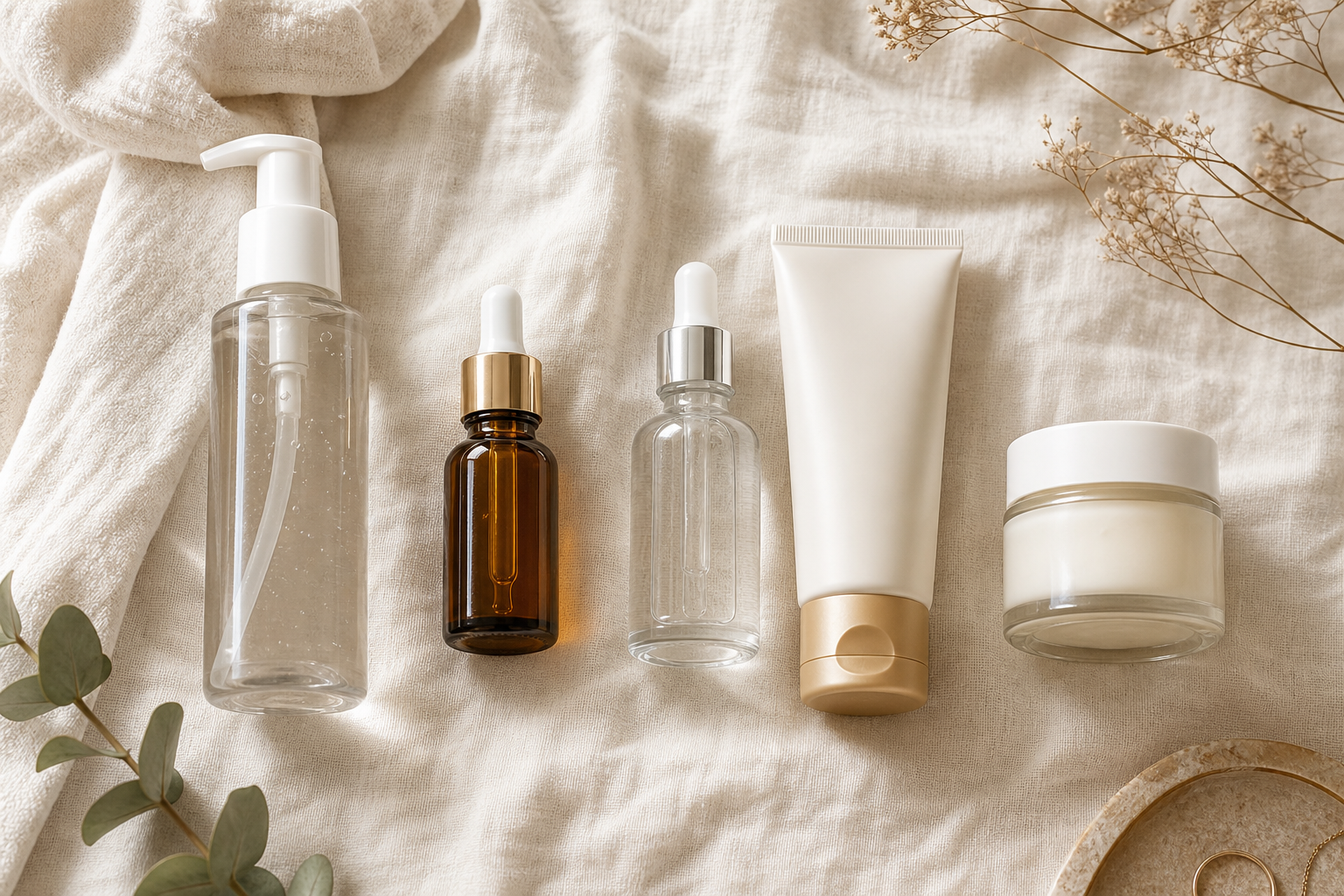
| Step | Timing | Aging-Skin Consideration | Interaction Risk |
|---|---|---|---|
| Gentle cleanser | AM | Non-stripping; preserve barrier | None |
| Vitamin C serum | AM, wait 1–2 min | Antioxidant stacks with SPF | None with mineral; minor with chemical |
| Hydrating toner / essence | AM, on damp skin | Improves SPF adhesion | None |
| Niacinamide serum | AM | Reduces SPF irritation; pairs with both | None |
| Moisturizer | AM (if needed) | Skip if sunscreen is hydrating | Can dilute SPF if over-layered |
| Sunscreen | AM, final treatment step | 1/4 tsp: face + neck + ears + décolletage | Wait 2–3 min before makeup |
| Retinoid | PM only | Increases UV sensitivity → AM SPF mandatory | Never combine with morning SPF |
The vitamin C + mineral sunscreen synergy. Because mineral sunscreen sits on the skin surface rather than absorbing into the dermis, it doesn't compete with vitamin C for skin penetration. Your vitamin C continues working underneath the SPF, and the sunscreen's built-in antioxidants stack on top of it. This combination is especially valuable for post-acne discoloration, where you need both prevention (sunscreen stops new pigment from forming) and correction (vitamin C fades existing pigment) running simultaneously every morning.
The retinoid trap. Retinoids increase cell turnover, exposing fresh, photosensitive keratinocytes that haven't developed full natural protection. Skipping sunscreen the morning after a retinoid night undoes the retinoid's benefit faster than skipping the retinoid entirely. Dr. Zoe Draelos, dermatologist and longtime Dermatology Times columnist, has been direct about this: sunscreen alone doesn't reverse damage — retinoids do. But without sunscreen, retinoids can't protect what they create. The two are interdependent, not interchangeable.
The moisturizer question. If your sunscreen has a hydrating base (criterion 5 above), you can usually skip separate moisturizer in summer — one less layer to pill, one less interaction to manage. In winter or for genuinely dry aging skin, moisturizer goes first, sunscreen second, but apply moisturizer to slightly damp skin so it absorbs fully before the SPF goes on top. Layering sunscreen over a moisturizer that hasn't dried down creates the pilling that makes people abandon mineral formulas.
The makeup-over-sunscreen issue. Allow two to three minutes of dry-down before foundation. Powder mineral sunscreen brushed over makeup at midday works for reapplication; liquid sunscreen over makeup smears it. If you can't commit to powder reapplication, position your sunscreen as a non-negotiable final step before the makeup goes on — and accept that your real-world protection drops by lunchtime.
What generic routine charts miss is the friction point specific to your skin: the formula that pills under your foundation, the ingredient sequence that triggers your rosacea, the texture you'll quietly abandon by week three. Personalized routine sequencing identifies these failure modes before they cost you six months of progress.
Six Sunscreen Mistakes That Silently Age You
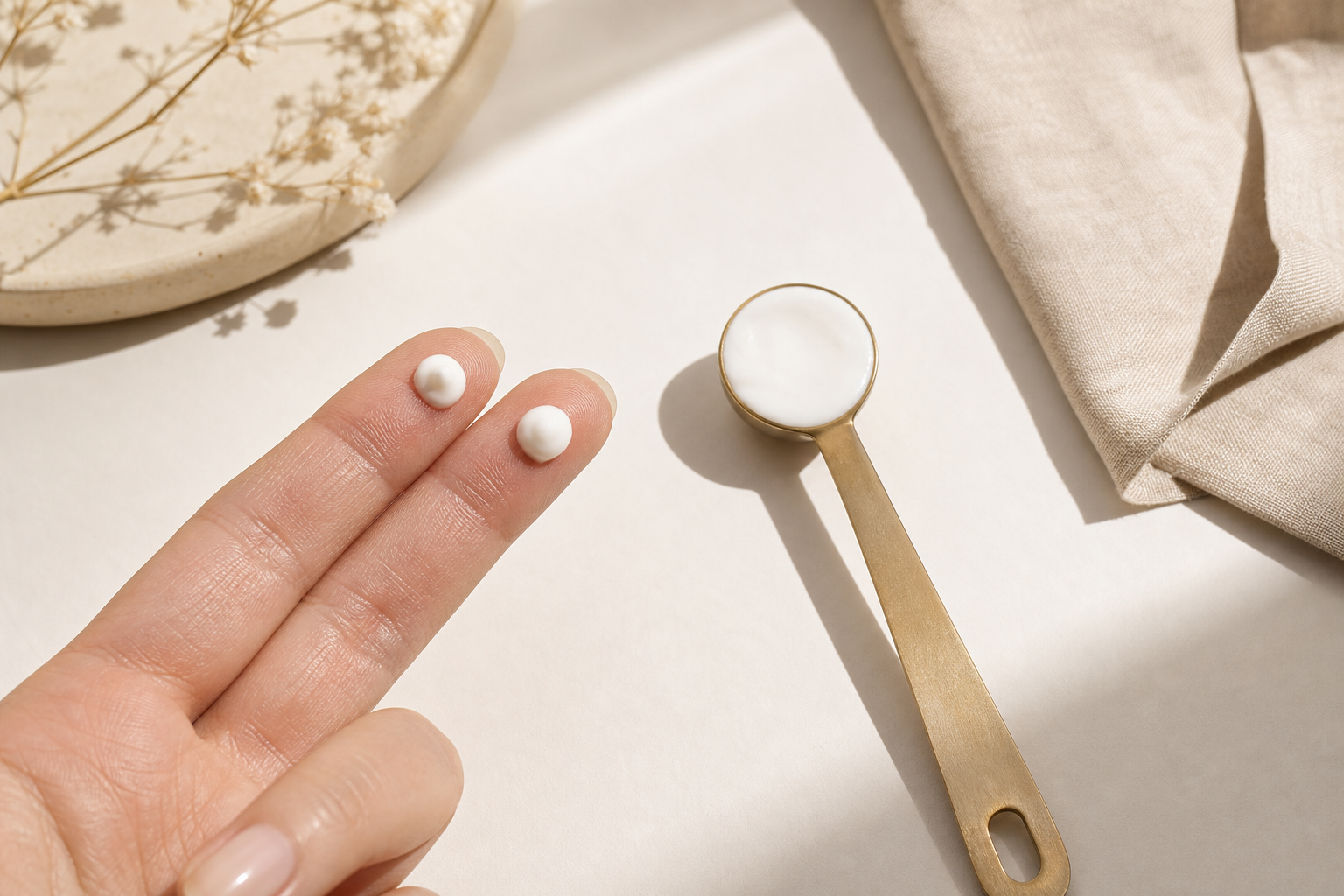
- "I apply enough — I think." Studies referenced by the British Journal of Dermatology show most people use only 25–50% of the recommended amount (1/4 tsp for face, 1 oz for body). That drops a labeled SPF 30 to an effective SPF of roughly 10–15. The fix takes 30 seconds: measure 1/4 teaspoon once, look at it on your palm, and use that as your visual reference forever.
A bottle of SPF 30 used correctly outperforms a bottle of SPF 50 used the way most people actually use it. Discipline beats label numbers, every time.
- "My moisturizer has SPF — I'm covered." SPF moisturizers are reliably under-applied because nobody dispenses a quarter-teaspoon of moisturizer onto their face. In practice, people use about one-tenth the amount needed for the labeled protection. Fix: treat SPF in moisturizer as a small bonus, never your primary protection. The dedicated sunscreen still goes on top.
- "I skip on cloudy days or when I'm indoors." Up to 80% of UV reaches skin on cloudy days, according to the Skin Cancer Foundation. UVA penetrates window glass freely. Office workers who sit near windows show measurable photoaging concentrated on the window-side of their face — visible asymmetry in fine lines and pigmentation by their 40s. Indoor doesn't mean protected.
- "I don't reapply because my makeup will smudge." Protection drops by roughly 50% after two hours of wear regardless of SPF, according to the American Academy of Dermatology. The realistic fix: a powder mineral SPF brushed over makeup at lunch, or a sunscreen-infused setting spray pressed in rather than misted on. Either preserves makeup and restores most of your protection.
- "I forget my neck, ears, and hands." These show photoaging first and most visibly precisely because they're applied to inconsistently. The neck, the back of the hands, and the décolletage are where age reveals itself before the face does. Skin texture issues on these areas — crepiness, sunspots, loss of firmness — are almost always a sunscreen application gap, not a missing serum. Same product, same amount, every exposed surface, every day.
- "Higher SPF means I can apply less or skip reapplication." SPF 50 vs. 30 is a 1% improvement in UVB blocking (98% vs. 97%). It doesn't extend reapplication intervals. The "SPF 50 lasts longer" idea is marketing, not science. SPF labels measure protection at a fixed application amount under controlled conditions, not duration of wear. Reapplication math is the same regardless of the number on the bottle.
Building a Lifetime Anti-Aging Sun Strategy — Beyond the Bottle
A bottle of sunscreen is one layer of defense. It's the most important topical layer, but it's not the entire strategy. Aging skin benefits most from a stacked approach — and from honesty about what each layer can and cannot do.
The hierarchy of sun defense. Topical sunscreen sits at the center of the stack, but it's surrounded by other inputs that compound its effect. The full picture: behavior (avoiding the 10 AM–4 PM peak UV window when possible) → clothing (UPF 50+ fabrics, wide-brim hats, UV-blocking sunglasses for the delicate skin around your eyes) → topical sunscreen as the foundational daily layer → antioxidant serum underneath the sunscreen to neutralize what gets through → diet (polyphenols from tea and berries, lycopene from cooked tomatoes, omega-3 fatty acids from fatty fish) which contributes measurable internal photoprotection. None of these alone is enough. Together, they're more than the sum of their parts.
The compliance principle is the actual variable. Return for a moment to the Australian trial in the Annals of Internal Medicine — the one with 900 adults over 4.5 years. The difference between the daily-use group and the discretionary-use group wasn't formula sophistication. Both groups used the same SPF 15+ product. The variable was frequency. The single most important factor in anti-aging sun protection is consistency, year-round, regardless of weather, regardless of indoor/outdoor plans, regardless of season. A modest formula used every day outperforms a sophisticated formula used three days a week. This is the unglamorous truth that the skincare industry quietly buries because there's no margin in selling you the same bottle for the next 30 years.
Acknowledge what sunscreen cannot do. Dr. Zoe Draelos, writing critically in Dermatology Times, makes a point that doesn't get repeated enough in beauty media: sunscreen prevents future damage. It does not reverse existing photoaging. For visible damage already present — wrinkles, age spots, post-inflammatory hyperpigmentation, loss of elasticity — prevention has to be paired with reparative actives (retinoids, vitamin C, exfoliating acids) and, when appropriate, clinical interventions. If you've been sun-exposed unprotected for 20 years and you start sunscreen at 42 expecting to see your fine lines vanish, you'll be disappointed. The lines that are there now stay there until something repairs them. Sunscreen's job is to make sure no new ones arrive.
Acknowledge the research gap honestly. Most photoaging research — including the Australian trial cited repeatedly above — has been conducted predominantly on lighter Fitzpatrick skin types (I–III). Photoaging in deeper skin tones (IV–VI) presents differently. It typically manifests as dyschromia, melasma, and uneven tone rather than wrinkling, and the formula priorities shift accordingly: heavier emphasis on iron oxides for visible-light protection, on niacinamide for tone regulation, on antioxidants for inflammation control. Research published in Pigment Cell & Melanoma Research underscores this gap — the same product recommendations don't translate uniformly across skin types, and generic guidance can leave deeper-toned readers under-served.
The reapplication reality for aging skin. Reapplication is harder when you're wearing makeup, when texture issues mean liquid sunscreen disrupts the surface, when you're layered with actives that don't love being re-disrupted at noon. Practical solutions that actually fit into real days: keep a compact of powder mineral SPF in your bag for midday touch-ups (it goes over makeup without smudging); use sunscreen-infused setting sprays pressed in with clean hands rather than misted from a distance; reapply at lunch even if you "feel fine," because feeling fine has nothing to do with UV exposure. Reapplication is a habit, not a response to sensation.
What a generic article cannot tell you is which of these principles applies most to your skin — your specific barrier function, your existing active routine, your texture preferences, your climate, your daily UV exposure profile, your skin tone, your medical history. A remote personalized consultation maps the specific friction points: the formula that pills under your foundation, the ingredient that triggers your rosacea flare, the reapplication routine you'll actually keep through a busy work week. That's the difference between knowing what to do and actually doing it for 30 years.
Sunscreen for Aging Skin — Practitioner Answers to the Questions Clients Actually Ask
Q1: Can I use the same sunscreen year-round, or does aging skin need seasonal swaps?
Consistency matters more than seasonal optimization. The Australian trial that proved sunscreen prevents aging used a single formula daily, year-round, for 4.5 years. If your formula works for your skin, keep it; adjust the moisturizer underneath for season instead — heavier in winter, lighter in summer. Switching sunscreens introduces compliance friction (relearning texture, dealing with new irritation), and compliance is the variable that actually moves the needle. Don't fix what isn't broken.
Q2: How long until I see anti-aging benefits from daily sunscreen?
Prevention starts immediately — UV damage stops accumulating the day you start applying sunscreen consistently. But visible improvement in existing photoaging (tone evenness, fine-line softening) requires pairing sunscreen with reparative actives like retinoids and vitamin C, and shows up at roughly three to six months. Sunscreen alone holds the line. It does not reverse it. Expect the right thing from the right product.
Q3: Is SPF 50 meaningfully better than SPF 30 for aging skin?
Marginally. SPF 30 blocks 97% of UVB; SPF 50 blocks 98%, according to the American Academy of Dermatology. The 1% difference is overwhelmed by application amount — if you apply SPF 50 at half the required dose (which most people do), you're getting roughly SPF 15 of real protection. Choose the SPF you'll apply correctly, every day. A correctly-applied SPF 30 beats a half-applied SPF 50, every time.
Q4: What if mineral sunscreen leaves a white cast on my skin tone?
Look for tinted mineral formulas with iron oxides at 3–5% — they neutralize the white cast and add visible-light protection, which matters more for deeper skin tones where hyperpigmentation is the dominant photoaging concern. Research in the Journal of Investigative Dermatology supports the iron-oxide approach for both visible-light defense and cosmetic finish. Non-nano zinc and modern micronized titanium dioxide also reduce cast significantly. Tinted mineral is often the right answer.
Q5: Can I layer mineral sunscreen over niacinamide and vitamin C without pilling?
Yes — with three rules. Apply serums to slightly damp skin so they absorb fully rather than sitting wet on the surface. Wait one to two minutes between layers. Apply sunscreen in thin, pressed layers rather than rubbing it in like lotion. If pilling persists after following all three, your serum likely contains silicones or polymers that conflict with your sunscreen's base — the fix is product substitution, not technique adjustment. Pilling is a chemistry problem, not a user error.
Q6: I'm overwhelmed. Where do I actually start?
Start with one bottle: a mineral sunscreen with 8–15% zinc oxide, SPF 30, in a hydrating base. Use it every morning — every season, every weather, indoors and out — for four weeks straight. Track what doesn't work: pilling, irritation, white cast, midday reapplication friction. Those friction points are the real diagnostic information. At Macherre, a remote consultation turns that information into a personalized routine — sunscreen, supporting actives, and sequencing — built around your skin's actual biology, not a generic article's averages. That's the difference between a product recommendation and a strategy that holds for 30 years.