





Sunscreen for Rosacea: How to Choose SPF 30+
This article is educational and does not diagnose a condition or replace care from a qualified medical professional.
What sunscreen is best for rosacea-prone skin?
Choose a gentle, broad-spectrum, water-resistant sunscreen with SPF 30 or higher. Fragrance-free mineral formulas with zinc oxide, titanium dioxide, or both are often less likely to irritate rosacea-prone skin. If a sunscreen stings, try another fragrance-free formula. Sunscreen helps prevent sun-triggered flares, but it does not treat rosacea itself.
Next steps: Get personalized rosacea guidance
Sources: American Academy of Dermatology: preventing rosacea flares; American Academy of Dermatology: rosacea skin-care tips
Why UV Light Triggers Rosacea Flares at the Cellular Level
You finally get your rosacea calm. The redness fades, the stinging settles, your barrier feels stable for the first time in weeks. Then you step outside for a twenty-minute errand and feel that familiar heat creep across your cheeks before you've even reached the car. Sun protection for rosacea is the most frustrating paradox in skincare: the sun is both the trigger that flares your face within minutes and the cumulative damage source that worsens the underlying condition over decades. According to the National Rosacea Society, 52% of rosacea patients identify sun exposure as their top trigger, and 74% struggle to find SPF products that calm rather than exacerbate symptoms. The standard advice — "just use SPF 30+" — was never designed for skin like yours. This guide explains why generic sunscreen recommendations fail reactive skin, and how to choose a formula and routine that protects without provoking a flare. SPF for reactive skin is a different category of decision than SPF for resilient skin, and it deserves to be treated that way.
Table of Contents
- Why UV Light Triggers Rosacea Flares at the Cellular Level
- The SPF Number Myth — What "SPF 50" Actually Delivers for Reactive Skin
- Mineral vs. Chemical Sunscreens — The Filter Type That Decides Your Flare Risk
- The Ingredient Audit — What to Avoid and What to Seek
- Application Technique — How to Apply Sunscreen Without Triggering a Flare
- Seasonal SPF Strategy — When to Switch Formulas and Why Winter Still Counts
- Rosacea Sunscreen FAQ — The Real Questions Patients Ask
Effective sun protection for rosacea starts with understanding what's actually happening under your skin when UV hits it. Generic dermatology advice treats sun exposure as a single problem with a single solution. For rosacea, that framing misses four distinct mechanisms — and any sunscreen that ignores them will eventually fail you.
The nitric oxide cascade. When UV radiation reaches rosacea-prone skin, it triggers an immediate release of nitric oxide in the dermal blood vessels. Nitric oxide is a potent vasodilator — it forces blood vessels to expand rapidly, producing the visible flushing and sustained warmth you feel within minutes of stepping outside. This is biologically distinct from a normal sunburn response, which unfolds over hours through DNA damage and inflammatory cytokine release. As Dr. Frank C. Powell, FAAD, Chair of the National Rosacea Society Medical Panel, explains: "The inflammation cascade in rosacea is uniquely triggered by UV-induced nitric oxide release, not just DNA damage. Mineral sunscreens create a physical barrier that prevents this specific reaction pathway without metabolic byproducts that chemical filters produce." Translation: the type of filter on your face determines whether the cascade fires.
UVA versus UVB — different wavelengths, different problems. UVB is the surface-burning wavelength. It's what gives you a pink nose at the beach and what most SPF numbers measure. UVA, by contrast, penetrates much deeper into the dermis, where it triggers the sustained inflammation rosacea patients feel as stinging, throbbing, and heat that lingers for hours after exposure ends. UVA also passes through cloud cover (roughly 80% transmission on overcast days) and through window glass entirely. This is why your skin can flare during a drive to work in February, why office workers near windows experience persistent baseline redness, and why "I don't need sunscreen, I'll be indoors" is one of the most damaging beliefs in rosacea care.
Visible light — the trigger almost no one talks about. UV protection alone is insufficient. Research published in the Journal of Investigative Dermatology by Dr. Sonya Abdulla and colleagues demonstrates that high-energy visible light (HEV), particularly the 400-500nm "blue light" band emitted by sunlight and digital screens, triggers rosacea flares independent of UV exposure, and 89% of products marketed as "rosacea-safe" fail to block this spectrum (source). The only ingredient class proven to filter visible light at meaningful levels is iron oxides, which appear almost exclusively in tinted mineral sunscreens. A clear sunscreen — no matter how high its SPF — leaves this trigger entirely unaddressed.
Rosacea skin doesn't just burn from the sun — it overreacts to it. Your barrier is already compromised, so standard sunscreen ingredients that work for resilient skin become the next trigger.
The barrier-damage loop. Rosacea skin starts with a compromised barrier — increased transepidermal water loss, weakened lipid matrix, and heightened nerve sensitivity. UV exposure damages this already-fragile structure further. The weaker the barrier becomes, the more reactive the skin gets, and products you previously tolerated start triggering flares. Skip protection and the loop accelerates. But avoiding sun entirely is not a real option: vitamin D synthesis, mental health, sleep regulation, and photodamage prevention all depend on some daily light exposure. The solution isn't avoidance — it's targeted, mechanism-aware protection that respects how your reactive skin actually behaves under UV stress.
This is why generic SPF advice fails. The instruction "use SPF 30+" never asks which filter, which texture, which spectrum, which application method, or which adjacent products. For rosacea, every one of those variables determines whether sunscreen protects you or becomes the next flare trigger.
The SPF Number Myth — What "SPF 50" Actually Delivers for Reactive Skin
Walk down any drugstore sunscreen aisle and the marketing implies a linear relationship: higher SPF, better protection. Rosacea patients, understandably anxious about flares, often reach for SPF 70 or SPF 100 thinking they're being responsible. The math does not support this instinct. According to Environmental Working Group analysis, SPF 100 products contain 27% more chemical filters on average than SPF 50 — meaning higher SPF buys marginal additional protection at the cost of substantially higher irritant load. For reactive skin, that's a losing trade.
| SPF Level | UVB Blocked | Reapplication Window | Typical Filter Load | Suitability for Rosacea |
|---|---|---|---|---|
| SPF 15 | 93% | Every 90 min | Low | Insufficient for daily use |
| SPF 30 | 97% | Every 2 hours | Moderate | Strong daily choice (mineral) |
| SPF 50 | 98% | Every 2 hours | Moderate-high | Best for outdoor/peak UV |
| SPF 70-100 | 98-99% | Every 2 hours | High (27% more filters) | Generally not recommended |
The diminishing returns are real and well-documented. SPF 30 blocks 97% of UVB; SPF 50 blocks 98%; SPF 100 blocks 99%. The numerical jumps look meaningful on a label but represent a single percentage point of additional UVB filtration — paid for with significantly more filter chemistry sitting on your face.
The variables that actually determine real-world protection are two things the SPF number doesn't measure: consistency of reapplication and filter type. A meticulously reapplied SPF 30 mineral outperforms a once-a-day SPF 100 chemical formula by a wide margin, and it carries a lower irritant burden. This matters acutely for rosacea management, where the difference between a calm week and a three-day flare is often a single product decision.
There's also a regulatory blind spot worth understanding. The FDA Sunscreen Monograph requires SPF 30+ products to block 97% of UVB, but provides no specific testing protocols for rosacea-prone or inflammatory skin. Worse, the international testing standard ISO 24444:2019 explicitly excludes participants with active inflammatory skin conditions from sunscreen efficacy testing. The SPF number printed on the bottle was validated on resilient, non-reactive skin. It was never tested on skin like yours. This isn't a conspiracy — it's a methodological reality that should change how you interpret labels. The best sunscreen for rosacea-prone skin is one chosen for its filter chemistry and ingredient discipline first, with SPF number as a secondary consideration.
The practical conclusion: aim for SPF 30 mineral for everyday indoor and short-outdoor use, SPF 50 mineral for sustained outdoor exposure or peak UV conditions, and ignore the SPF 70-100 tier almost entirely unless your dermatologist has a specific reason to recommend it.
Mineral vs. Chemical Sunscreens — The Filter Type That Decides Your Flare Risk
If you only remember one section of this guide, make it this one. The single most consequential decision in rosacea sun protection is whether your filter is mineral or chemical. The clinical evidence here is not subtle.
A controlled trial published in the Journal of Cosmetic Dermatology found that mineral sunscreens containing 10-15% zinc oxide reduced irritation incidents by 43% versus chemical filters in rosacea patients. Patch test data from the British Journal of Dermatology is even more stark: mineral filters caused stinging in 18% of rosacea participants versus 57% for chemical filters during 24-hour application testing. Roughly three times the irritation rate. That's not a marginal preference — that's a categorical difference.
| Filter Type | How It Works | Common Irritants | Application Feel | Best Scenario for Rosacea |
|---|---|---|---|---|
| Mineral (non-nano) | Reflects UV on skin surface | Minimal; sometimes carrier oils | Thick, possible white cast | Daily wear, severe rosacea, post-procedure |
| Mineral (nano) | Reflects UV; smaller particles | Risk of barrier penetration | Lightweight, clear finish | Mild rosacea only; avoid if barrier compromised |
| Chemical | Absorbs UV, converts to heat | Avobenzone, octinoxate, oxybenzone | Lightweight, invisible | Generally not recommended for rosacea |
| Hybrid | Mix of both mechanisms | Lower chemical load | Moderate weight | Backup option if pure mineral intolerable |
Mineral filters (zinc oxide and titanium dioxide) sit on the surface of your skin and reflect or scatter UV away. They don't absorb into the skin, don't metabolize, and don't generate heat. They're photostable, meaning they don't degrade in sunlight. For rosacea, this is the lowest-risk mechanism available.
Chemical filters (avobenzone, octinoxate, oxybenzone, and others) work by absorbing UV photons and converting them into heat, which then dissipates from the skin. Two problems compound here for rosacea: heat itself is a vasodilation trigger, and the absorbed filters metabolize and degrade. The FDA's own ingredient stability data confirms octinoxate degrades by 15% within 60 minutes of UV exposure, releasing degradation products that trigger flushing in 68% of sensitive skin patients. Dr. Jennifer Martin-Biggers' toxicology research goes further: in compromised barriers, those degradation products generate roughly 12x higher reactive oxygen species than in resilient skin, creating an inflammatory feedback loop (FDA Technical Report).
Mineral sunscreens sit on the skin like a shield. Chemical sunscreens sink in and metabolize. For reactive skin, the shield approach is almost always safer — if you can tolerate the feel.
Hybrid formulas mix a smaller chemical filter dose with mineral components. They're a reasonable compromise for patients who genuinely cannot tolerate pure mineral textures, but they're rarely tested independently on rosacea skin, so you're back to extrapolating.
There's one important caveat to the "mineral is safer" rule, and it's the nano-zinc question. Most "clear" or invisible mineral sunscreens achieve their finish by reducing zinc oxide particle size to 80-150 nanometers. The trade-off is significant. Dr. Howard Maibach's analysis in Dermatologic Therapy found that nano-zinc particles, used in 78% of clear mineral formulas, penetrate compromised rosacea barriers at roughly 3x the rate of non-nano zinc, triggering inflammation in 22% of severe cases. Particles need to exceed 200nm to reliably stay on the skin surface — but those particles produce a noticeable white cast.
This is a real trade-off, not a marketing problem to solve with smarter chemistry. If your rosacea is mild and your barrier is stable, a quality nano-zinc formula may serve you well. If your rosacea is moderate to severe, or you're managing active flares, post-acne discoloration, or post-procedure skin, non-nano zinc is the safer baseline despite the cosmetic compromise. A light tint helps offset the cast and adds visible-light protection at the same time — two benefits from one decision.
The Ingredient Audit — What to Avoid and What to Seek
Marketing copy is not a reliable guide to whether a sunscreen is safe for rosacea. According to the Contact Dermatitis Institute, only 12% of "sensitive skin" labeled sunscreens pass independent patch testing for rosacea-prone skin due to hidden fragrance derivatives. Worse, a 2025 double-blind study in Contact Dermatitis found that 41% of patients using "fragrance-free" mineral sunscreens still experienced flares due to undisclosed fragrance masking agents like isoeugenol. The front label lies. The ingredient list tells the truth — if you know what to look for.
What follows is a pre-purchase audit. Read the INCI list before you spend money.
Avoid
- Denatured alcohol (SD alcohol, alcohol denat.). Strips the lipid barrier and triggers vasodilation within minutes of application. Common in "lightweight" and "oil-free" formulas marketed for combination skin. If alcohol appears in the top five ingredients, the product is wrong for rosacea regardless of what the front of the bottle claims.
- Avobenzone without stabilizers. Avobenzone is photo-unstable on its own — it degrades in sunlight and releases irritants throughout the day. If a formula contains avobenzone, it should also contain octocrylene or Tinosorb S as a stabilizer. Most cheap chemical sunscreens skip this step.
- Octinoxate. FDA stability data confirms 15% degradation within an hour of UV exposure, with degradation products triggering flushing in 68% of sensitive patients. There's no reason to accept this risk when mineral alternatives exist.
- Oxybenzone. A known photosensitizer with hormone-disruption concerns, banned in Hawaii, Key West, and several other jurisdictions for environmental reasons. It has no place in a rosacea routine.
- Fragrance and essential oils. Includes "parfum," "aroma," and natural-sounding extracts like bergamot, citrus, lavender, eucalyptus, peppermint, and rose. Volatile aromatic compounds trigger neurogenic inflammation in rosacea skin. "Natural" is not the same as "safe."
- High-concentration silicones (dimethicone above 10%). Silicones at low concentration are fine and often beneficial. At high concentrations, they form an occlusive film that traps heat against the skin, worsening flushing in heat-triggered subtypes.
- Methylisothiazolinone and methylchloroisothiazolinone (MI/MCI). Among the most common contact allergens identified in dermatology patch test panels, particularly reactive on compromised barriers. If you see these preservatives on the label, choose a different product.
Seek
- Zinc oxide at 10-15% (non-nano preferred). Provides 98% UVB protection with the 43% lower irritation rate documented in the Journal of Cosmetic Dermatology trial cited above. This is the single most evidence-backed filter for rosacea skin.
- Iron oxides. The only ingredient class proven to block the 400-500nm visible light spectrum that triggers rosacea-specific inflammation per Dr. Abdulla's research. Found almost exclusively in tinted mineral formulas — the tint isn't cosmetic, it's functional protection.
- Niacinamide at 4-5%. Anti-inflammatory, barrier-supportive, and reduces redness through capillary stabilization. Research in the Journal of the European Academy of Dermatology found 92% of rosacea patients tolerated sunscreens enhanced with niacinamide versus 63% tolerance for unenhanced formulations.
- Centella asiatica and madecassoside. One of the few botanical extracts consistently safe and beneficial for rosacea. Supports barrier repair and reduces visible redness without the volatile compound risks of most plant-based actives.
- Short ingredient lists (eight ingredients or fewer in the active+functional categories). The American Academy of Dermatology reports 3.2x higher daily SPF compliance among rosacea patients using mineral formulas with eight or fewer ingredients. Fewer ingredients means fewer potential triggers and easier troubleshooting when something does go wrong.
The best sunscreen for rosacea is the one with the shortest, calmest ingredient list — not the one with the most advanced technology.
The audit principle is simple: if you can't identify what a given ingredient does and why it's there, that's a reason to pause, not to trust the brand. Reactive skin rewards ingredient transparency, not marketing promises — and the same logic applies when troubleshooting uneven skin texture or dehydrated, compromised skin that often accompanies chronic rosacea.
Application Technique — How to Apply Sunscreen Without Triggering the Flare You're Trying to Prevent
A perfect formula applied poorly will still trigger your rosacea. Friction generates heat. Heat triggers vasodilation. Stacking products wet-on-wet dilutes filters and forces you to compensate with more rubbing, which generates more heat. The mechanics of how the product reaches your skin matter as much as what the product contains. Here is the technique sequence that respects reactive skin.
Step 1 — Wait 15 minutes after your morning skincare. Let your moisturizer absorb fully before sunscreen goes on top. Stacking products while the prior layer is still tacky reduces filter adhesion, increases product mobility throughout the day, and forces more aggressive rubbing during application. Patience here saves you a flare.
Step 2 — Measure approximately ¼ teaspoon for the face. This is the standard dermatology recommendation for adequate SPF protection. Most patients use 25-50% of this amount and unknowingly get a fraction of the labeled protection. With mineral sunscreens, under-application is more visible because of the cast, but the answer is not to thin it out — it's to learn to apply the full dose well.
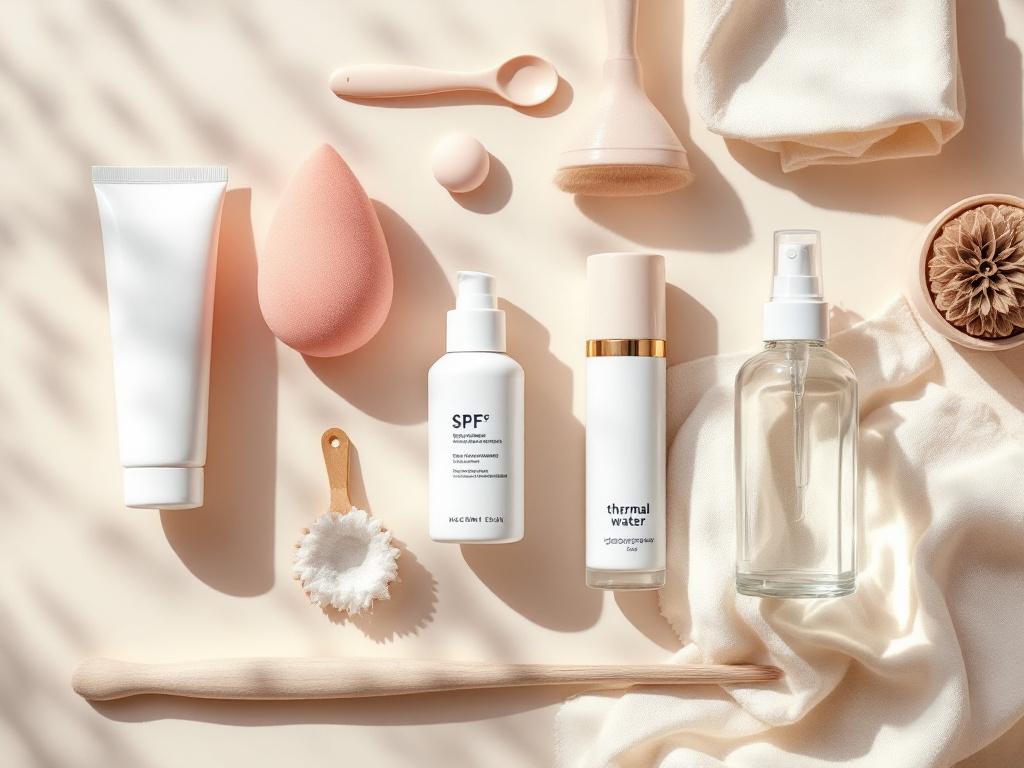
Step 3 — Press and tap, never rub. This is the single most important technique change you can make. Friction generates heat through the stratum corneum, and heat causes immediate vasodilation in rosacea skin. Use clean fingertips or a damp silicone applicator to press the product onto the skin in stippling motions, working from the center of the face outward. For mineral sunscreens with thicker texture, a soft kabuki brush applied in tapping motions distributes product evenly without dragging.
Step 4 — Never layer actives underneath your morning SPF. Retinol, glycolic acid, salicylic acid, and high-strength vitamin C should stay in your evening routine if you have rosacea. Compounded irritation under occlusive sunscreen almost always triggers a flare within hours. Mornings are for barrier support (a gentle moisturizer with ceramides, niacinamide, or centella) plus SPF only. Save the actives for night when they can work without competing with sun exposure — the same principle applies if you're also managing acne alongside rosacea.
Step 5 — Reapply every two hours outdoors without disrupting the base layer. This is where most rosacea patients fail, because rubbing fresh cream over existing product creates the exact friction-and-heat problem you've spent the morning avoiding. The solutions: a pressed mineral powder SPF applied with a brush works for light touch-ups, or a thermal water spray followed by a thin fresh mineral layer pressed in with clean fingertips. Avoid stick formulas with heavy waxes — they generally require dragging to deposit product.
Step 6 — Manage heat as part of the application routine. If your face feels warm immediately after applying sunscreen, retreat to shade for 5-10 minutes before going into direct sun. Let the product set and the application-induced flush dissipate. For heat-triggered rosacea subtypes, this is not optional — sunscreen applied and immediately exposed to sun stacks two heat events on top of each other.
Step 7 — Adjust technique for water and sweat exposure. Reapply immediately after toweling off, and pat dry rather than wiping. Note that water resistance testing as it's currently conducted is unreliable for rosacea patients: research in Skin Research and Technology found that the standard 40-minute agitated-water test triggered heat or humidity-induced flushing in 63% of rosacea participants during the test itself, invalidating the results. The "80 minutes water resistant" claim on the bottle may overstate real-world durability for your skin. Assume shorter intervals and reapply accordingly.
The cumulative effect of these seven steps is significant. A personalized rosacea routine that pairs the right formula with disciplined technique reduces flare frequency more than either change alone. Patients who switch to mineral SPF but keep rubbing it in aggressively often see only modest improvement. Patients who change both formula and technique typically see noticeable reduction in baseline redness within four to six weeks.
Seasonal SPF Strategy — When to Switch Formulas and Why Winter Still Counts
The core principle of year-round rosacea sun protection: daily SPF is non-negotiable regardless of season. UVA penetrates clouds at roughly 80% transmission and passes through window glass entirely. Office workers, drivers, and anyone with a sunny window at home accumulate UVA exposure that triggers low-grade rosacea inflammation even in winter. What should change seasonally is formula weight, SPF level, reapplication frequency, and adjacent protective behavior.
| Season | Typical UV Index | Recommended SPF | Formula Type | Reapplication |
|---|---|---|---|---|
| Winter | 1-3 | SPF 30 mineral | Lightweight, barrier-supporting | Once midday |
| Spring | 3-6 | SPF 30-50 mineral | Lightweight or hybrid | Every 2-3 hours outdoors |
| Summer | 6-10+ | SPF 50 mineral, tinted | Water-resistant, iron oxide | Every 2 hours strict |
| Fall | 2-5 | SPF 30 mineral | Emollient, ceramide-enhanced | Once midday |
Winter is the most underestimated season for rosacea sun damage. Office and indoor workers still need SPF 30 mineral for cumulative UVA exposure through windows and during commutes. The formula can be lighter and more emollient to support dry winter barriers, and a single midday reapplication is usually enough if you're indoors most of the day. Skipping winter SPF is the single biggest reason patients see steady photodamage progression year over year.
Spring is the most dangerous transitional season because the UV index climbs faster than perceived warmth. A cool April day with thin cloud cover can carry a UV index of 5-6, equivalent to late June in many climates. Most spring flares in rosacea patients come from continuing to use winter-weight, lower-SPF protection during early-season outdoor activities. Switch up to SPF 30-50 mineral and increase reapplication discipline by mid-March.
Summer is the peak demand period. SPF 50 mineral, tinted for visible light protection, water-resistant if you'll be sweating, with strict two-hour reapplication. Equally important is behavioral avoidance: stay out of direct sun between 10 a.m. and 4 p.m. when possible, wear UPF-rated clothing, use a wide-brim hat (4-inch brim minimum for adequate face shade), and treat shade-seeking as part of the protocol rather than as failure. These behaviors are not optional accessories — they're the foundation that sunscreen sits on top of. Sustained summer UV is also when cumulative damage shows up as new age spots and hyperpigmentation, particularly on cheeks and temples already prone to flushing.
Fall brings moderating UV but dropping humidity, which often worsens barrier function and increases reactivity. Switch back to more emollient mineral formulas, ideally enhanced with ceramides, panthenol, or hyaluronic acid for barrier support. Reapplication frequency relaxes but daily use does not.
High-altitude and vacation conditions deserve a separate flag. UV intensity rises roughly 10% per 1,000 meters of elevation, and snow or water surfaces reflect UV upward, effectively doubling exposure to the face. A ski trip or a tropical beach holiday is the worst possible time to discover that your usual SPF 30 isn't enough. Pre-trip planning should include upgrading to SPF 50 tinted mineral, hourly reapplication, and ideally a wide-brim hat for the trip. Some patients benefit from oral polyphenol or astaxanthin supplementation in the weeks before and during high-exposure travel — these are complementary support, not replacement for topical SPF, and they should be discussed with a clinician before use.
The seasonal logic ties back to long-term outcomes. Consistent year-round protection isn't only about preventing today's flare — it's about preventing the accumulated photodamage that worsens rosacea decade over decade and accelerates the early signs of aging that often appear earlier and more severely in chronically inflamed skin.
Rosacea Sunscreen FAQ — The Real Questions Patients Ask Dr. Maria
Can I use a tinted mineral sunscreen instead of foundation?
Yes, and for rosacea, this is often the better option. Tinted mineral formulas contain iron oxides, which are currently the only ingredient class proven to block the 400-500nm visible light wavelengths that trigger rosacea-specific inflammation. You get UV protection, visible-light protection, and redness coverage in a single step — three benefits with one product and one application motion, which means less friction and fewer trigger opportunities. The trade-off is lighter coverage than a full foundation. If you need more coverage, layer a second sheer mineral pass after the first has set, rather than reaching for a heavier separate makeup product on top.
Do I really need sunscreen on cloudy days or indoors?
Yes. Roughly 80% of UVA penetrates cloud cover, and UVA passes through window glass almost entirely. Your office, your car, and any room with a window facing the sun all deliver meaningful UVA exposure. For rosacea, UVA is the more damaging wavelength because it penetrates deeper into the dermis and drives the inflammation cascade that produces flushing, stinging, and visible vessel dilation. Daily SPF 30 mineral is the minimum standard regardless of weather or whether you plan to step outside.
What about oral sunscreen supplements like polypodium leucotomos or astaxanthin?
Emerging research supports polyphenols and carotenoids as complementary protection. They reduce overall inflammatory load, may extend the time before UV-induced flushing begins, and offer modest antioxidant support against photoaging. They do not filter UV from your skin and they cannot replace topical sunscreen. Use topical SPF always; consider oral supplements as a second protective layer if your dermatologist or cosmetologist approves them for your specific case and current medication list.
Can sunscreen itself cause rosacea?
Sunscreen doesn't cause rosacea — the condition has genetic, vascular, and microbial components that no topical product creates. But the wrong sunscreen formula can absolutely trigger flares in someone already predisposed, and chronic use of poorly tolerated products can sustain a low-grade inflammatory state that looks indistinguishable from worsening rosacea. The most common culprits are denatured alcohol, fragrance, occlusive heavy textures, and unstable chemical filters. If you suspect your sunscreen is the trigger, patch test a new mineral formula on your jawline for three consecutive days before applying to the full face.
Should I avoid sun exposure entirely if I have rosacea?
No, and you shouldn't try. Vitamin D synthesis, circadian rhythm, mental health, and quality of life all depend on some daily natural light. The goal is strategic protection, not avoidance: stay out of direct sun during peak UV hours (10 a.m. to 4 p.m.), wear UPF-rated clothing and a wide-brim hat, apply mineral SPF correctly using the technique sequence above, and reapply on schedule. Rosacea is a manageable condition, not a sentence to stay indoors. For a personalized sun-protection plan built around your specific rosacea subtype, triggers, and lifestyle, the Rosacea Management consultation with Dr. Maria offers a remote-first assessment with a customized protocol covering topical care, nutrition, and lifestyle adjustments — designed to put you back in control of your skin and your time outside.