





PRP Under-Eye Treatment: How It Works and Who's a Good Candidate
This article is educational and does not diagnose a condition or replace care from a qualified medical professional.
PRP Under-Eye Treatment: The Honest Guide to Results, Cost, and Whether You're a Candidate
You booked the appointment, then cancelled it. Or maybe you've scrolled through twenty before-and-after grids on Instagram and still can't tell if a PRP under-eye treatment will actually do what you want it to do. The marketing promises are loud. The clinical reality is quieter, more specific, and — if you understand it — far more useful to you than any "85% off this week" ad.
This guide walks through the science, the procedure, the realistic timeline, the true five-year cost, and the seven warning signs that mean a clinic shouldn't touch your face. By the end, you'll know whether platelet-rich plasma belongs in your routine, or whether the smarter move is a topical-led protocol that costs 10% as much.
Table of Contents
- How PRP Under-Eye Treatment Works at the Cellular Level (And Why It's Not Filler)
- PRP vs. Fillers vs. Microneedling vs. Topical-Only: Which Solves Your Specific Concern
- Inside the PRP Under-Eye Procedure: A Step-by-Step Walkthrough
- What PRP Under-Eye Results Actually Look Like at 4, 8, and 12 Weeks
- Are You a Candidate for PRP Under-Eye Treatment? An Honest Self-Screen
- The True Cost of PRP Under-Eye Treatment Over One, Three, and Five Years
- Seven Red Flags That Mean You Should Walk Out of a PRP Consultation
- Your Pre-Booking PRP Readiness Checklist
How PRP Under-Eye Treatment Works at the Cellular Level (And Why It's Not Filler)
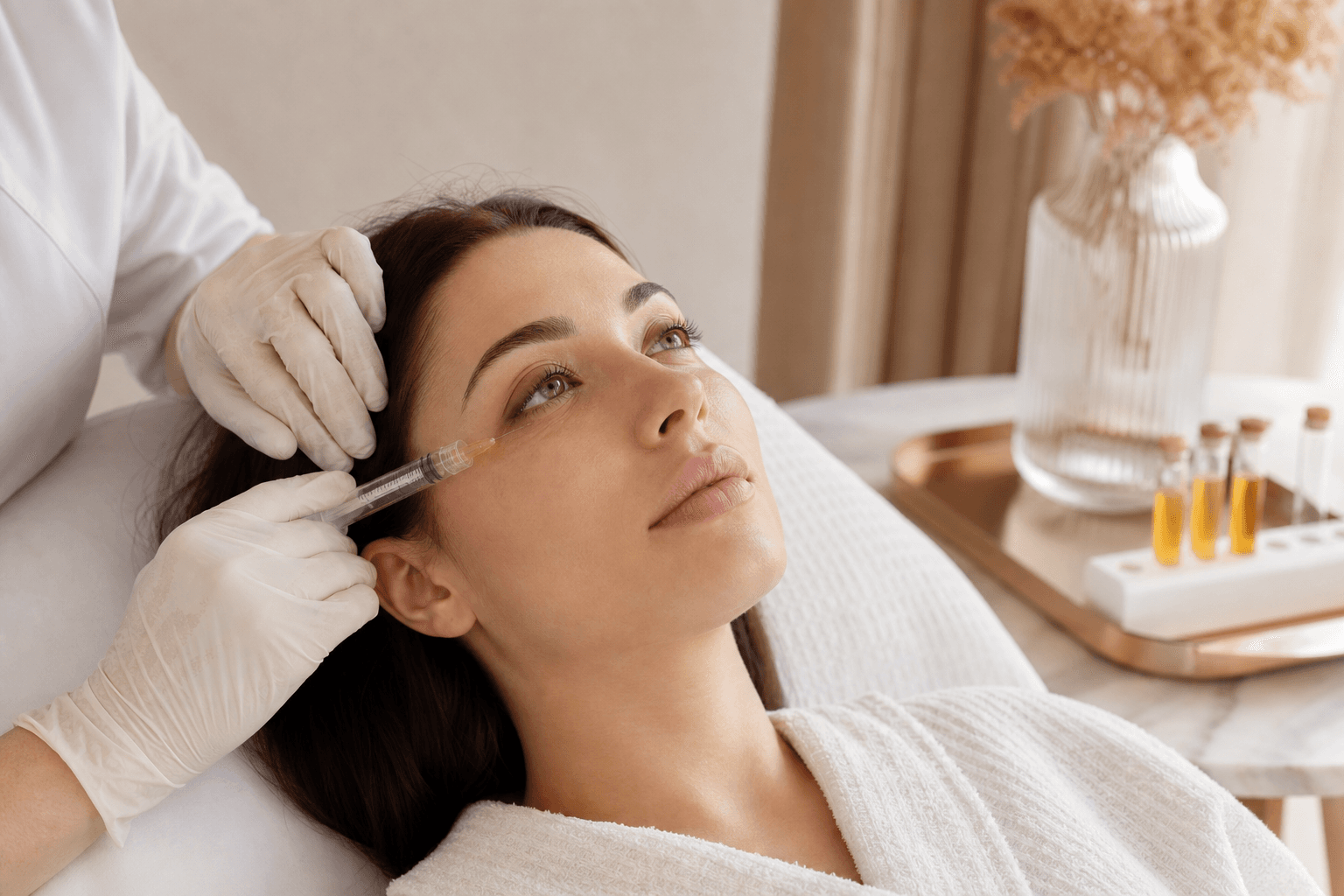
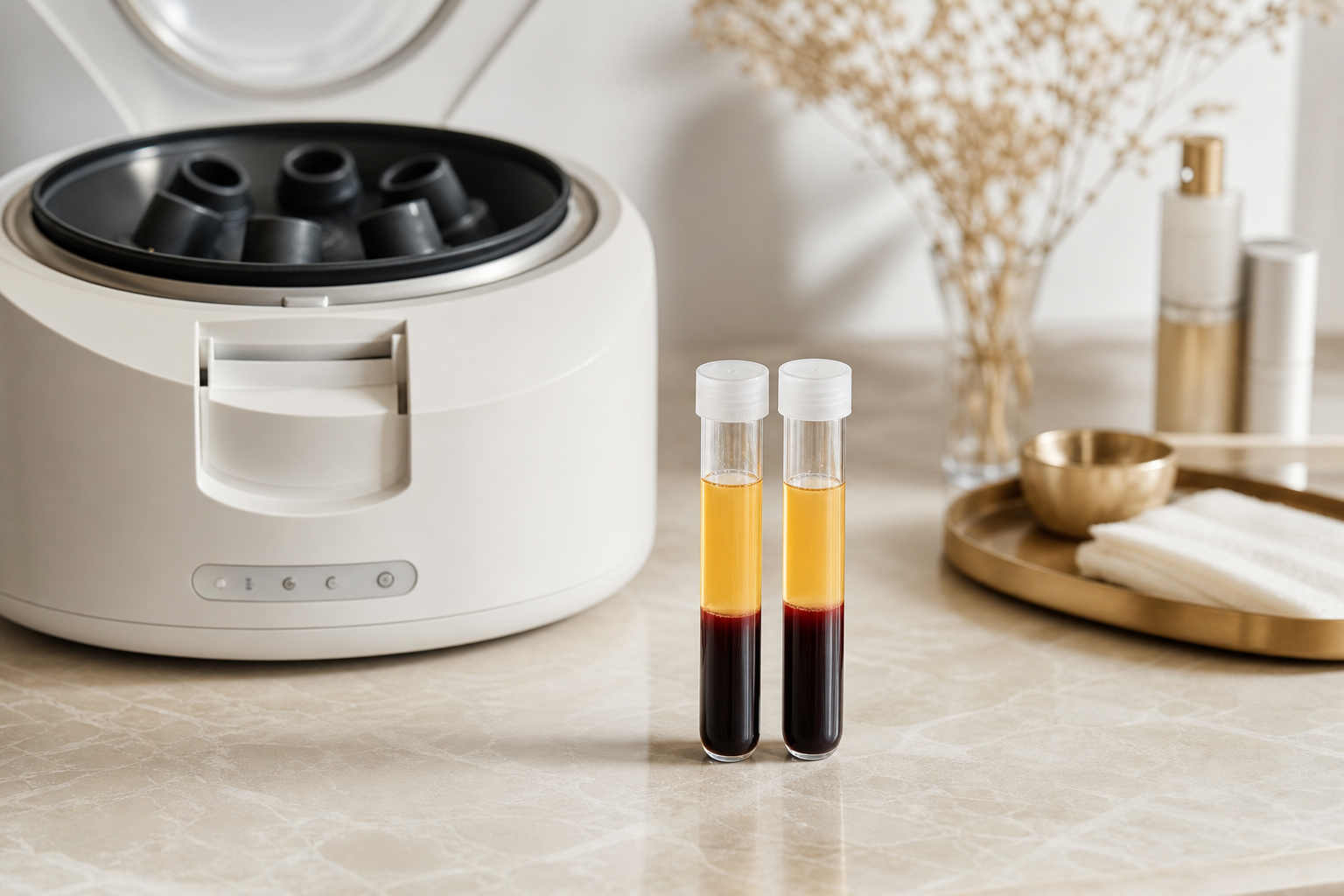
A prp under-eye treatment starts in a centrifuge, not on your face. The clinician draws 8-10mL of your own blood from your arm, spins it at 1,200-1,500 rpm for 10-15 minutes, and isolates 2-3mL of concentrated plasma containing 5-7x your baseline platelet count, according to NIH-published clinical protocols. That concentrated plasma is what gets injected under your eyes. Nothing synthetic. No added volume. Just a denser version of biology you already produce.
Platelets are tiny cellular fragments that carry growth factors — signaling proteins your body uses to repair injured tissue. Three matter most for skin: PDGF (platelet-derived growth factor), VEGF (vascular endothelial growth factor), and TGF-β (transforming growth factor beta). When concentrated PRP is injected into the dermis (the deeper layer of skin), these growth factors signal fibroblasts — the cells that build collagen — to produce new structural proteins. They also stimulate microcirculation, the network of tiny blood vessels that determines how bright or dull the skin under your eyes appears.
This mechanism explains a distinction most clinics gloss over: PRP works on inflammatory dark circles, where sluggish microcirculation creates blue-purple tones, but not on genetic pigmentation, where excess melanin sits in the skin from childhood. A clinical comparison published in the Journal of Clinical and Aesthetic Dermatology found PRP delivered 42% improvement in inflammatory dark circles at 12 weeks, versus 18% for topical vitamin C in the same population. If your circles fade when you sleep and worsen when you don't, that's the inflammatory variety. If they look identical at 7 a.m. and 11 p.m., melanin is the driver — and PRP is the wrong tool.
PRP doesn't fill wrinkles — it reactivates the cells that built your skin in the first place. That's why results take weeks to appear, and why they look like you, only rested.
The single most important thing to understand before you book: PRP is not filler. Hyaluronic acid fillers add volume mechanically and you see the change before you leave the chair. PRP regenerates tissue biologically, and the first visible change typically takes 4-6 weeks. Dr. Christopher Zachary, former Chair of Dermatology at UC Irvine, frames this clearly in a Skin Inc. investigation: the periorbital area — the region surrounding the eye — has skin only 0.7-0.8mm thick and minimal underlying fat, which limits PRP's ability to create structural or volume changes. PRP improves skin quality, not volume.
It's also worth holding the counter-evidence in view from the start. A study in JAMA Dermatology by Dr. George Y. Wu of Yale found no statistically significant difference in collagen density between PRP-treated and control sites at six months in a placebo-controlled trial. The honest read: PRP has reproducible benefits for specific concerns, but it's not the universal regenerative cure marketing implies.
Because PRP works with your skin's regenerative capacity rather than replacing tissue, what you do between sessions matters as much as the injections themselves. Daily SPF, peptide-supported barrier repair, and addressing nutrition and sleep patterns are not optional add-ons. They're the conditions under which PRP either delivers or disappoints. This is why a PRP procedure sits naturally inside a broader early signs of aging protocol rather than functioning as a standalone fix.
PRP vs. Fillers vs. Microneedling vs. Topical-Only: Which Solves Your Specific Concern
Most patients arrive at a consultation convinced they need "the under-eye treatment" without knowing which under-eye problem they actually have. There are four distinct concerns — pigmentation, fine lines and crepiness, hollowing and volume loss, and texture — and each has a leading treatment. Matching the wrong tool to the wrong problem is the single most common reason patients walk away disappointed and several thousand dollars lighter.
| Criterion | PRP | HA Filler | Microneedling | Topical Only |
|---|---|---|---|---|
| Best for | Inflammatory dark circles, fine lines | Volume loss, tear-trough hollowing | Texture, mild pigmentation | Genetic pigmentation, prevention |
| Time to visible result | 4-6 weeks | Immediate | 2-3 weeks | 8-12 weeks |
| Results duration | 9-12 months | 9-12 months | 3-6 months per session | Ongoing with use |
| Per-session cost (US avg) | $1,200-$1,800 | $600-$1,200 | $300-$700 | $300-$600/year |
| Downtime | 2-5 days | 1-3 days | 1-2 days | None |
When PRP wins. Inflammatory dark circles with the 42% improvement signal documented in the Journal of Clinical and Aesthetic Dermatology, fine lines, and early crepiness in patients between roughly 28 and 55 who want to use their own biological material rather than a synthetic implant. PRP is also the option of choice for patients who've reacted poorly to HA fillers or who want a regenerative — rather than corrective — approach.
When fillers win. True volume loss and tear-trough hollowing where the orbital fat pad has receded or where a structural shadow is creating the dark appearance. Fillers showed 95% patient satisfaction at one week versus PRP's 62% at eight weeks for hollowing-driven concerns, per the Aesthetic Surgery Journal. Speed of result matters, but more importantly, PRP simply cannot mechanically lift a hollow — it can only improve the skin draping over it.
When microneedling plus PRP wins. Patients with skin texture problems and mild pigmentation. The combined protocol creates micro-channels that enhance growth factor absorption and shows 27% lower complication rates in periorbital applications than competing energy-based devices, according to Dermatologic Surgery.
When topical-only wins. Genetic pigmentation, preventative care for patients in their 20s, budget-conscious treatment, and anyone not ready for needles. Topicals cannot redistribute melanin the way targeted brightening protocols can, but they outperform PRP for the right candidate at roughly 10% of the five-year cost.
If your under-eye concern is pigmentation that doesn't shift with sleep, hydration, or season, you're likely looking at a melanin-driven issue — a personalized post-acne and discoloration protocol or age spots and hyperpigmentation approach will outperform PRP every time, at a fraction of the lifetime cost.
Inside the PRP Under-Eye Procedure: A Step-by-Step Walkthrough
The procedure itself takes about 45-60 minutes from arrival to exit. Knowing what happens in each phase — and what each phase is supposed to look like — is the difference between confident consent and blind trust.
Step 1: Consultation and blood draw. Before the needle goes anywhere near your face, a clinician should review your medical history, current medications, and the specific under-eye concern you're treating. The blood draw itself takes 60 seconds — 8-10mL drawn from the arm, the same volume as a standard lab panel — per the NIH-documented PRP protocol. If a clinic skips meaningful screening and goes straight to the draw, that alone is a warning.
Step 2: Centrifugation. Your blood is placed in a centrifuge that separates plasma from red blood cells at 1,200-1,500 rpm for 10-15 minutes. The yellow plasma layer above the red cells contains your concentrated platelets. The clinician extracts 2-3mL of this layer. Quality depends entirely on these specifications. A Dermatology Review investigation using third-party lab testing found 68% of clinics use centrifugation protocols that produce sub-therapeutic platelet concentrations — effectively injecting platelet-poor plasma while charging platelet-rich prices. Ask the rpm. Ask the time. A clinic that won't answer should not be your clinic.
Step 3: Topical anesthesia. A lidocaine-based numbing cream is applied to the under-eye area and left for 20-30 minutes. The wait feels long but it matters — the periorbital skin is dense with nerve endings, and full anesthesia turns a sharp procedure into a pressure sensation. Sensitive skin types or anyone with a history of skin reactivity should disclose this beforehand so the formulation can be adjusted.
Step 4: Injection technique. Following American Society for Dermatologic Surgery guidelines, the clinician uses a 22-gauge needle (or finer), deposits 0.05-0.1mL of plasma per injection site, and places 5-7 punctures per side at a depth of 1.5-2.0mm. Depth matters — too shallow wastes the plasma, too deep risks vascular structures. The injections themselves take about 5-10 minutes total once you're numb.
Step 5: Optional microneedling overlay. Some protocols pair injections with a microneedling pass to enhance superficial absorption. This adds value for patients with combined texture and pigmentation concerns but extends downtime by 24-48 hours due to additional micro-trauma. It's a clinical judgment call, not a default.
Step 6: Aftercare. Avoid sun exposure, makeup, and intense exercise for the first 48 hours. Apply a clean cold compress for 10-15 minutes, three to four times in the first 72 hours — this single habit drops the incidence of visible swelling from 89% to 34%, per a study in the Journal of Cosmetic Dermatology. Resume your sunscreen, peptide serum, and vitamin C from day three onward.
What PRP Under-Eye Results Actually Look Like at 4, 8, and 12 Weeks
The single biggest reason patients feel disappointed by PRP isn't that PRP failed — it's that the timeline they were sold doesn't match the timeline their biology actually follows. Collagen remodeling and microcirculation improvement happen on a fibroblast's schedule, not a marketing team's. Here's what to actually expect.
Week 4: The Doubt Window
At the four-week mark, your skin will feel different to the touch — slightly smoother, slightly more elastic — but the mirror won't show much. This is the window where most patients second-guess the investment. It is also the window where the most important work is happening invisibly. Fibroblasts have been activated, but the collagen they're producing hasn't yet woven into a visible structural change. Photographs taken under consistent lighting at week four often show no measurable difference from baseline, and that is normal, not a failure. Holding nerve here is part of the protocol.
Week 8: The First Real Change
This is where the data starts to deliver. The Journal of Cosmetic Dermatology's 2020 review reports that 67% of patients show noticeable texture improvement at the 8-week mark and dark circle appearance reduces by 30-50% in the inflammatory-driven population. Fine lines soften by roughly 30%. The under-eye area looks less shadowed in side-light. Friends start asking if you're sleeping more, which is the specific compliment PRP is designed to earn. If your second session is part of the protocol, it typically sits in this window — building on the foundation laid by the first.
Week 12: Peak Results, After Two Sessions
Twelve weeks after the first injection and roughly four weeks after the second, results land at their most visible point. The NIH systematic review of 14 clinical studies found 78% of patients showed measurable improvement in periorbital hyperpigmentation at this stage. The same review noted that PRF (platelet-rich fibrin, a second-generation variant) outperformed standard PRP for fine lines specifically, with 85% improvement in that subset, while PRP held its edge for pigmentation outcomes.

The Counter-Evidence You Need to Hold Alongside the Numbers
Honest framing matters here. A 2025 systematic review in the Journal of the American Academy of Dermatology found that several PRP studies lacked sufficient evidence versus placebo, citing small sample sizes (under 30 patients) and high risk of bias. Dr. George Y. Wu's placebo-controlled trial found no significant difference in collagen density between PRP and control sites at six months.
This doesn't invalidate the procedure. It means PRP is a reasonable bet, not a sure one. Patients who do best are those who go in expecting "softer, brighter, more rested" rather than "transformed."
Why Results Plateau and Why Maintenance Matters
Even strong results have a shelf life. For pigmentation outcomes, 71% of patients maintained results at 9-12 months — and the patients at the longer end of that range were consistently those with disciplined topical and sun-protective routines between sessions. Patients with chronically dehydrated and dry skin tended toward the shorter end of the range, since compromised barrier function blunts the durability of regenerative work. PRF results for texture diminished faster, with 62% requiring maintenance by month six. Translation: PRP doesn't end the work. It starts a maintenance cycle that your daily skincare either extends or shortens.
A single PRP session almost never delivers the "before and after" you saw in the ad. The transformation lives in the second and third sessions — and in the twelve weeks of healing between them.
Are You a Candidate for PRP Under-Eye Treatment? An Honest Self-Screen
Before you pay a deposit, run yourself through this screen. Each item has a reason behind it. The more "good candidate" criteria you check, the more likely PRP is the right tool for your concern.
You are a strong candidate if:
- Your dark circles look worse when you're tired or dehydrated. This pattern points to an inflammatory or vascular cause — exactly the population where PRP delivered 42% improvement in the clinical comparison.
- You have fine lines or mild crepiness, not deep static wrinkles. PRP improves skin quality on the order of 30% softening; it does not erase set wrinkles formed over decades.
- You're between roughly 28 and 55 years old. Skin regenerative capacity supports a meaningful growth-factor response in this range. Younger patients usually don't need PRP; older patients often need it combined with other modalities.
- You can commit to 2-3 sessions spaced 4-6 weeks apart. A single session does not produce the published results. The protocol is a course, not a treatment.
- You can avoid sun exposure and intense exercise for 48-72 hours after each session. The aftercare window is short but non-negotiable for results and safety.
- You're not pregnant, breastfeeding, or actively immunocompromised. Contraindications here aren't bureaucratic — they affect platelet function and healing.
- You're not on aspirin, warfarin, high-dose fish oil, or vitamin E. These thin the blood and meaningfully increase bruising risk in the periorbital area.
- You understand "improvement," not "erasure." Your reference photo should be your own face on its best day, not a celebrity.
You are likely not a candidate if:
- Your dark circles have been visible since childhood and don't change with sleep. This points to genetic melanin distribution, which PRP cannot redistribute. A targeted topical protocol will outperform PRP for your concern.
- You have severe tear-trough hollowing. Volume loss is a structural problem requiring filler or surgical correction. PRP can't lift what isn't there.
- You expect a single-session transformation. The data simply doesn't support this expectation, and any clinic that does is overselling.
- You have an active rosacea flare on or near the lid area. Injecting into inflamed tissue worsens both the flare and the procedure outcome.
- You have active eczema or dermatitis around the eyes. Treat the underlying sensitivity first; PRP on a compromised barrier is a poor investment.
- You smoke heavily. Smoking impairs microcirculation and collagen response — the two mechanisms PRP relies on most.
How to read your score. If you checked six or more "good candidate" boxes and zero "not a candidate" boxes, you're a strong candidate worth a consultation. Mixed results suggest a hybrid approach — PRP plus a topical protocol, or PRP plus a single filler session targeted at structural loss. Mostly "not a candidate" boxes mean a topical-led post-acne and discoloration or pigmentation protocol will deliver a better return on your money and time.
The True Cost of PRP Under-Eye Treatment Over One, Three, and Five Years
Patients almost universally underestimate the lifetime cost of PRP. The price quoted at the consultation is the cost of one session — not the cost of the result. Using American Society of Plastic Surgeons 2025 cost data and the standard 2-3 session induction protocol followed by annual maintenance, here is the realistic financial picture.
- Year 1 initial investment. Two to three induction sessions at $1,200-$1,800 each = $2,400 to $5,400. Add a consultation fee of $150-$300 (often waived if you book the procedure) and a topical post-care kit of $100-$200 if you don't already own quality SPF, vitamin C, and peptide products. Year-one realistic range: roughly $2,650 to $5,900.
- Years 2 through 5 maintenance. One maintenance session every 9-12 months at $1,200-$1,800 per session. Over four maintenance years, that's about $4,800 to $7,200 added to your initial investment. Five-year cumulative cost: roughly $7,450 to $13,100.
- Hidden costs most patients miss. Time off work for visible swelling (1-2 days per session for many patients); ongoing SPF compliance products (~$80-$150/year); topical adjuncts — vitamin C, peptides, retinoids — that meaningfully extend results between sessions. None of these are optional if you want the durability data to apply to you.
- What disciplined topical support actually buys you. The 71% durability figure from the NIH systematic review wasn't evenly distributed — patients at the longer end of the 9-12 month results window were consistently those with disciplined skincare between sessions. Without that discipline, you may be paying for a 12-month result and getting a 6-month one.
- The benchmark comparison. A medically-led topical protocol with quarterly check-ins runs $400-$900 per year — about $2,000 to $4,500 over five years, or roughly 15-30% of PRP's lifetime cost. For many under-eye concerns, particularly pigmentation-driven ones, that protocol produces meaningful improvement without a single needle.
The honest read on cost: PRP isn't expensive because of the plasma. It's expensive because the result needs renewal. If you go in with realistic expectations and a topical foundation already in place, that five-year spend buys you a sustained outcome. If you go in expecting one session to solve it, you'll either chase results with more sessions than the protocol intends, or you'll abandon the investment partway through.
This is where a remote consultation earns its place in the decision. For readers whose concerns will respond to PRP, the right topical foundation — built before the first injection — extends results into the longer end of the durability range. For readers whose concerns won't respond to PRP, a diagnostic conversation saves them several thousand dollars and points them toward an early signs of aging protocol that fits the actual concern.
The price on the invoice isn't the real cost of PRP. The real cost is your discipline between sessions — and without it, even the best clinic can't deliver what you paid for.
Seven Red Flags That Mean You Should Walk Out of a PRP Consultation
The Dermatology Review investigation that found 68% of clinics deliver sub-therapeutic platelet concentrations is the single most useful piece of consumer-protection data in this field. The clinics in that 68% don't usually look unprofessional. They look polished, well-reviewed, and confident. What separates them from the qualified 32% is what they're willing to tell you when you ask.
Use these seven signals to sort.
1. They won't disclose their centrifugation rpm and time. The standard, per NIH-published protocols and FDA-cleared device specifications, is 1,200-1,500 rpm for 10-15 minutes. A clinician who can't recite this on request — or who deflects with "we use the best equipment" — either doesn't know or doesn't want you to know. Dr. Robert A. Norman, Professor of Dermatology at Nova Southeastern University, has noted on the Journal of Cosmetic Dermatology Podcast that many clinics produce platelet-poor plasma without realizing it. Ask the question. The answer is your single best filter.
2. They promise visible results from one session. Per Dr. Melissa Do of UCLA, speaking to Dermatology Times: expect 20-30% improvement per session, not miracle results. Any clinic guaranteeing a transformation from a single injection is either overselling or misunderstanding their own product. The published efficacy data is built on 2-3 session protocols. A single-session promise contradicts the science the clinic is supposedly practicing.
3. They use needles thicker than 22-gauge in the under-eye region. American Society for Dermatologic Surgery standards specify 22-gauge as the minimum fine-gauge requirement for periorbital work. Thicker needles increase tissue trauma in skin that is only 0.7-0.8mm thick. Bruising, lumping, and prolonged swelling correlate directly with gauge selection. Ask what gauge they use. If they don't know, walk.
4. No before-and-after portfolio of their own patients. Stock photography, generic "results may vary" disclaimers, or refusal to show their own work are all the same signal. A clinician with a steady PRP practice has photographs of their actual outcomes, taken under consistent lighting, at consistent intervals. The absence of this portfolio is evidence of either inexperience or unwillingness to be evaluated on their actual results.
5. Pressure to buy a package before you've been examined. Reputable practice sequences look like this: consultation, examination, candidacy assessment, then a recommended protocol. Package upselling before that sequence is sales, not medicine. You should never feel pressured to commit financially before the clinician has assessed whether you're a candidate.
6. No screening for contraindications. A competent consultation includes questions about blood thinners (aspirin, warfarin, high-dose fish oil), pregnancy and breastfeeding status, autoimmune conditions, active dermatitis or rosacea, and recent infections. If none of these come up, the clinic isn't screening — and a clinic that doesn't screen for contraindications is a clinic that will inject you despite them.
7. They tell you PRP "replaces" filler or surgery. Dr. Christopher Zachary, former Chair of Dermatology at UC Irvine, has been explicit on this point in the Skin Inc. investigation: PRP improves skin quality, not volume. A clinic conflating PRP with filler is either undertrained on the anatomy or actively misleading you to win a sale you wouldn't otherwise make.
A clinic that can't tell you its centrifuge rpm is a clinic that can't tell you what it's actually injecting into your face.
Your Pre-Booking PRP Readiness Checklist (Use This Before You Pay a Deposit)
If you've read this far, you already know more than most patients walk into a consultation knowing. The final task is to convert that knowledge into a decision. Move through these six blocks before you book — they map every variable that will determine whether your investment pays off.
Block 1 — Diagnose your specific concern.
- Is your concern pigmentation, fine lines, hollowing, or texture? Cross-reference the matrix earlier in this guide.
- If pigmentation: does it change with sleep, hydration, or season (inflammatory), or has it been constant since childhood (genetic)?
Block 2 — Audit your skin's regenerative capacity.
- Are you between 28 and 55, generally healthy, and not on blood thinners?
- Are you genuinely consistent with daily sun protection? Honest sun habits predict PRP results more reliably than the technique itself.
- How is your sleep? Chronic sleep deprivation suppresses the exact healing pathways PRP relies on.
Block 3 — Confirm your time and money commitment.
- Can you commit to 2-3 sessions over the next 12 weeks, including the recovery windows?
- Have you budgeted the realistic year-one range of roughly $2,650 to $5,900?
- Are you prepared for annual maintenance at roughly $1,200-$1,800 indefinitely?
Block 4 — Define a realistic visual goal.
- Find a reference photograph. If it's "softer, brighter, more rested" — that's PRP territory.
- If it's "dramatically tighter, filled, transformed" — that's filler, energy device, or surgical territory, and PRP will disappoint you.
Block 5 — Vet your provider using the red flag list.
- Ask explicitly: rpm? Centrifuge time? Needle gauge? Can I see before-and-afters? What's your screening process for contraindications?
- If a clinic hesitates, deflects, or improvises an answer on any of these — that is the answer. Walk.
Block 6 — Decide whether PRP is actually your best move.
- For genetic pigmentation: a targeted post-acne and discoloration or age spots and hyperpigmentation protocol outperforms PRP at a fraction of the lifetime cost.
- For structural volume loss: filler, not PRP.
- For uncertainty about which concern is actually driving your appearance: a remote diagnostic consultation maps your concern to the right protocol before you spend on a procedure that may not fit.
If you've read this guide carefully, you already understand more than the marketing wants you to. The next step isn't a booking — it's a diagnosis. A focused remote consultation with Dr. Maria reviews your photographs, your history, and your goals, and identifies whether PRP is your right tool or whether a topical-led protocol will deliver more for less. That diagnostic step is what we exist to provide. Whatever you decide afterward, you'll be deciding from clarity rather than from a clinic's sales script.