


How to Use Niacinamide in Your Skincare Routine for Clearer, Calmer Skin
This article is educational and does not diagnose a condition or replace care from a qualified medical professional.
Skincare Products with Niacinamide: What Actually Works, What's Marketing, and How to Build a Routine That Delivers
You've bought three serums in the past six months. One promised "barrier repair." Another swore it would minimize pores in fourteen days. A third claimed to "calm reactive skin overnight." Your bathroom shelf is fuller, your bank account thinner, and your cheeks still flush after cleansing. The red patches around your nose haven't budged. If this sounds familiar, the problem usually isn't the number of skincare products with niacinamide you've tried — it's that the anchor ingredient is either underdosed, mis-layered, or working against the rest of your routine.
Niacinamide is the rare active that calms inflammation and regulates sebum without the drying side effects of salicylic acid or the retinization phase of retinol. This guide explains what concentration actually treats versus simply maintains, where niacinamide fits in your morning and evening sequence, and what eight weeks of consistent use should realistically deliver — backed by clinical trial data, not Instagram before-and-afters.
Table of Contents
- Why Niacinamide Outperforms Single-Action Acne and Redness Fixes
- Decoding the Label: What Concentration Actually Treats vs. Just Maintains
- The Morning and Evening Layering Order That Lets Niacinamide Actually Work
- Niacinamide Pairings: What It Amplifies and What It Can't Replace
- Seven Habits That Quietly Sabotage Your Niacinamide Results
- The Real Niacinamide Timeline: Week 1 to Week 8, Backed by Clinical Data
- The Pre-Consultation Niacinamide Checklist
Why Niacinamide Outperforms Single-Action Acne and Redness Fixes
Most active ingredients pick a lane. Salicylic acid dissolves pore contents. Retinoids accelerate turnover. Benzoyl peroxide kills bacteria. Each one solves a single problem and creates a side effect — usually dryness, peeling, or stinging — that you then have to manage with a second product. Skincare products with niacinamide work differently because the molecule itself operates on four mechanisms at once.
Start with cellular energy. Niacinamide is a precursor to NAD⁺ and NADP⁺, cofactors essential for cellular energy metabolism and DNA repair. According to a peer-reviewed mechanistic review, maintaining NAD⁺ levels directly supports the skin's ability to repair oxidative and UV-induced damage. WebMD's medically reviewed overview frames this as the foundation of niacinamide's wider clinical usefulness — without functional cellular energy, none of the visible outcomes (less redness, smaller pores, more even tone) are sustainable.
The second mechanism is barrier lipid synthesis. Niacinamide upregulates production of ceramides, fatty acids, and cholesterol in the stratum corneum. According to Paula's Choice, this reinforces the lipid barrier and reduces transepidermal water loss (TEWL). The practical consequence: skin that holds moisture stops overproducing sebum to compensate, and the chronic low-grade inflammation that drives acne and rosacea quiets down.
The third is direct anti-inflammatory action. Niacinamide inhibits pro-inflammatory mediators and reduces oxidative stress, which is why WebMD specifically notes it as useful for managing inflammatory skin conditions including eczema and inflammatory acne, and for reducing redness and red patches.
Niacinamide doesn't strip your skin or trigger a purging phase — it repairs the barrier while you're treating the condition, which means faster, calmer results than actives that work in isolation.
The fourth mechanism is sebum regulation. At topical concentrations around 2–4%, niacinamide reduces sebum excretion rate, which correlates with smaller-appearing pores and smoother texture. This is the mechanism that makes niacinamide uniquely well-suited to the population of patients dermatology has historically struggled to treat: people with reactive skin that's also oily, where traditional acne actives strip the barrier and worsen redness while traditional rosacea calming agents do nothing for the sebaceous component.
This dual action is why Healthline frames niacinamide as a multi-target ingredient rather than a single-issue active. Most acne medications dry and irritate, which worsens rosacea. Most rosacea creams calm redness but ignore comedogenesis. Niacinamide simultaneously regulates oil and calms inflammation. That's the unique value proposition — and it's also why the ingredient has become the quiet anchor of nearly every credible modern routine.
A note before the next section: not all niacinamide products are equivalent. Concentration, vehicle, ingredient-list position, and pairing decisions determine whether you get therapeutic results in eight weeks or barrier maintenance with no visible change. The next section dismantles the label.
Decoding the Label: What Concentration Actually Treats vs. Just Maintains
"Contains niacinamide" is a marketing claim. It tells you almost nothing about whether the product will resolve your inflammation, fade your post-acne marks, or simply sit on your skin as a hydrating layer. Concentration, format, and ingredient-list position determine the difference between treatment and window dressing.
| Product Format | Typical Niacinamide % | Best Use Case | Absorption Profile |
|---|---|---|---|
| Serum / Essence | 4–10% | Active acne, hyperpigmentation, fastest results | Fast (5–10 min) |
| Moisturizer | 2–5% | Long-term barrier and hydration support | Slower (15+ min) |
| Toner / Essence Layer | 1–3% | Gentle introduction for sensitive skin | Very fast |
| Cleanser | 1–2% | Maintenance only (short contact time) | Rinse-off |
| SPF / Daytime Moisturizer | 1–2% | Daytime barrier maintenance | Slow |
The clinical literature draws a clear line between maintenance and treatment ranges. Concentrations of 2% or less function as barrier and hydration support — useful for stable skin, insufficient for active disease. Concentrations of roughly 4–5% sit at the clinical sweet spot for active acne, hyperpigmentation, and pronounced barrier compromise, according to the PMC mechanistic review and Paula's Choice.
Two clinical studies anchor the therapeutic threshold. In a randomized split-face trial, a 4% nicotinamide gel reduced inflammatory acne lesions as effectively as 1% clindamycin after 8 weeks, with no significant difference in efficacy — but without the antibiotic resistance risk that comes with topical antibiotics. Separately, a clinical study using 5% niacinamide cream showed significant improvement in hyperpigmentation and skin lightness after 4 weeks, attributed to inhibition of melanosome transfer.
Translation: when a brand advertises niacinamide for acne or for age spots, the dose that produced those clinical outcomes is 4–5%. A 2% moisturizer is not equivalent.
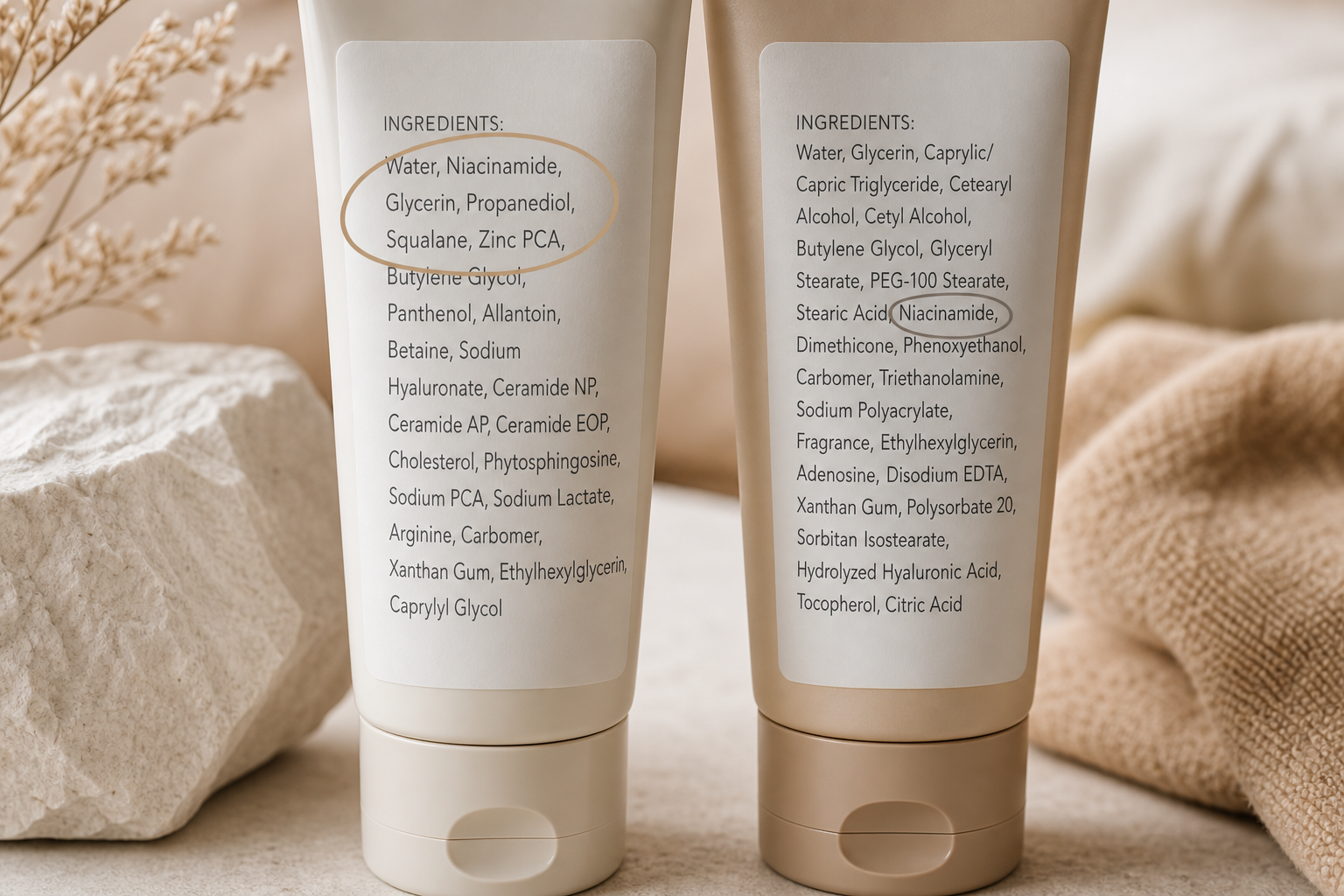
Reading the label is the practical skill. "Niacinamide," "nicotinamide," and "vitamin B3" are interchangeable terms — brands rotate between them mostly for aesthetics. The ingredient list position matters more than the marketing copy. INCI rules require ingredients above 1% to appear in descending order by concentration. If niacinamide sits at position 2 or 3 (typically after water and a humectant like glycerin), you're looking at roughly 4–10%. If it's at position 8 or later, the concentration is almost certainly below 2% — maintenance territory.
Two vehicle red flags are worth scanning for. High-alcohol bases (denatured alcohol high in the list) can compromise tolerance for reactive skin, regardless of niacinamide content. Extremely low-pH formulations — most often older vitamin C serums — can still cause transient flushing in very sensitive users. Older concerns about niacinamide instability at low pH, however, came from extreme lab conditions and not normal product use, as Healthline clarifies.
The Morning and Evening Layering Order That Lets Niacinamide Actually Work
The order in which you apply skincare products with niacinamide affects results almost as much as the product itself. A 10% niacinamide serum applied to soaking-wet skin under an occlusive balm performs worse than a 4% serum applied correctly. The sequence below is the framework used by clinicians treating acne and rosacea simultaneously.

The Morning Sequence
1. Gentle Cleanse. Use a non-foaming, low-pH cleanser. Pat your skin nearly dry — not bone-dry, but no visible water film. Wait roughly 30 seconds. Niacinamide needs to penetrate the stratum corneum, and a water film on the surface dilutes the active and slows absorption.
2. Niacinamide Serum (4–10%). One to two pumps, distributed evenly across the face. Press in lightly rather than rubbing. Wait 1–2 minutes for a slight dry-down before layering anything else. This is the step that determines whether your treatment works or whether you've just applied an expensive humectant.
3. Hydrating Toner or Essence (Optional). Recommended for sensitive or rosacea-prone skin to buffer subsequent layers. Skip it if your skin is oily and uncomplicated — more steps don't equal more results.
4. Moisturizer. Lightweight gel for oily skin; richer cream for barrier-compromised or dehydrated skin. The moisturizer locks in the niacinamide and reinforces the barrier work it's doing underneath.
5. Sunscreen SPF 30+. Non-negotiable. Niacinamide supports barrier repair, but it does not block UV. According to WebMD and Healthline, daily SPF is the layering benchmark that makes every other active in your routine worth applying. UV exposure on a niacinamide-treated barrier will undo weeks of pigmentation work in days.
The Evening Sequence (Active Stacking)
Cleanse → niacinamide serum → wait 2–3 minutes → active (retinol, azelaic acid, or low-dose vitamin C) → moisturizer.
The reason niacinamide goes underneath your active rather than over it: it functions as a barrier buffer. According to Paula's Choice, WebMD, and Healthline, niacinamide reduces irritation from retinoids by supporting the barrier while retinoids accelerate cell turnover. This is the combination that makes retinization tolerable for sensitive skin — and the same logic applies to azelaic acid for rosacea, or salicylic acid for blackheads.
The vitamin C question deserves direct treatment. Older concerns about niacinamide and ascorbic acid forming irritating byproducts came from extreme laboratory conditions, not normal skincare pH. At modern formulation pH and storage, they can be layered safely. Very sensitive users — particularly rosacea-prone — may still prefer separating them by 10 minutes to minimize any chance of transient flushing.
Frequency Adjustment Guide
- Weeks 1–2: 4–5x per week, morning and evening. Let your skin adjust before pushing frequency.
- Tolerated well: Move to daily, morning and evening.
- Any irritation: Drop to 3x per week until the barrier recovers, then ramp back up.
This conservative ramp is more important for reactive skin than for stable skin. The goal is consistency at a tolerable frequency, not maximum dosing on day one.
Niacinamide Pairings: What It Amplifies and What It Can't Replace
Niacinamide is a supporting player, not a standalone cure. WebMD notes that research on niacinamide is still developing, and the PMC mechanistic review explicitly frames it as a complement to — not a replacement for — clinical treatment in moderate-to-severe disease. Independent reviews and clinical summaries emphasize that moderate-to-severe acne, melasma, or rosacea often still require prescription therapies.
| Active / Treatment | Niacinamide Pairing | Realistic Timeline |
|---|---|---|
| Benzoyl Peroxide | Compatible — buffers BP irritation | 6–8 weeks |
| Salicylic Acid (BHA) | Cautious — both regulate sebum; alternate days | 4–6 weeks |
| Retinol / Retinoid | Compatible — stabilizes barrier during retinization | 8–12 weeks |
| Azelaic Acid | Synergistic — pair daily for rosacea/acne | 6–8 weeks |
| Vitamin C (Ascorbic Acid) | Compatible at modern pH; sensitive users may space | 8–12 weeks |
| Oral Antibiotics (Doxycycline) | Topical anchor — supports while oral treatment works | 8–12 weeks |
The pattern across this matrix is consistent: niacinamide's role is to enable harsher actives to work without compromising barrier health. Benzoyl peroxide is more tolerable when niacinamide is buffering the dryness. Retinol's purge phase shortens when the barrier is being actively reinforced. Azelaic acid and niacinamide are particularly synergistic for rosacea — both reduce inflammation, and the combination addresses redness and post-inflammatory marks simultaneously.
Niacinamide is the unpaid hero of skincare — it makes everything else work better, but it rarely works alone. Pair it correctly, and you stop choosing between effectiveness and skin health; you get both.
What niacinamide will not do, on its own, is resolve cystic or hormonal acne, severe rosacea, or established melasma. These conditions need professional evaluation and often prescription support — oral antibiotics, isotretinoin, hormonal modulation, or prescription-strength topicals. Brands that position niacinamide as a "natural" or "non-medicated" replacement for clinical treatment are overselling.
There's a practical lesson here for anyone who has been cycling through products for six months without progress. The bottleneck is rarely the niacinamide. It's usually an inaccurate diagnosis of the underlying condition — what you think is bacterial acne might be fungal folliculitis, what you think is rosacea might be perioral dermatitis, what you think is post-acne hyperpigmentation might be melasma needing a different brightening protocol entirely. A personalized cosmetologist consultation, with skin photo analysis and a structured intake, is the moment a remote consultation model actually saves money — because you stop restocking your bathroom on guesswork.
Seven Habits That Quietly Sabotage Your Niacinamide Results
Most niacinamide "failures" aren't ingredient failures. They're application failures. Each item below corrects a habit that quietly blunts results — sometimes for months — without the user realizing why nothing is changing.
- Applying to Soaking-Wet Skin. Niacinamide needs to penetrate the stratum corneum, not float on a water film. Pat skin nearly dry, wait 30 seconds, then apply. Damp ≠ wet. The difference between proper prep and wet application is measurable in absorption time.
- Mixing With Acidic Actives Without Spacing. Modern formulations of niacinamide and vitamin C are generally stable, and Healthline confirms older instability concerns came from extreme lab conditions rather than normal skincare pH. Very sensitive users — particularly rosacea-prone — should still separate by 10 minutes to prevent transient flushing.
- Using Under 2% and Expecting Acne Clearance. A moisturizer with niacinamide as the 8th ingredient is maintenance, not treatment. For active acne, you need a serum at 4% or higher — the concentration that matched 1% clindamycin in the split-face trial. Expecting therapeutic results from a maintenance dose is the most common reason people abandon the ingredient prematurely.
- Skipping Sunscreen. Niacinamide supports barrier repair but doesn't block UV. A compromised barrier under sun exposure produces prolonged inflammation and slower healing. SPF 30+ daily is non-negotiable — without it, the skin texture improvement you're working toward will be undone faster than the niacinamide can build it.
- Stacking Multiple Niacinamide Products. Serum plus toner plus moisturizer all containing niacinamide does not amplify results — it just stacks vehicles. Paula's Choice and The Ordinary both note that excessive layering can still cause irritation in very reactive skin, even with a generally gentle ingredient. Choose one therapeutic format (usually a serum) and let your other products do their own jobs.
- Quitting at Week 2. Niacinamide works more slowly than retinol or vitamin C. Independent reviews and clinical summaries cite 4–8 weeks as the realistic window for visible improvements in redness, oiliness, and texture. Two weeks tells you almost nothing except whether your skin tolerates the formulation.
- Treating "Gentle" as License to Stack Actives. Non-irritating does not mean immune to over-formulation. Combining niacinamide with four or five other actives nightly is the fastest way to trigger the very barrier damage niacinamide is meant to repair. Less is genuinely more in the first two months of any new routine.
The Real Niacinamide Timeline: Week 1 to Week 8, Backed by Clinical Data
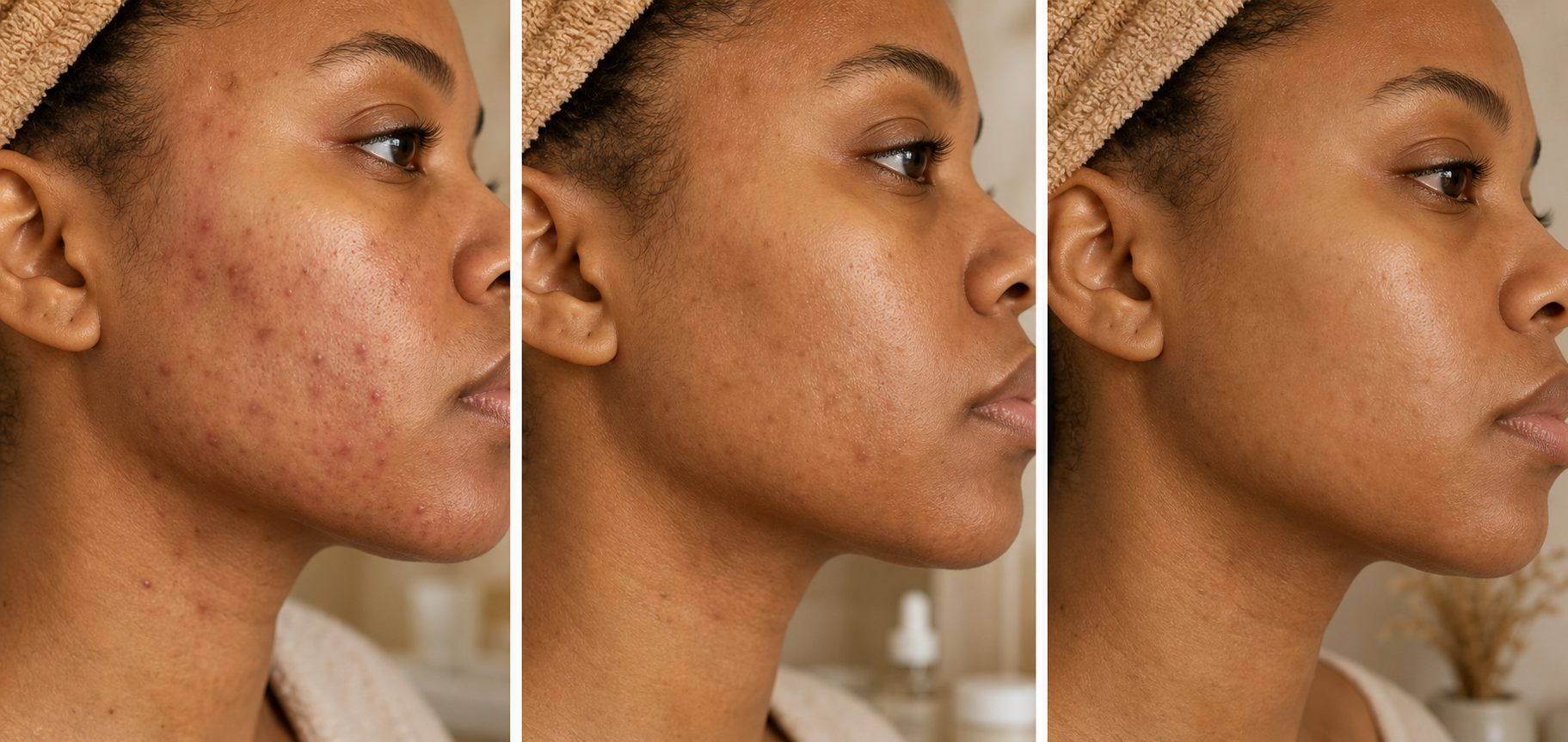
Most disappointment with niacinamide comes from a timeline mismatch. Social media compresses weeks of slow biological change into 30-second before-and-after edits, and the result is that people expect at week two what the clinical literature shows at week eight. Here's what to actually expect, phase by phase.
Week 1–2: The Hydration Phase
Within the first several days, skin feels calmer. Redness may decrease slightly. Tightness after cleansing diminishes. This is not acne clearing — this is your barrier becoming hospitable to treatment. The PMC review notes that moisturizers with 2–5% niacinamide measurably reduce TEWL within roughly four weeks, but the subjective experience of "less tight, less reactive" tends to start earlier.
Do not over-interpret this phase. If your acne is unchanged at day 10, that is expected. The hydration phase is preparation, not outcome.
Week 3–4: The Stabilization Phase
Inflammation visibly decreases. Rosacea flare-ups become less frequent in terms of both duration and intensity. Oil control improves as sebaceous activity plateaus — you'll notice less midday shine and fewer new comedones forming, though existing lesions may still be working their way through their cycle.
This is the window where the 5% niacinamide hyperpigmentation study showed significant improvement at week four through inhibition of melanosome transfer. Roughly 30–40% improvement in baseline redness and reactivity is a reasonable expectation by the end of week four, though individual response varies with hormones, UV exposure, and concurrent products.
Week 5–8: The Compound Phase
If you've been layering niacinamide with retinol or azelaic acid, this is when synergy starts compounding. Post-acne erythema — the lingering red marks left behind after individual lesions resolve — fades faster because the barrier is stable and inflammation is suppressed. New acne formation slows. Texture smooths. Pore appearance reduces as sebum normalizes.
The 8-week clinical anchor: in the randomized split-face trial, 4% nicotinamide matched 1% clindamycin for inflammatory acne lesion reduction at this exact mark. When paired with a complementary active, roughly 50–70% improvement in baseline inflammation and lesion count is realistic by week eight.
Why the Timing Truth Matters
Healthline explicitly notes that results take several weeks to months and are influenced by hormones, UV exposure, and other products. If you see zero change by week six, the issue is almost never that niacinamide "doesn't work for you." It's usually one of three things: the concentration is too low (under 2%), the formulation is poorly absorbed, or there's an untreated underlying cause — hormonal imbalance, food sensitivities, chronic stress, or a misdiagnosed skin condition.
The Plateau and Maintenance Question
Can you use niacinamide indefinitely? Yes. Once active disease has cleared and the barrier is consistently stable, shift to maintenance frequency — roughly 3–4x per week with a lighter serum, or a 2–3% niacinamide moisturizer used daily. Seasonal scaling helps: winter and high-stress periods generally warrant daily use; stable summer skin often does well at 4–5x per week.
For patients in their thirties and beyond, niacinamide also pulls double duty for early signs of aging — supporting barrier resilience, evening out tone, and complementing whatever retinoid program is running underneath. This is the long-term reason skincare products with niacinamide remain in nearly every clinically-built routine well after the initial acne or rosacea phase has resolved.
The Pre-Consultation Niacinamide Checklist
Before you buy another bottle — or before you scale up the one you have — work through these nine questions. The answers will either let you self-correct or make it obvious that you need professional input.
The right niacinamide product won't fix the wrong diagnosis. Match the ingredient to your actual skin, not to the marketing claim on the bottle.
Before You Start Niacinamide
1. What's your current barrier integrity?
If your skin stings when applying water-based serums, peels visibly, or feels tight for hours after cleansing, you have barrier damage. Use a repair-only routine — gentle cleanser, ceramide moisturizer, SPF — for 1–2 weeks before introducing any active, including niacinamide. Starting an active on a compromised barrier is the surest way to misread tolerance and quit prematurely. This is particularly true for sensitive skin that has been over-treated in the past.
2. What type of acne are you treating — hormonal, bacterial, or both?
Niacinamide helps inflammatory and bacterial acne and supports post-inflammatory healing. Hormonal and cystic acne typically need systemic evaluation. Independent reviews stress that niacinamide is usually used alongside other treatments, not as a monotherapy for moderate-to-severe disease.
3. Are you on isotretinoin or other oral acne medication?
Generally compatible, but barrier sensitivity is heightened. Start at lower frequency — 3x per week — and only with a 2–4% formulation. Higher concentrations are typically too much during isotretinoin treatment.
If You're Already Using Other Actives
4. What's your current active stack?
Map your routine before adding anything. If you're using retinol nightly, niacinamide goes underneath as the barrier buffer. If you're using vitamin C in the morning, niacinamide can layer over it. If you're using multiple acids, audit before adding.
5. Morning, evening, or both?
Depends on your active schedule. Most reactive-skin readers do best with morning-only niacinamide for the first four weeks, then add evening once tolerance is established.
6. When should you expect to see results?
Roughly 4–8 weeks for visible change in redness, oil, and texture. Anything sooner is barrier hydration, which is real but not the same as treatment effect. Don't conflate the two.
If You're Six Weeks In With No Results
7. Is your concentration high enough?
Check the ingredient list position. If niacinamide isn't in the top five ingredients, your concentration is probably below 2% — maintenance, not treatment. Replace with a serum where niacinamide sits at position 2 or 3.
8. Are you applying to properly prepped skin?
Damp ≠ wet. Wait 30 seconds after cleansing. This single habit correction has rescued more "failed" niacinamide routines than any product swap.
9. Is there an underlying cause niacinamide can't address?
Hormonal imbalance, food sensitivities, chronic stress, poor sleep, or untreated rosacea triggers — alcohol, spicy food, extreme temperature swings, sun — will all blunt results regardless of how clinically appropriate your topical routine is. This is the threshold where professional intake becomes valuable: a cosmetologist can evaluate your barrier, confirm acne type, and identify lifestyle or systemic factors over a photo-and-form consultation.
The right skincare products with niacinamide can do remarkable work, but only when the underlying skin diagnosis is accurate. Macherre Medical Center's remote consultation — starting at $95 — includes skin photo analysis, a structured intake form, and a personalized treatment plan covering topical skincare, nutrition, and lifestyle. Bi-weekly follow-ups within the ProAcne Program help recalibrate the protocol as your skin changes through the typical 3–4 month treatment arc. Niacinamide, like any tool, works best in the right hands and in the right context — matched to the actual condition rather than the marketing claim that sold you the last three bottles.