





hyperpigmentation treatment dermatologist: Hyperpigmentation Treatment From a Dermatologist: What Actually Fades Dark Spots
This article is educational and does not diagnose a condition or replace care from a qualified medical professional.
Dark spots rarely respond to willpower or another drugstore serum, and that frustration is usually what drives people toward a hyperpigmentation treatment dermatologist search in the first place. The marks left behind after acne, the freckle-like patches from years of sun, the brownish shadows that seem to darken every summer — these are not stains you can scrub away. They are pigment sitting in the skin, laid down by a biological process that a structured, medically informed plan can actually influence. At Macherre Medical Center, Dr. Maria works with clients remotely to build exactly that kind of plan: a personalized regimen grounded in the same evidence dermatologists use, delivered without the wait for an in-person appointment.
This article separates what genuinely fades dark spots from the folklore that clogs skincare feeds. It explains the ingredients with real medical backing, when professional procedures enter the picture, and how a remote clinic like Macherre turns that evidence into a routine tailored to your skin, your pigment type, and your tolerance.
Table of contents
- Why dark spots form and why they fade so slowly
- Sunscreen and lifestyle come before any brightening step
- The ingredients dermatologists trust to fade pigment
- When topicals plateau: peels, lasers, and IPL
- How Macherre builds your dark-spot plan online
- Realistic timelines, expectations, and maintenance
- Frequently asked questions
Why dark spots form and why they fade so slowly
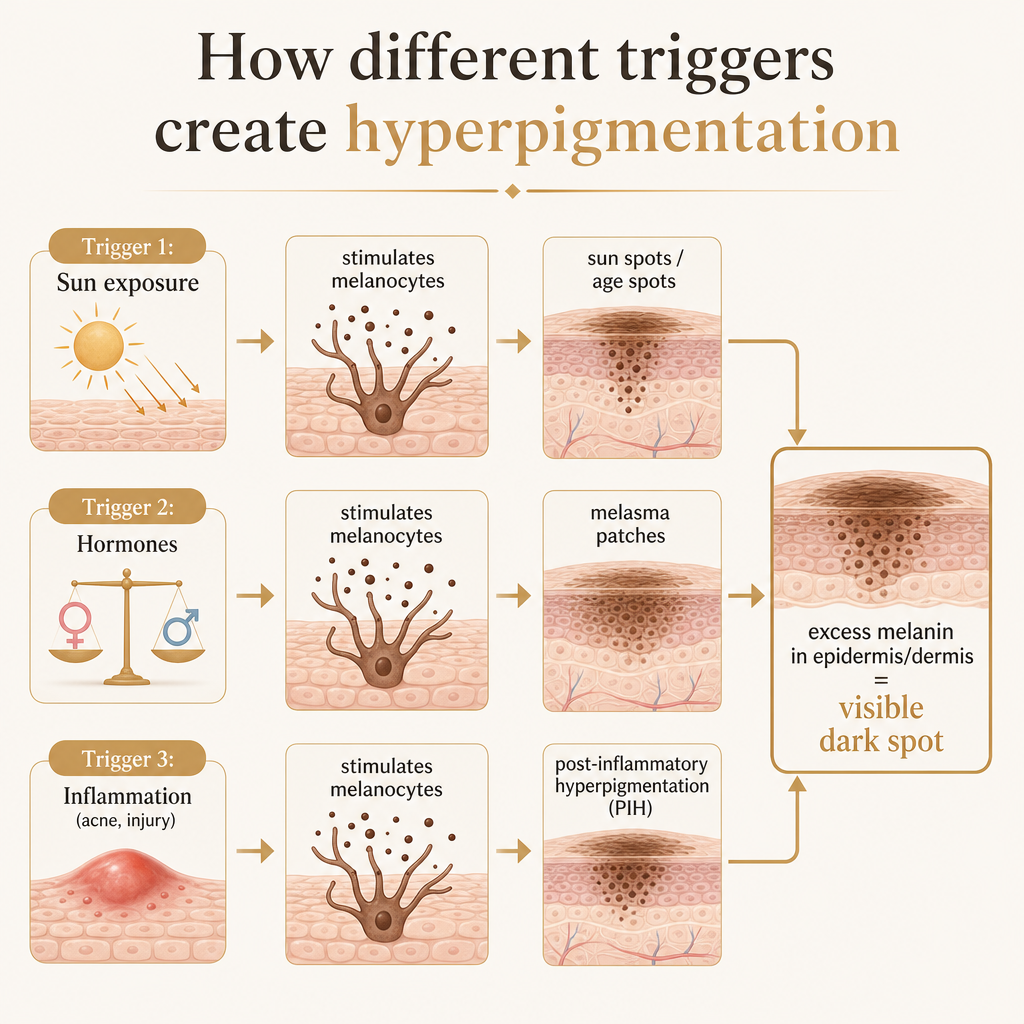
Hyperpigmentation is an excess of melanin — the pigment that gives skin its color — deposited unevenly in the skin. Several triggers set that process in motion, and understanding which one applies to you is the first step toward treating it correctly. Sun exposure is the most common driver, producing the flat brown patches often called age spots or sun spots. Hormonal shifts can cause melasma, the symmetrical facial patches that frequently appear during pregnancy or with certain medications. And inflammation of nearly any kind can leave post-inflammatory hyperpigmentation (PIH) behind once the original problem heals.
PIH is the reason so many people with a history of breakouts end up chasing dark marks long after the pimples themselves are gone. Any inflamed lesion — an acne papule, a scratch, a reaction — can prompt the skin to over-produce pigment in that spot. This is why dermatology reviews stress that identifying and treating the underlying condition matters as much as fading the mark itself. If new breakouts keep appearing, new spots keep appearing with them.
Left alone, some superficial pigment does lighten over time, but the process is genuinely slow, and deeper or long-standing pigment can persist for years. There is no biological fast-forward button. What professional care offers is not a miracle, but a way to work with the skin's turnover cycle deliberately: suppressing excess pigment production, accelerating the shedding of already-pigmented cells, and — crucially — stopping fresh pigment from being laid down faster than the old is cleared. That combination is what turns a plateau into visible progress.
Sunscreen and lifestyle come before any brightening step
Every credible dermatology source arrives at the same conclusion: photoprotection is the single most important part of managing hyperpigmentation. This is not a footnote to add after the active ingredients. It is the foundation the rest of the plan stands on. Ultraviolet light — and, for pigment concerns, visible light too — continuously stimulates melanin production. Apply the most sophisticated brightening regimen in the world without daily sun protection, and you are effectively bailing water out of a boat while leaving the hole open.
The practical guidance is consistent. A broad-spectrum sunscreen of at least SPF 30, reapplied through the day, does the heavy lifting. Physical blockers such as titanium dioxide and zinc oxide are widely recommended, and protective clothing and shade add meaningful defense. For people with deeper skin tones, tinted sunscreens containing iron oxide are specifically useful because they also screen visible light, which can worsen dark spots that mineral-only formulas miss.
Lifestyle sits alongside protection rather than replacing it. Macherre's model deliberately folds nutrition and daily habits into each plan, because adherence and skin-barrier health are what make an active regimen sustainable over months. A treatment you abandon because it stings, or a routine that ignores hydration until the skin becomes irritated, will not deliver results regardless of how strong the actives are. Framing photoprotection and habits as the base layer is also why hyperpigmentation care overlaps naturally with proactive early aging prevention — uneven tone and sun damage are among the earliest visible signs of aging skin, and the same protective habits address both at once.
Any lightening treatment without diligent daily sun protection is working against itself.
The ingredients dermatologists trust to fade pigment
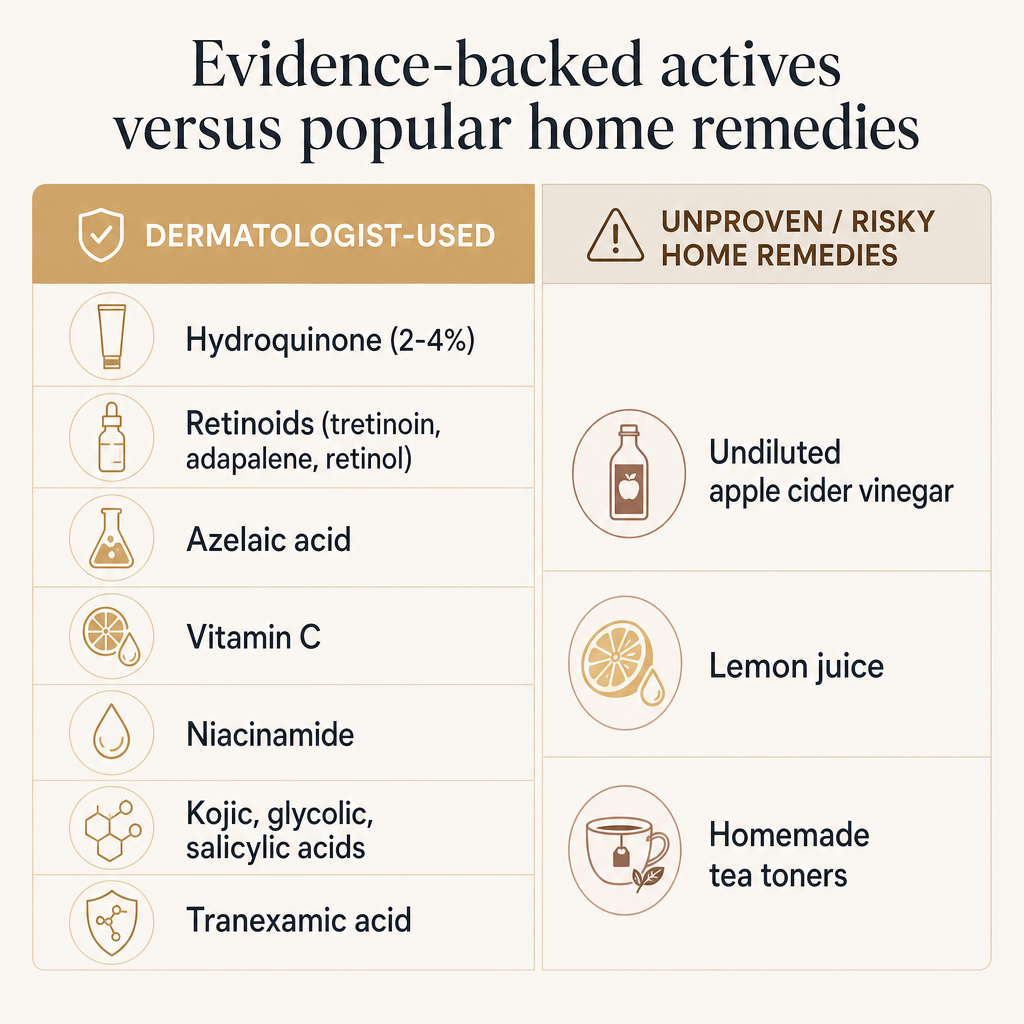
This is where evidence diverges sharply from social-media folklore. Undiluted apple cider vinegar, lemon juice, and homemade tea toners circulate endlessly online, yet they lack strong supporting evidence and can irritate skin badly enough to cause more pigmentation than they remove. The ingredients that actually earn their place in a dermatologist's toolkit are a smaller, well-studied group.
Hydroquinone remains a long-standing option, often used at 2–4% and frequently considered first-line for melasma and other stubborn pigmentation. It works by inhibiting the enzyme that produces melanin. Retinoids — including tretinoin, adapalene, tazarotene, and over-the-counter retinol — normalize skin-cell turnover and help move pigmented cells to the surface and off. Azelaic acid is a versatile choice that suits acne-related PIH and melasma, and tends to be better tolerated by reactive skin.
Beyond those, dermatology sources cite vitamin C, niacinamide (vitamin B3), kojic acid, glycolic and salicylic acids, arbutin, thiamidol, and tranexamic acid as agents with pigment-fading roles. Each behaves slightly differently — some suppress melanin production, others exfoliate accumulated pigment, others reduce the inflammation that feeds PIH. Vitamin C, for instance, is an antioxidant that also interferes with pigment formation, while niacinamide is generally gentle and helps limit the transfer of pigment to surface skin cells. Acids such as glycolic and salicylic accelerate the shedding of pigmented cells, and tranexamic acid has drawn interest specifically for stubborn melasma. Harvard Health notes that topical therapy is the most common treatment route and that combination therapy, using several agents together, is usually more effective than any single product.
That combination principle is exactly where professional guidance earns its keep. A well-designed regimen might pair a pigment-suppressing agent with a turnover-boosting retinoid and rigorous sunscreen — the kind of layered approach that a review of the medical literature supports. The classic example is triple topical therapy, combining hydroquinone, a retinoid, and a mild topical corticosteroid, described in professional references as an effective first-line combination for melasma. But it also carries real risk: irritation, rebound darkening, and misuse when assembled and dosed without supervision. Stacking three potent actives yourself is precisely the scenario where dark spots get worse instead of better, and it is why a supervised plan that introduces agents gradually and watches for reactions is safer than self-experimentation.
Matching the right ingredient to the right pigment story is the whole point of individualized care. A melasma plan leans on gentle, sustained suppression paired with strict light protection, because the condition is stubborn and easily aggravated. A single sun-induced age spot may respond to a more targeted approach. Reactive skin that flares at the first sign of an acid needs the slowest, most cautious introduction of all. Sun-driven spots and age spots are the core focus of Macherre's age spots and hyperpigmentation treatment, while brown marks left after breakouts are addressed through post-acne and discoloration treatment.
For an authoritative overview of these agents, the Cleveland Clinic guide to hyperpigmentation is a reliable reference, and a broader clinical picture of combination approaches appears in this review of hyperpigmentation therapy.
When topicals plateau: peels, lasers, and IPL
Some pigmentation resists even a well-run topical regimen, and dermatology offers a further tier of in-office procedures for those cases. Chemical peels using glycolic acid, salicylic acid, trichloroacetic acid, or Jessner's solution remove pigmented surface layers in a controlled way. Laser therapies — including pigment-targeting and Q-switched devices, laser resurfacing, and intense pulsed light (IPL) — break up or target melanin more aggressively. Microneedling appears in the literature as an adjunct for some pigment and texture concerns.
These are genuinely useful tools, but they belong firmly in the hands of an experienced clinician working in person. That boundary matters for a specific medical reason: peels, lasers, and IPL all carry a heightened risk of triggering post-inflammatory hyperpigmentation themselves, particularly in darker skin tones. Done without careful case selection and skilled technique, an aggressive procedure can leave a patient darker than they started. This is not a category for DIY devices or unsupervised experimentation, and even in skilled hands it usually follows, rather than replaces, a period of disciplined topical treatment.
A remote clinic does not perform these procedures, and Macherre is transparent about that. What the remote model does well is help you decide whether and when escalation is worth pursuing locally. Often it is not needed at all: many facial pigmentation cases respond to a disciplined topical plan given enough time. When a plan plateaus despite consistent use, that is the signal to discuss in-person options with a local dermatologist — a decision informed by months of documented response rather than guesswork. The Harvard Health overview of hyperpigmentation lays out these procedural options and their trade-offs in more detail.
One further note belongs here. Occasionally, widespread or unusual pigmentation changes can reflect an underlying systemic condition rather than a purely cosmetic concern. Anyone noticing sudden, extensive, or atypical darkening should seek local medical evaluation rather than assuming a skincare routine is the whole answer. A remote consultation can help flag when a pattern looks unusual enough to warrant that in-person check.
How Macherre builds your dark-spot plan online
Macherre Medical Center is a remote-first skincare consultation clinic led by Dr. Maria, a cosmetologist with five years of experience across acne, rosacea, pigmentation, sensitive skin, and early signs of aging. The premise is straightforward: you should be able to get an expert-designed plan without trial-and-error through a drawer full of half-used serums, and without waiting weeks for an in-person slot. Consultations start from $115 | €99, positioning the service as a premium but accessible alternative to conventional visits, for both English- and Russian-speaking clients.
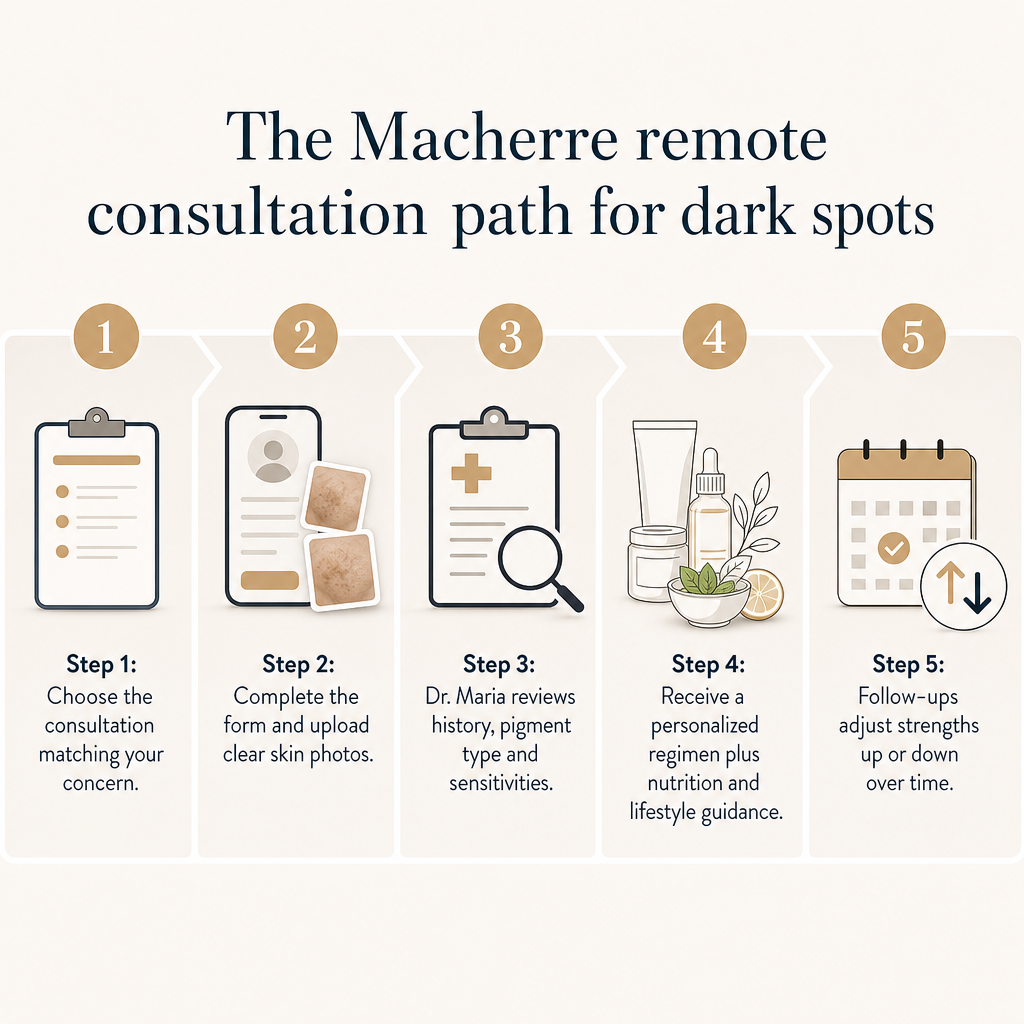
The process is built around a few clear steps. You begin by choosing the consultation that matches your main concern, then complete an online form and upload clear photos of the affected areas. Dr. Maria reviews your history, pigment pattern, skin type, and sensitivities, then designs a personalized regimen — cleanser, targeted actives, moisturizer, and sunscreen — supported by nutrition and lifestyle guidance. From there, follow-ups let the plan evolve: strengths can be stepped up as your skin adapts or scaled back at the first sign of irritation.
That adaptive follow-up is where a remote clinic mirrors the rhythm of good in-person dermatology. Pigment work is slow, and the ability to adjust an active over successive check-ins — rather than committing to a single fixed prescription — is what keeps a regimen both effective and tolerable. It is especially valuable for the many clients whose dark spots are PIH left by acne. In those cases, controlling the breakouts is inseparable from fading the marks, which is why Macherre treats the two together through its dedicated acne treatment consultation. Calming active acne reduces the fresh inflammation that would otherwise keep generating new spots faster than any lightening agent can clear the old ones.
The plan also flexes for skin that does not tolerate strong actives easily. Bleaching agents and acids can be irritating, and a barrier already compromised by dryness will not cope with an aggressive protocol. Macherre can layer in support for reactive and sensitive skin so that pigment correction proceeds gently, prioritizing barrier health rather than sacrificing it for speed. The result is one coherent regimen rather than a pile of contradictory products bought on impulse. Because everything is designed by one clinician, the actives, the moisturizer, and the sunscreen are chosen to work together instead of competing, which is a common failing of self-assembled routines.
Realistic timelines, expectations, and maintenance
Honest expectations protect you from quitting a plan that is actually working. Meaningful fading of hyperpigmentation typically takes months, not days, even with the correct therapy applied consistently. Deeper or hormonally driven pigment can take longer still. Anyone promising to erase dark spots in a week is selling optimism rather than dermatology. The skin has to cycle through its natural turnover repeatedly for suppressed pigment production and exfoliation to show as visibly lighter skin.
Consistency is the variable most under your control. Potent agents such as hydroquinone, retinoids, and higher-strength acids only work when used regularly, monitored for irritation, and — always — paired with strict sunscreen. Skipping applications, or using an active only when you remember, stretches an already slow process into an indefinite one. A useful habit borrowed from clinical practice is taking baseline photos and tracking response over time; progress on pigment is gradual enough that month-to-month comparison photos often reveal improvement the mirror hides. This tracking fits naturally into Macherre's follow-up structure, where visual progress guides the next adjustment.
Maintenance is the part people forget. Because sun continually re-triggers pigment, treatment rarely ends with a hard stop. More often it transitions to a lighter maintenance regimen — a lower-strength active, ongoing daily sunscreen — that holds results in place. Stopping everything, including sun protection, invites the spots to return. Dark spots frequently travel with other concerns too, such as rough or uneven texture, and a plan may combine pigment correction with texture-improvement strategies so the skin looks smoother as it evens out.
One figure worth being precise about: Macherre reports a 95% success rate for its signature ProAcne Program, which runs bi-weekly follow-ups over a 3–4 month course. That number applies to the acne program specifically, not to hyperpigmentation outcomes, and it should not be read as a guaranteed fading percentage for dark spots. What it does illustrate is the clinic's structured, follow-up-driven method — the same sustained, adjustable approach that pigment work rewards. No responsible plan promises an exact fade percentage or clearance date; skin type, pigment depth, and consistency all shape the result.
Deciding your next step comes down to your pigment story. If your situation is straightforward facial pigmentation and you are tired of guessing, a remote plan is a sensible move: it gets you an expert-designed regimen quickly and spares you the cost of ineffective products. If your concern is a single stubborn lesion that has resisted everything, or pigmentation that seems tied to a broader medical change, a remote consultation can still help you understand your options and point you toward the right in-person care. Naming that story accurately — sun damage, post-acne marks, melasma, or a mix — is what turns scattered effort into steady progress.
Frequently asked questions
How long until I see dark spots start to fade?
Expect months rather than days. Superficial pigment may begin to lighten within several weeks of consistent, correct treatment, but meaningful, stable improvement usually takes multiple skin-turnover cycles, and deeper or hormonal pigment can take longer. Progress is easy to underestimate day to day, so taking baseline photos helps you see gradual change that the mirror misses. That is exactly why Macherre's follow-ups track results visually over time and adjust the plan based on what the photos show rather than on impatience.
Can I treat dark spots without hydroquinone?
Yes. Hydroquinone is one well-studied option, but it is not the only route. Azelaic acid, vitamin C, niacinamide, retinoids, kojic acid, glycolic and salicylic acids, and tranexamic acid all have pigment-fading roles, and dermatology sources note that combining several complementary agents is often more effective than relying on a single one. A personalized plan can be built around your preferences and tolerance, including hydroquinone-free approaches, which suit people who prefer to avoid it or who react to it.
Is an online consultation enough if I have melasma?
For many people with facial melasma, a topical, routine-based plan plus strict photoprotection is the mainstay of care, and that is well suited to a remote model. Melasma is stubborn and often hormonally driven, so it typically needs patient, adjusted long-term management rather than a quick fix. A remote clinic can design and monitor that plan, keep sun protection central, and advise whether in-person procedures are worth considering locally if progress stalls despite consistent use.
Will my dark spots come back if I stop treatment?
They can, particularly with ongoing sun exposure, because sunlight continually re-triggers pigment production. For this reason treatment usually transitions to a lighter maintenance regimen rather than stopping abruptly, and daily sunscreen becomes a permanent habit rather than a temporary one. Macherre can adjust the intensity of your plan over time — easing off strong actives once spots have faded while keeping protection in place — so you hold results without over-treating the skin.
Can sensitive skin safely use acids and retinoids?
Often yes, when introduced carefully. Strong actives and peels can irritate reactive skin and, if pushed too hard, even worsen pigmentation by adding fresh inflammation. The safer path is a gradual, supervised introduction with barrier support built in, starting at low strengths and increasing only as the skin tolerates it. Macherre adapts regimens for sensitive and dehydrated skin, prioritizing tolerance so pigment correction does not come at the cost of a damaged barrier.
Is Macherre a replacement for an in-person dermatologist?
Not entirely, and it does not claim to be. Macherre is ideal for expert-designed topical and routine-based plans and for deciding when escalation makes sense. It does not perform in-office procedures such as peels, lasers, or IPL, and unusual or widespread pigmentation changes still warrant local medical evaluation in case they signal an underlying condition. For most mild-to-moderate facial pigmentation, though, it replaces months of unguided trial and error with a considered, monitored plan.