






Acne Treatment That Actually Works: A Dermatologist-Backed Roadmap
This article is educational and does not diagnose a condition or replace care from a qualified medical professional.
Why Generic Acne Advice Keeps Failing You — And Why Your Skin Isn't the Problem
You bought the $40 serum the influencer swore by. It did nothing. You tried to book a dermatologist and the next opening is six weeks out. So at 2 a.m. you spiraled through Reddit, where one thread says cut dairy, another swears by hypochlorous acid mist, and a third tells you to never moisturize again. If you've searched "acnes treatment" at midnight, you're in the right place — and you're not failing. Acne affects roughly 85% of adolescents and frequently persists into adulthood, according to the American Academy of Dermatology. That makes it one of the most common diseases on the planet, not a willpower problem the over-the-counter market is equipped to solve at scale. This guide gives you three things: a framework for identifying your specific acne subtype, a guideline-backed shortlist of ingredients with real evidence, and a clear signal for when to stop experimenting and get professional eyes on your skin.

Table of Contents
- Why Generic Acne Advice Keeps Failing You — And Why Your Skin Isn't the Problem
- The Three Pillars Behind Every Acne Treatment That Actually Works
- Acne Type Decoder: Match Your Subtype to the Right Treatment Pathway
- The Topical Arsenal: Ingredients With Real Evidence Behind Them
- The Lifestyle Blueprint: What the Evidence Actually Says About Diet, Sleep, and Skin
- When to DIY, When to Get Professional Eyes on Your Skin: An Honest Decision Guide
- Acne Treatment Questions Your Search Bar Won't Answer Cleanly
The reason your last four acne treatment attempts didn't work is almost never user error. It's the combination of two structural problems: you were treating the wrong subtype, and you weren't treating it long enough for the biology to respond. Both problems are invisible to the marketing apparatus selling you the next bottle.
Start with the first one. Acne is not one condition. It is at least four functionally distinct presentations, each driven by a different mechanism. Comedonal acne — your blackheads and whiteheads — is driven by pore obstruction and the bacterium Cutibacterium acnes colonizing those clogged follicles. Inflammatory papulopustular acne shows up as red papules and pustules and involves a strong immune response. Cystic and nodular acne forms deep, painful lesions that carry a real scarring risk. And the fourth category — post-acne sequelae — is the brown post-inflammatory hyperpigmentation (PIH) and red post-inflammatory erythema (PIE) marks that linger after the lesion itself has healed. Each subtype responds to a different mechanism, which is why the 2024 JAAD acne guideline escalates treatment based on severity, scarring risk, and psychosocial burden rather than recommending a one-size protocol. A topical retinoid that resolves comedonal acne will barely touch jawline hormonal flares.
The second structural problem is that over-the-counter products are formulated for a fictional "average" face. They cannot account for your hormone cycle, your microbiome, your climate, or your stress baseline. Dr. John Barbieri, a board-certified dermatologist at Brigham and Women's Hospital, frames this clearly in his acne plan explainer: aggressive over-routining doesn't accelerate clearance — it creates an "irritation cycle" that perpetuates the breakouts you were trying to fix. Three exfoliating acids on top of a benzoyl peroxide wash on top of a physical scrub is not a treatment plan. It's a barrier emergency dressed in serum bottles.
The third reason your routines fail is product hopping, the single most common self-sabotage pattern. The clinicians at Foothill Dermatology set the floor: give any acne treatment at least 4 weeks before judging it, and only add a second product after 4 to 6 weeks of inadequate response. Barbieri sets the ceiling stricter — 2 to 4 months before declaring a plan failed. The skin cell turnover cycle is approximately 28 days. The biology cannot move faster than that, no matter how expensive the bottle. If you swap products every ten days, you have never actually tested any of them.
There's a fourth myth worth dismantling: the purge. A legitimate retinoid-induced purge happens in your usual breakout zones, peaks around weeks 2 to 4, and resolves by week 6 as cell turnover normalizes. That is biology working as designed. What is not purging: persistent burning, breakouts in new locations, peeling that doesn't calm, or worsening barrier signs after three weeks. That is irritation, and the product needs to stop. Dr. Jenny Liu, in her Acne 101 review, reinforces a frame that most consumer skincare content avoids: acne is a medical condition first, a cosmetic concern second. Treating it as a serum-shopping exercise is what keeps people stuck.
And finally, the cost of staying stuck is not just visible on your skin. The AAD documents that acne is linked to depression, social isolation, and suicidality — and that effective treatment is associated with reduced depressive symptoms. The frustration you feel reading skincare threads at 2 a.m. is not vanity. It is a documented psychosocial burden, and it is one of the criteria guidelines use to justify escalation to stronger therapy. You are allowed to take this seriously.
Acne is not a failure of willpower or discipline. It is a signal that something — hormones, bacteria, inflammation, or barrier function — is out of balance, and generic products fail because they were never designed to address your specific imbalance.
The Three Pillars Behind Every Acne Treatment That Actually Works
If product-shopping is the wrong mental model, what replaces it? A process model. Every acne treatment plan that produces durable results — whether built by a dermatologist in clinic or by a remote consultation — rests on three sequential pillars: Diagnosis → Targeted Topicals → Sustained Regimen Discipline. Skip any one and the other two collapse.

Pillar 1 — Diagnosis. Before any product decision, the acne subtype must be identified. Barbieri's routine-building framework puts this first: categorize the acne pattern and the skin type before you select a single active. This is the step the consumer skincare market structurally cannot perform for you. It's also exactly what a properly designed remote consultation does — a photo intake plus history form replicates the diagnostic step a dermatologist performs in-clinic, identifying whether you're looking at comedonal obstruction, hormonal androgen drive, deep inflammatory pathology, or a mixed presentation. Without this step, every product choice that follows is a guess.
Pillar 2 — Targeted Topicals (Combination Therapy). The 2024 JAAD guideline issues strong recommendations for topical benzoyl peroxide, topical retinoids, topical antibiotics, and oral doxycycline. The AAD's good-clinical-practice position is explicit: combine topicals with different mechanisms — a comedolytic retinoid paired with an antibacterial benzoyl peroxide, for example — rather than stacking three products that all do the same thing. Spot-treating underperforms because new lesions are forming beneath skin you can't see yet. The Foothill Dermatology clinicians specifically recommend spreading medication across the entire acne-prone zone, treating future lesions before they surface.
Pillar 3 — Sustained Regimen Discipline. A guideline-correct plan misapplied still fails. The two benchmarks are non-negotiable: a minimum of 4 weeks before judgment, and 2 to 4 months for a full plan evaluation. This is also why a structured acne treatment plan is designed at 3 to 4 months in length — it matches the biological timeline of cell turnover and inflammation resolution, not the consumer-impatience timeline of the next product launch.
Pillar 1 is what you have. Pillar 2 is what you use. The next two sections handle each in detail.
Acne Type Decoder: Match Your Subtype to the Right Treatment Pathway
This is the diagnostic centerpiece. The reason it matters: the JAAD escalation logic is not "try harder products" — it is "match the mechanism to the pathology, then escalate to systemic agents if topical mechanisms are insufficient for the severity, scarring risk, or psychosocial burden." The right treatment is a function of what kind of acne you have. The table below maps the four functional subtypes plus post-acne sequelae to their guideline-backed pathways.
| Acne Subtype | Typical Presentation | Guideline-Backed Topical Approach | When to Escalate |
|---|---|---|---|
| Comedonal (blackheads/whiteheads) | Non-inflamed bumps, T-zone, forehead | Topical retinoid (adapalene, tretinoin) + salicylic acid | No improvement after 8–12 weeks |
| Inflammatory papulopustular | Red papules, pustules, mixed face | Benzoyl peroxide + topical retinoid combination | Add oral doxycycline if widespread |
| Hormonal | Jawline/chin, cyclical with menses, deeper | Topical clascoterone; retinoid; azelaic acid | Spironolactone or combined oral contraceptive |
| Cystic/Nodular | Deep, painful, scarring lesions | Combination topicals insufficient alone | Strong indication for isotretinoin |
| Post-acne PIH/PIE | Brown or red marks after lesions heal | Azelaic acid, niacinamide, daily sunscreen | Professional pigmentation protocol at 12 weeks |
The reason hormonal acne won't fully respond to salicylic acid alone is mechanistic: the driver is androgen-mediated sebum production, not pore obstruction. Salicylic acid is a keratolytic — it works on the clog, not the hormone. This is why topical clascoterone, the first topical anti-androgen, became a meaningful addition when it received an AAD conditional recommendation; per the AAD summary, it addresses the hormonal pathway directly. If your flares track your menstrual cycle and concentrate along the jawline and chin, a salicylic acid cleanser is not the wrong tool — it is simply not the only tool the situation requires.
For readers with deep, painful, or scarring lesions, the JAAD 2024 guideline is unambiguous: oral isotretinoin is strongly recommended for severe acne, scarring acne, acne causing psychosocial burden, or acne failing standard topical and oral therapy. That is a concrete "you are past DIY" signal. A second clinical option many readers don't know exists: intralesional corticosteroid injections are guideline-endorsed for rapid relief of large, painful inflammatory nodules — a single in-office injection can collapse a cyst in 24 to 48 hours. If you have rosacea-overlap presentations with persistent central facial redness alongside acne, the topical mechanisms shift again, and aggressive acne actives can worsen the rosacea component — a scenario that calls for dedicated rosacea management rather than acne-only protocols. The same caution applies to sensitive skin protocols: subtype-appropriate is not subtype-aggressive.
Treating hormonal acne with salicylic acid alone is like using a wrench to fix an electrical problem. The tool is fine; it is simply not designed for the problem in front of you.
The Topical Arsenal: Ingredients With Real Evidence Behind Them
The 2024 JAAD guideline gives strong recommendations to a narrow set of topical actives — benzoyl peroxide, topical retinoids, and topical antibiotics — and conditional recommendations to a second tier including clascoterone, salicylic acid, and azelaic acid. Everything else marketed at you is either off-label, evidence-thin, or both. That is not a stylistic opinion. That is the evidence base.
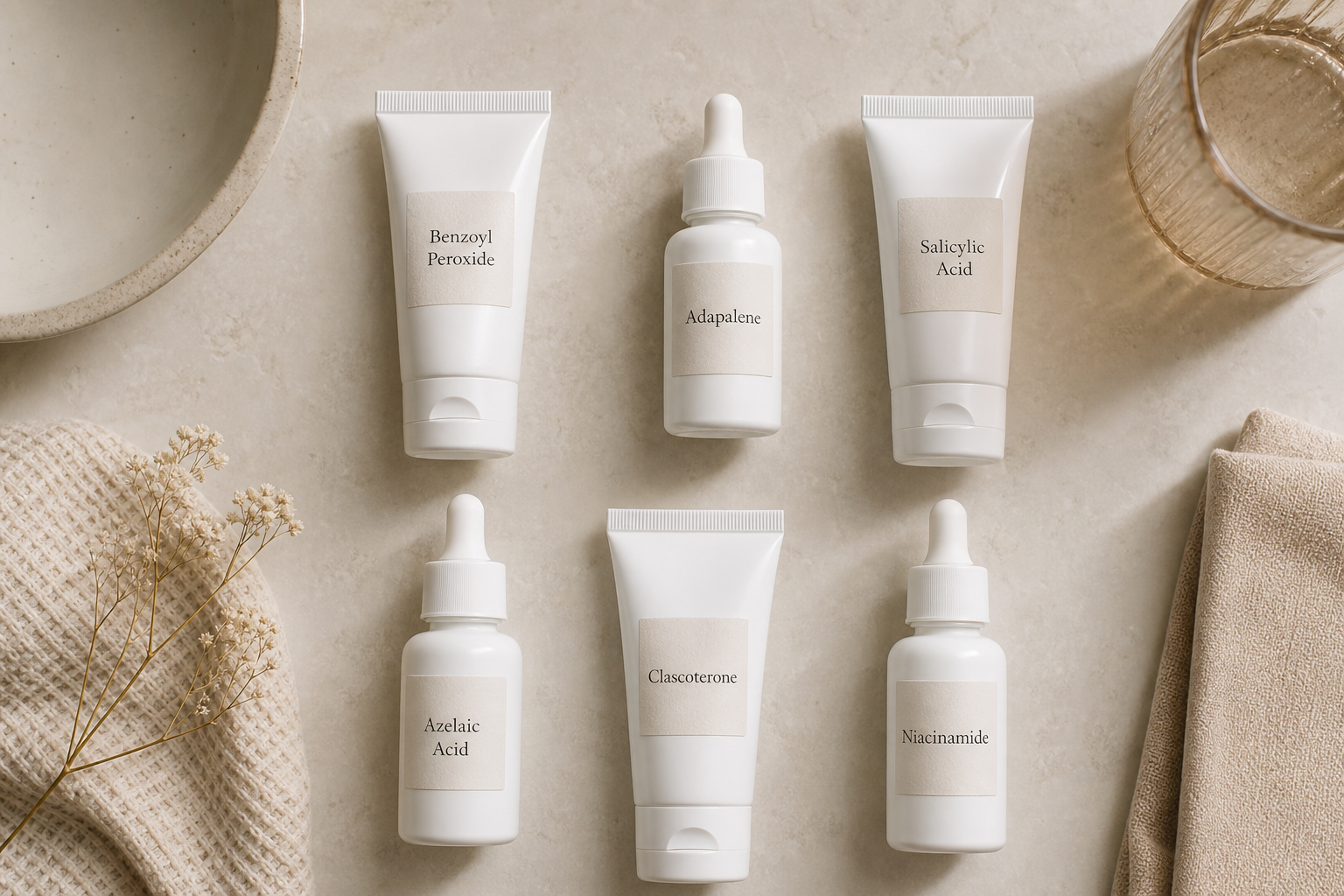
| Active | Mechanism (Guideline-Stated) | Best Suited For | Guideline Strength | Common Pitfall |
|---|---|---|---|---|
| Benzoyl peroxide | Reduces C. acnes bacteria | Inflammatory, papulopustular | Strong recommendation | Bleaches fabric; over-drying at high % |
| Topical retinoid | Unclogs pores, reduces inflammation | Comedonal, inflammatory, maintenance | Strong recommendation | Purge mistaken for failure |
| Topical antibiotic | Reduces C. acnes and inflammation | Inflammatory (short-term) | Strong recommendation | Must be paired with BPO |
| Salicylic acid | Keratolytic; exfoliates, unclogs pores | Comedonal, oily skin | Conditional recommendation | Overuse damages barrier |
| Azelaic acid | Comedolytic, antibacterial, fades dark spots | Acne with PIH, rosacea overlap | Conditional recommendation | Slow onset; 8–12 weeks |
| Clascoterone | Topical anti-androgen | Hormonal acne | Conditional recommendation | Prescription required |
The mandatory pairing rule from the AAD is the single most violated principle in consumer acne care: topical and oral antibiotics must always be combined with benzoyl peroxide to prevent the development of antibiotic resistance. This is standard of care, not a stylistic suggestion. If you are using a clindamycin lotion without benzoyl peroxide somewhere in your routine, you are accelerating resistance in your own skin flora — and resistance is one of the reasons antibiotics stop working for people who have used them repeatedly across years.
The second principle to internalize is combination over duplication. A retinoid (unclogs) plus benzoyl peroxide (antibacterial) addresses two different mechanisms. A retinoid plus salicylic acid plus glycolic acid plus a sulfur mask addresses one mechanism — exfoliation — four times. That is irritation, not coverage. Readers who feel their routine has become a shelf are almost always violating this principle. The fix is removing products that do similar work, particularly the ones aggravating barrier function in dehydrated and dry skin presentations where the irritation cycle becomes most visible.
A direct counter to device marketing is also warranted. The AAD issues a conditional recommendation against adding broadband or intense pulsed light to adapalene 0.3% gel. Light-device add-ons do not outperform guideline topicals — a gap also documented in the Kansas City University analysis comparing AAD guidelines against modern skincare trends. Dr. Jenny Liu's accessibility note is worth holding alongside this: OTC adapalene and salicylic acid are real evidence-backed entry points, but prescription-strength retinoids are often more effective for stubborn comedonal patterns. The line between "self-directed" and "needs a prescription" is not severity alone — it's often potency, and that is a clinical decision.
The Lifestyle Blueprint: What the Evidence Actually Says About Diet, Sleep, and Skin
This is the section most skincare content gets wrong by overclaiming. The AAD explicitly states that available evidence was insufficient to support formal recommendations for dietary changes, vitamins, or plant-based products in routine acne management. That is the honest starting line. Lifestyle still matters — barrier health, irritation reduction, and consistency directly determine whether your topical actives perform — but the role of lifestyle is to support a guideline-backed regimen, not to replace one.
- Cleansing rhythm. Wash twice daily and after sweating. The Foothill Dermatology clinicians are explicit that overwashing worsens acne by stripping the barrier and provoking compensatory oil production. Use gentle, non-alcohol, pH-balanced cleansers — the Advanced Dermatology & Cosmetic Center guidance names this as the baseline that makes every active applied afterward more tolerable. Three washes a day is not cleaner. It is more inflamed.
- Daily sunscreen is acne care, not anti-aging care. Oil-free, non-comedogenic SPF is the single highest-leverage habit for anyone with active PIH or PIE. It prevents post-inflammatory hyperpigmentation and age spots from becoming permanent dark marks that persist long after the original lesion has resolved. The Advanced Dermatology guidance places this in the core daily routine, not the optional add-ons. If you have brown marks left from old breakouts and you are not wearing sunscreen, you are working against your own retinoid every afternoon.
- Non-comedogenic everything. Foundations, moisturizers, hair products, sunscreens, and even pillowcases washed in heavy fabric softeners can introduce comedogenic carriers that undo otherwise excellent regimens. Dr. Liu makes this point in her Acne 101 review: the most carefully chosen prescription retinoid can be neutralized by a coconut-oil-based hair conditioner running down the forehead in the shower. Audit the supporting cast, not just the actives. This also matters for readers with uneven skin texture concerns, where comedogenic occlusion stacks visibly over time.
- Diet — the honest version. The AAD does not endorse dietary intervention as guideline-level acne treatment. Clinical practice frequently observes flares with high-glycemic patterns or dairy in certain individuals, but "frequently observed" is not the same as "evidence sufficient to recommend." Treat diet as a personal experiment: track your skin against your intake for 6 to 8 weeks before drawing conclusions. Don't cut whole food groups based on a TikTok claim. If you suspect a trigger, test it deliberately and write it down.
- Sleep and stress — irritation amplifiers, not standalone causes. No guideline-grade evidence shows that sleep alone clears acne. What stress reliably does, per Barbieri's irritation-cycle framing, is push people into over-application of actives, skipped moisturizer steps, and lesion picking. Those behaviors worsen the breakouts directly. The real intervention is not "sleep eight hours and you'll clear" — it's "manage stress enough to stop touching your face."
- Don't pick. Don't scrub. Picking converts inflammatory lesions into scars and PIH. This is one of the highest-impact behavioral changes most readers can make this week, with effects visible within a single cycle. Physical scrubs — gritty exfoliants, brushes, washcloths used aggressively — provoke the same inflammatory response from outside that picking provokes from above. The acne treatment plan you've been frustrated with may have been working fine; the picking was undoing it nightly. The same restraint protects against the accelerated pigmentation and texture changes that contribute to early signs of aging in acne-prone skin.
For hormonally driven acne, lifestyle has a hard ceiling. The next section addresses when that ceiling is the signal to escalate.
The most powerful upgrade to most acne routines is not a new product. It is removing three of the products that are already there.
When to DIY, When to Get Professional Eyes on Your Skin: An Honest Decision Guide
The difference between DIY-worthy and professional-grade acne is not severity alone — it is pattern stability. If your acne is mild, recently started, and you haven't yet tried a guideline-backed topical for 8 weeks at consistent application, self-directed treatment is reasonable. If any escalation marker below is present, the time and money cost of continuing to self-treat exceeds the cost of getting a structured plan from someone who can actually see your skin.
You are a reasonable candidate for self-directed treatment if:
- Your acne is mild — occasional papules, comedones, no deep painful lesions.
- You haven't yet trialed a guideline-backed topical (adapalene, benzoyl peroxide) for a full 8 weeks at consistent daily application.
- You have no scarring and no persistent dark or red marks after lesions heal.
- There is no clear hormonal pattern — no cyclical jawline flares tracking your menstrual cycle.
- You can commit to a single regimen for the full 2 to 4 months Barbieri recommends without switching out of impatience.
- You are willing to apply medication across the full acne-prone zone, not just on visible spots, per the Foothill Dermatology application principle.
You should escalate to professional diagnosis — in-person or remote — if any of the following apply:
- You have deep, painful, or cystic lesions. The JAAD 2024 guideline strongly recommends isotretinoin for severe, scarring, or treatment-resistant acne, and that decision requires medical supervision.
- You have existing scarring or worsening post-inflammatory discoloration that is not fading on its own.
- Your pattern is cyclical and hormonal — jawline, chin, around menses. This may need clascoterone, spironolactone, or combined oral contraceptive evaluation.
- You have tried three or more regimens across 6+ months without sustained improvement.
- Your acne is affecting your mood, social engagement, or work. The AAD documents the link between untreated acne and depression as a legitimate criterion for escalating care.
- You are taking, or considering taking, oral antibiotics without a benzoyl peroxide pairing. This is a guideline violation with documented resistance risk.
- You have rosacea-overlap symptoms — persistent central facial redness, flushing triggers — which require a different protocol than acne alone.
Now the economics. Most readers stuck in DIY acne care are not saving money. They are spending it slowly. Two years of $40 serums, $25 cleansers, and the occasional $80 mistake adds up to four-figure spending — without the diagnostic step that determines whether any of those products had a mechanistic chance of working. A structured remote consultation replicates the diagnostic pillar from earlier: photo intake, history form, subtype categorization, and a written plan that names the actives, the application rules, and the evaluation timeline. That is the missing piece in most DIY journeys, and it is the piece that determines whether the next 12 weeks produce results or produce another shelf.
A structured 3-to-4 month program with bi-weekly follow-ups is not arbitrary in length. It matches Barbieri's 2-to-4 month evaluation window and the JAAD escalation framework's clinical review points. Consultations starting from $115 | €99 should be measured not against an imagined alternative of "free," but against the realistic alternative of two more years of trial-and-error spending plus the psychosocial cost the AAD has formally documented. Macherre's ProAcne Program is structured around this evaluation window for exactly that reason, with a reported 95% success rate across its 3-to-4 month course.
The right next step for most readers reading this far is one of two things. Either commit fully to one guideline-backed regimen — adapalene plus benzoyl peroxide is a defensible self-directed starting point — for a full 8 weeks without swapping anything, or get a diagnostic plan from someone who can see your skin and your history. Either is a real choice. "Keep buying" is not.
Acne Treatment Questions Your Search Bar Won't Answer Cleanly
How long does acne treatment actually take to show results?
Specific numbers, by active. The Foothill Dermatology benchmark is 4 weeks minimum before judging any treatment, with a second product added only after 4 to 6 weeks of inadequate response. Barbieri's stricter rule is 2 to 4 months before declaring a plan failed. Active-specific timelines matter too: benzoyl peroxide shows anti-inflammatory effect in 1 to 4 weeks, topical retinoids often worsen skin briefly before improving over 8 to 16 weeks, and azelaic acid typically requires 8 to 12 weeks to show meaningful PIH fading. If you've been on a regimen for 10 days and "it isn't working," you have not yet tested it.
Is my skin purging or am I reacting badly?
A legitimate purge happens in your usual breakout areas, occurs with retinoids or exfoliating acids that accelerate cell turnover, peaks at 2 to 4 weeks, and resolves by week 6. True irritation looks different: burning that persists past application, breakouts in new locations, sheet-like peeling, redness that doesn't calm overnight. Barbieri's irritation-cycle warning is the relevant frame — over-aggressive routines can manufacture acne where there was none. If irritation persists past 2 weeks or is worsening, stop and reassess. A purge fades. Irritation escalates.
Can hormonal acne be treated without oral medication?
Sometimes. Topical clascoterone is the newest guideline-supported option for the hormonal pathway, addressing androgen drive at the receptor level. Azelaic acid and topical retinoids contribute supporting mechanisms. There is a ceiling, though — for moderate-to-severe hormonal acne, spironolactone or combined oral contraceptives are guideline-endorsed and frequently more effective. A personalized hormonal acne consultation determines which side of that ceiling you're on, which is the question topical-only marketing can't answer. The honest version: mild hormonal acne, topical-first; moderate-to-severe, systemic options deserve the conversation.
Why does my acne get worse seasonally?
Two different mechanisms by season. In winter, barrier dehydration provokes reactive over-application of actives, which triggers an irritation cycle on already-compromised dehydrated skin. In summer, heat plus occlusive sunscreens plus sweat creates a more comedogenic environment, particularly along the hairline and back. The adjustment strategy is to change the vehicle, not the active — lighter lotion in summer, heavier cream-based vehicles in winter — while maintaining the daily oil-free, non-comedogenic SPF the Advanced Dermatology guidance flagged as core. Don't abandon the regimen when the weather changes. Adapt around it.
Should I layer multiple actives or commit to one?
Guidelines favor combination therapy with different mechanisms, not stacking multiple actives in the same mechanism category. A retinoid (unclogs) plus benzoyl peroxide (antibacterial) is a textbook combination. Three exfoliating acids together is not a combination — it is the same job done four times, with proportional barrier damage. The right question to ask of every product on your shelf is: "what mechanism does this contribute that nothing else in my routine already covers?" If the answer is "none," it is not adding to the plan. It is adding to the irritation, particularly for sensitive skin protocols where the threshold for compounding actives is lower than the marketing implies.